



Updated 2 months ago
Non-Yellowing Deep Casting Epoxy Resin for Clear River Tables and Art Panels

hqt
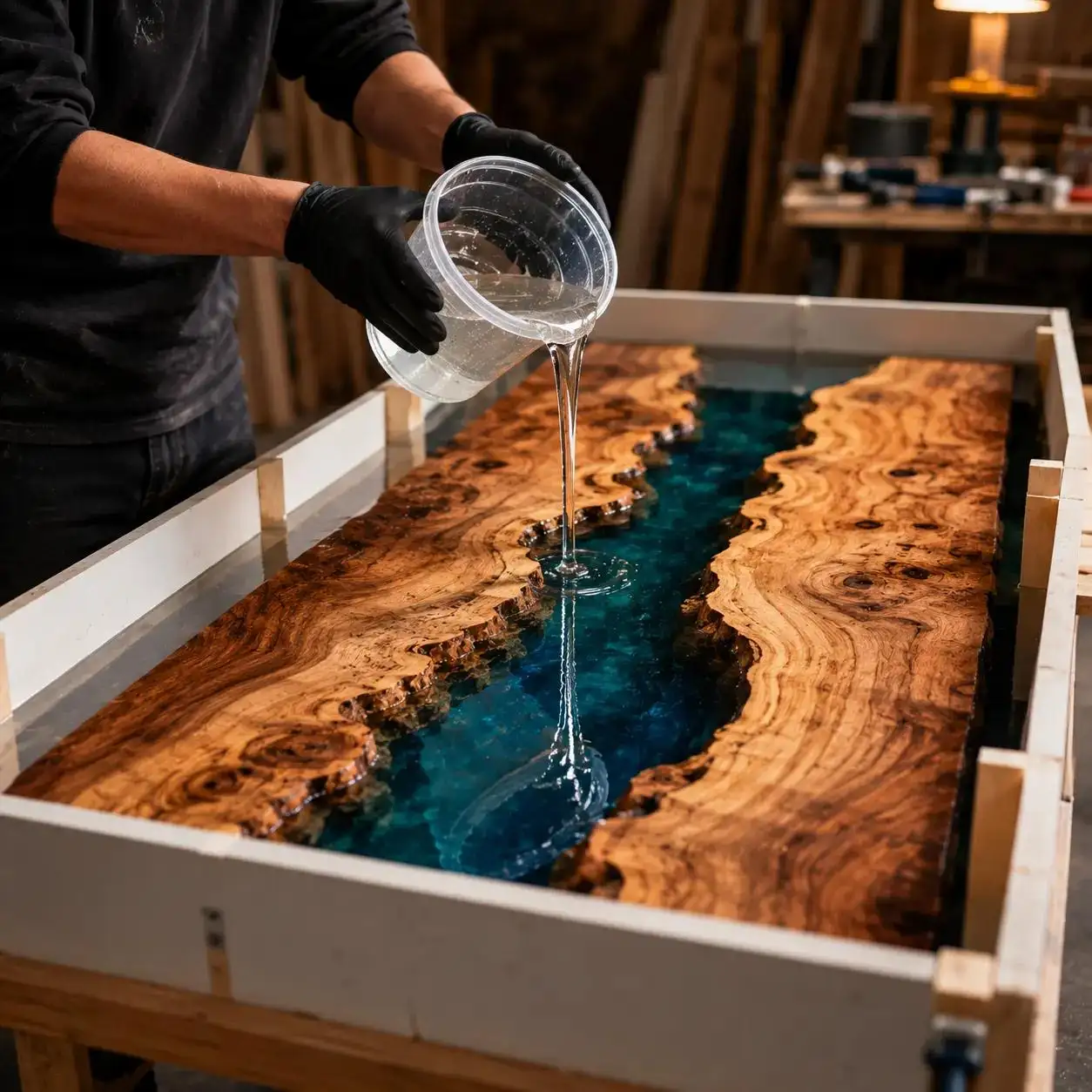
A non-yellowing Deep Casting Epoxy Resin is formulated to slow discoloration while maintaining clarity in thick castings. However, "non-yellowing" does not mean permanently colorless under unlimited UV exposure. Long-term appearance depends on formulation, curing temperature, pour depth, wood moisture and exposure conditions.
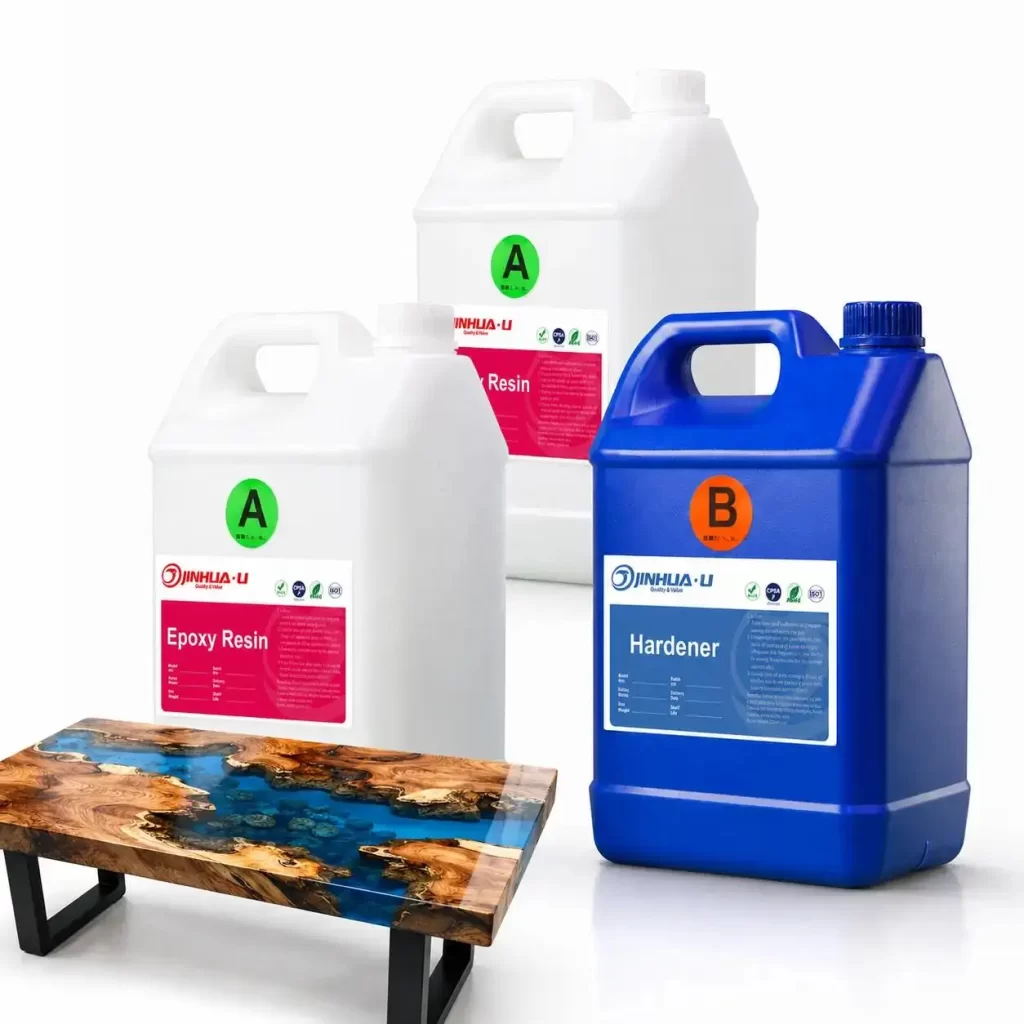
For clear river tables and art panels, a reliable Deep Casting Epoxy Resin should combine controlled exotherm, low viscosity, long working time, bubble release and improved UV resistance. UV additives cannot compensate for excessive curing heat.
What "Non-Yellowing" Means
Epoxy can develop a pale yellow or amber tone through UV exposure, heat and oxidation. "Non-yellowing" normally means the formulation is designed to delay visible discoloration.
Color stability is influenced by:
•Initial color and purity of the resin
•Color stability of the curing agent
•UV stabilizer system
•Peak curing temperature
•Casting volume and thickness
•Exposure to sunlight, heat and moisture
Professional claims should use terms such as "improved resistance to yellowing" or "designed to maintain clarity." No epoxy system should be described as permanently UV-proof.
Why Deep Castings Lose Clarity
UV Exposure
Sunlight and strong artificial UV alter cured epoxy over time. Furniture near windows or outdoors is more vulnerable than indoor castings.
Excessive Exothermic Heat
Every epoxy reaction generates heat. In a deep mold, heat can become trapped in the center if the system cures too quickly.
Possible defects include:
•Localized yellowing
•Cracking and shrinkage
•Surface ripples
•Expanded internal bubbles
•Uneven hardness
•Abnormal curing speed
A purpose-designed Deep Casting Epoxy Resin uses a slower reaction profile so heat can dissipate more gradually.
Mixing, Moisture and Contamination
An incorrect resin-to-hardener ratio may cause sticky areas, soft sections or incomplete cure. Wet wood, dirty tools and incompatible pigments can also cause cloudiness. Live-edge wood should be dry, clean and sealed.
Using the Wrong Epoxy
Tabletop epoxy cures faster and is intended for thin coatings. In a thick mass, it may overheat, crack or discolor. Deep Casting Epoxy Resin is engineered for larger sections.
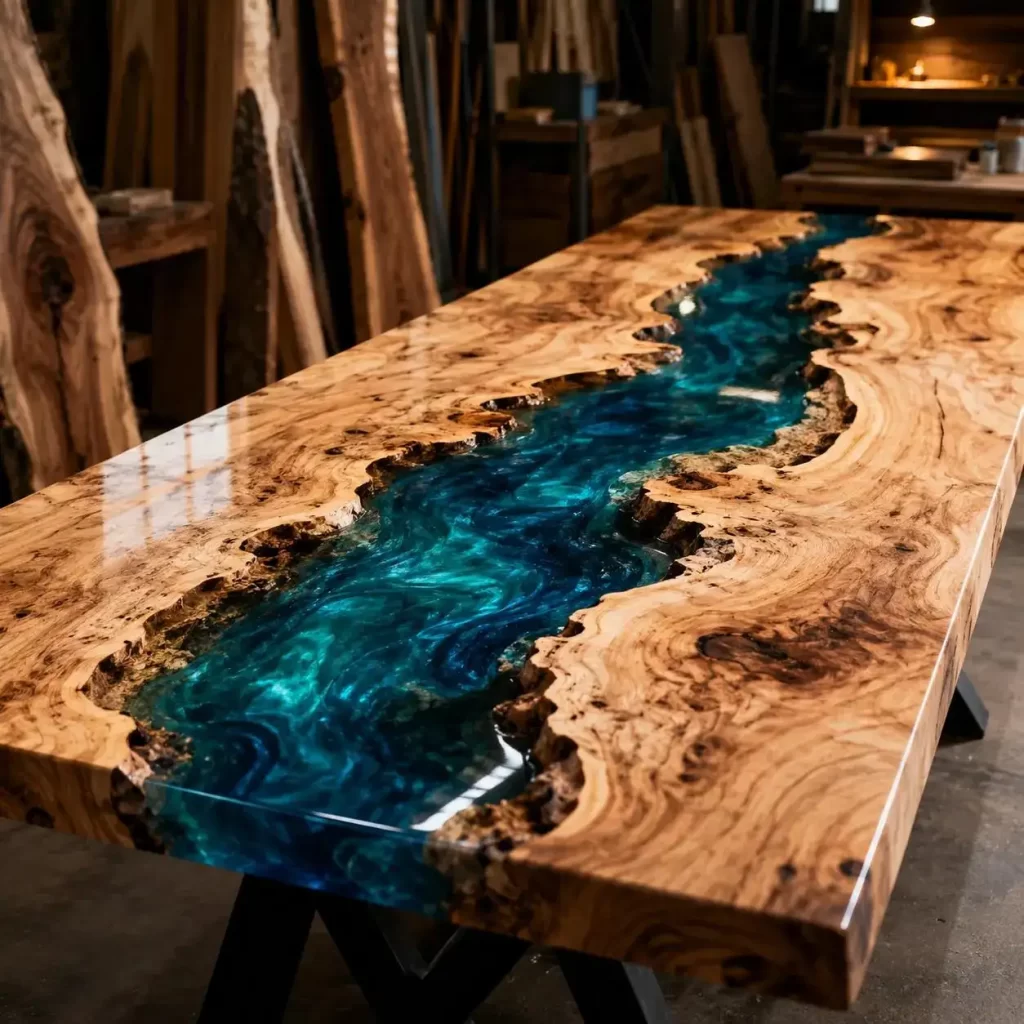
Deep Casting Epoxy Resin vs Tabletop Epoxy
| Performance Factor | Deep Casting Epoxy Resin | Tabletop Epoxy |
| Main use | River tables, slabs and art panels | Coatings and thin layers |
| Viscosity | Low | Medium to high |
| Cure profile | Slow and controlled | Faster |
| Working time | Longer | Shorter |
| Heat management | Critical | Easier in thin films |
| Bubble release | Better natural escape | More surface treatment may be needed |
| Misuse risk | Excessive depth or slow cure | Overheating in thick pours |
The slower cure of Deep Casting Epoxy Resin allows bubbles to rise while reducing concentrated heat.
How to Evaluate a Deep Casting Epoxy Resin
Buyers should consider the full processing window when analyzing resins, not just claims of "crystal clarity" or "UV resistance."
•Initial Clarity: Resins and hardeners should have low starting colors.
•Controlled Exotherm: The reaction curve must be aligned with the mold volume and thickness of casting.
•Defined Pour Depth: Understand whether the stated depth is per layer, per pour, or total project depth.
•Working Time: Large project volume requires time for batch mixing and pigmenting as well as sufficient time to pour and control trapped gasses within the resin.
•Low Viscosity: Resin should flow into wood cracks and around embedded objects.
•Cured Performance: The casting should support sanding and polishing and withstand normal use as furniture.
•Batch Consistency: Stability of viscosity, clarity, cure time, and hardness are all important to commercial users.
How JINHUA 318AB-8V Addresses Deep-Pour Challenges
JINHUA developed 318AB-8V for clear castings where heat, working time and appearance must be controlled together. The 2:1 system suits river tables, thick slabs and resin art panels.
| Processing Parameter | 318AB-8V Reference |
| Mixing ratio | A:B = 2:1 by volume |
| Pot life at 25°C | Up to 1 hour |
| Cure time at 25°C | Approximately 48–72 hours |
| Typical layer guidance | Up to about 2 inches / 5 cm |
| Intended project range | 2–4 inch deep casting projects |
Confirm thickness against the TDS, resin volume, mold geometry and ambient temperature. Deeper single pours require validated conditions.
Controlled Reactivity
The slower cure profile helps limit rapid heat accumulation, reducing the risk of thermal cracking, localized discoloration and uncontrolled curing.
Ultra-Low Viscosity and Bubble Release
Low viscosity leads to better flow through tight spaces and also helps to aid the escape of air that is mixed in the resins and porous timber. Adequate mixing, sealing, and control of process temperature is a must.
Improved Yellowing Resistance
318AB-8V has the ability to retain clarity and also enhance the yellowing resistance for indoor cast applications. Due to the nature of the wood grain and the other elements of enhancement, cases may still warrant the use of a shade protection or a UV-protective topcoat.
Extended Working Time and Batch Control
A pot life of up to one hour gives fabricators more time to:
•Mix larger batches thoroughly
•Add pigments accurately
•Allow entrained air to rise
•Pour slowly into complex molds
•Position embedded objects
JINHUA controls viscosity, initial color, curing behavior, hardness and clarity for repeat production.
Recommended Application Procedure
- Measure: Mix Part A and Part B at 2:1 by volume; for example, 200 ml A with 100 ml B.
- Mix: Stir slowly for 3–5 minutes, scraping the container sides and bottom.
- Rest: Leave the mixture for 2–3 minutes to release air.
- Pour: Pour gradually along one side of the prepared mold.
- Remove bubbles: Pass a heat gun lightly over the surface without concentrating heat.
- Cure: Maintain a stable, ventilated and dust-free environment for 48–72 hours.
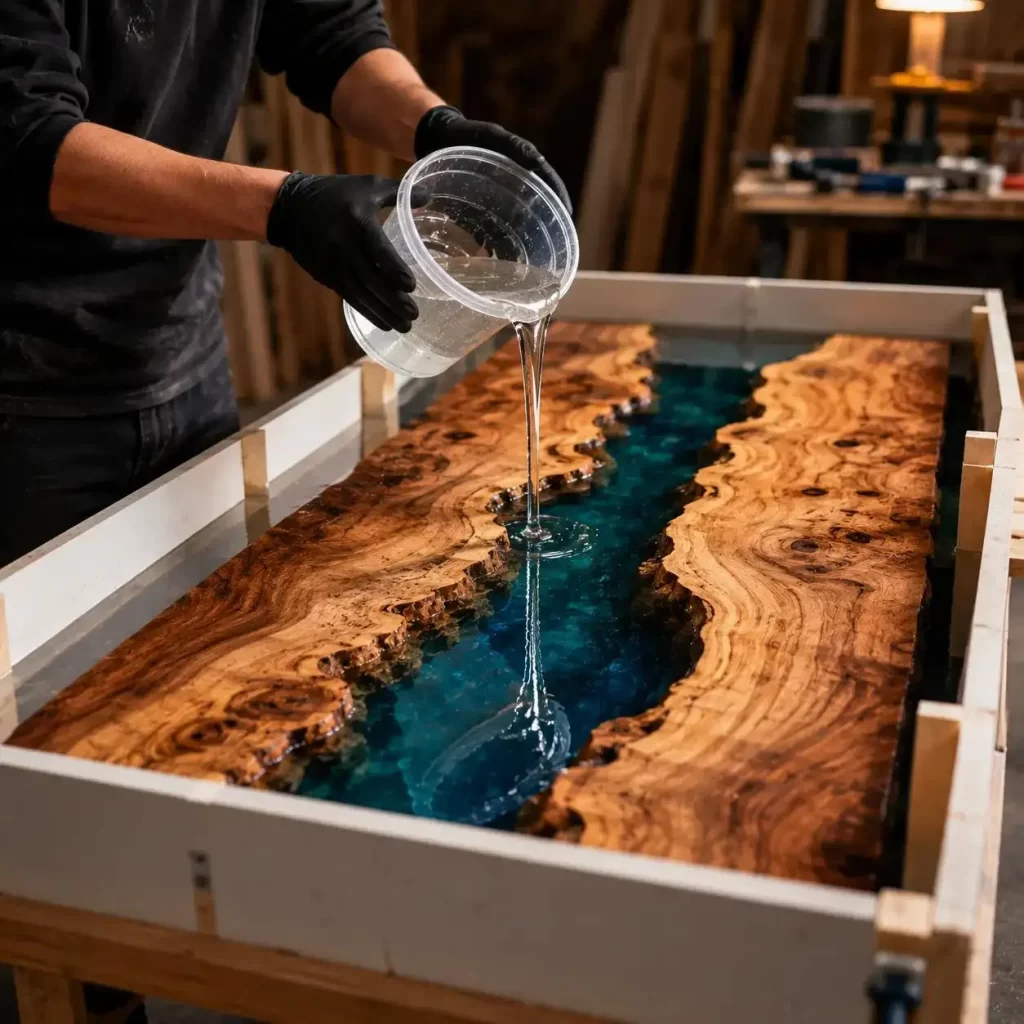
Suitable Applications
| Application | Critical Requirement |
| River dining tables | Controlled heat and long working time |
| Live-edge coffee tables | Wood penetration and bubble release |
| Crystal bar tops | Clarity, hardness and polishability |
| Resin art panels | Pigment compatibility and color stability |
| Embedded castings | Flow around complex shapes |
| Decorative countertops | Visual depth and surface durability |
Common Mistakes That Reduce Clarity
Even a high-quality Deep Casting Epoxy Resin can fail when application conditions are ignored:
•Using fast-curing coating epoxy for a deep pour
•Working in an excessively warm room
•Mixing more material than recommended
•Stirring too aggressively
•Casting over wet or unsealed wood
•Using incompatible pigments or fillers
•Applying concentrated torch heat for too long
Storage and Handling
Store sealed containers at about 25°C in a cool, dry place away from sunlight, humidity and excessive heat. Reseal promptly.
Use gloves and eye protection, provide ventilation and keep the material away from flames and children. Run a small trial before production. Reference shelf life is 12 months when unopened and correctly stored.
Selecting Deep Casting Epoxy Resin for Long-Term Clarity
Long-term clarity depends on UV resistance, controlled exotherm, low viscosity, accurate mixing, suitable depth and stable workshop conditions.
For river tables, art panels and thick castings, JINHUA 318AB-8V provides a 2:1 Deep Casting Epoxy Resin system with a long working time, controlled curing and bubble release. Buyers can contact JINHUA to review the TDS, casting conditions, packaging and batch-testing requirements.
FAQs
Q1. What can JINHUA 318AB-8V Deep Casting Epoxy Resin be used for?
JINHUA 318AB-8V can be used to make river tables, live edge furniture, thick wood slabs, art panels, bar tops, and countertops. This product also helps make tabled art and castings with embedded items. This resin has a low viscosity and long working time which creates a deep filled and air bubbled free casting with a clear finished appearance.
Q2. What mixing ratio is JINHUA 318AB-8V?
JINHUA 318AB-8V should be mixed at a 2:1 ratio (by volume) of Part A to Part B. Users can mix 200 ml of Part A to 100 ml of Part B. It is very important to measure everything out carefully because a bad ratio can result in inconsistency in hardness, soft areas, or incomplete curing.
Q3. Is JINHUA Deep Casting Epoxy Resin completely non-yellowing?
JINHUA 318AB-8V provides increased anti-yellowing and clarifying effect on indoor casting. However, clarity of epoxy resins can never be proved to be unaffected by the UV light. Yellowing can occur from long exposure to UV light or intense heat, or from not using proper curing conditions.
Q4. How deep can JINHUA Deep Casting Epoxy Resin be poured?
With the 318AB-8V system, this epoxy resin can be poured down to a depth of roughly 2-4 inches. In typical workshop conditions, casting layers should be no more than roughly 4 inches or 10 cm thick. Limits should be adjusted based on a project’s specifics and on the TDS, the working environment’s temperature, and the mold size.
Q5. How long is the working time of JINHUA 318AB-8V?
At approximately 25°C, the resin provides a working time of up to one hour. From a fabricator’s perspective, an increased pot life means more time to mix and add pigment, allow trapped air to escape, pour over large molds, and position decorative reinforcement and flow control inclusions.