



Updated 1 month ago
Epoxy Encapsulant Manufacturer: REACH and RoHS Compliance for Global Buyers

hqt
Selecting an Epoxy Encapsulant Manufacturer for international electronics requires more than a certificate marked "REACH" or "RoHS." Buyers must verify that the compliance evidence matches the exact resin system, curing agent, color, filler package and mass-production grade.
A practical compliance review should confirm:
•The product code and formulation covered;
•The report date and applicable regulatory scope;
•Whether the sample represents mass production;
•Availability of SDS, SVHC declarations, RoHS reports and batch records;
•Procedures for formulation changes, material substitution and retesting.
Compliance is application-specific. Material-level evidence supports the buyer's assessment, but it does not automatically establish compliance for the finished electronic product.
Why Epoxy Encapsulant Compliance Matters
Epoxy encapsulants protect PCBs, sensors, transformers, relays, LED drivers, power supplies and automotive electronics. Because the cured resin remains inside the component, the complete formulation may require assessment, including:
•Base epoxy resin and curing agent;
•Mineral or thermally conductive fillers;
•Pigments and flame-retardant systems;
•Catalysts, flexibilizers and processing additives.
An Epoxy Encapsulant Manufacturer must therefore support more than viscosity, hardness, dielectric strength and thermal conductivity. Weak documentation can result in repeat testing, delayed product approval, redesign costs or supplier replacement.
REACH vs. RoHS: Different Rules, Different Evidence
REACH addresses chemical substances, mixtures, articles and supply-chain communication. RoHS controls restricted substances in electrical and electronic equipment. The current consolidated RoHS text includes amendments effective from July 1, 2026, making it important to check current requirements and valid exemptions before approving a material.
| Review Area | REACH | RoHS |
| Main focus | Chemicals, mixtures, articles and supply-chain information | Restricted substances in electrical and electronic equipment |
| Encapsulant concern | Composition, SVHC status, restrictions and safe-use data | Restricted substances in homogeneous materials |
| Typical evidence | SDS, REACH declaration, SVHC statement | RoHS test report and material declaration |
| Buyer's key check | Candidate List version, SKU and formulation | Tested sample, limits, scope and exemptions |
| Finished-product approval | No | No |
Buyers should request REACH compliance documentation and a RoHS test report for the specified formulation, rather than assume one certificate covers every product manufactured at the facility.
What REACH Compliance Means for Epoxy Encapsulants
Review the Complete AB System
A two-part electronic encapsulation resin contains both resin and curing-agent components. Both parts must be assessed.
A declaration covering only the base epoxy resin may exclude substances introduced through:
•Hardeners and accelerators;
•Pigments and color pastes;
•Thermal or mineral fillers;
•Flame-retardant packages;
•Flexibility and processing modifiers.
For this reason, a professional Epoxy Encapsulant Manufacturer should clearly state whether its documentation applies to one component or the complete AB formulation.
Check the Current SVHC Status
The REACH Candidate List is updated when new substances of very high concern are added. Inclusion can create immediate obligations under Articles 7, 31 and 33, so an undated declaration should not be treated as permanent evidence.
A useful SVHC declaration should identify:
•Product name and model;
•Covered component or complete AB system;
•Candidate List version or update date;
•Applicable concentration threshold;
•Basis of the assessment.
A statement such as "REACH compliant" without a product number, date or substance-list reference has limited audit value.
Where a Candidate List substance is present above 0.1% w/w in an article, suppliers may need to communicate sufficient safe-use information to recipients. Consumer requests for this information must generally be answered free of charge within 45 days.
Support Downstream and SCIP Assessment
Once the cured encapsulant becomes part of an electronic article or complex product, the EU manufacturer, importer or other responsible operator must assess its downstream obligations.
SCIP requirements focus on articles or complex objects containing Candidate List substances above 0.1% w/w. A non-EU Epoxy Encapsulant Manufacturer can support this assessment by providing accurate substance, concentration and material-location information.
What RoHS Compliance Means for Potting Compounds
RoHS restricts ten substances in homogeneous materials. Cadmium is generally limited to 0.01%, while the other nine substances are generally limited to 0.1%. The four phthalates—DEHP, BBP, DBP and DIBP—were added to Annex II through Delegated Directive (EU) 2015/863.
| Restricted Substances | General Maximum Concentration |
| Lead, mercury and hexavalent chromium | 0.1% each |
| PBB and PBDE | 0.1% each |
| DEHP, BBP, DBP and DIBP | 0.1% each |
| Cadmium | 0.01% |
Why Homogeneous Material Matters
A cured potting compound may be assessed separately from the PCB, solder, housing, wires and terminals. Testing a crushed complete device can dilute a restricted substance and hide the actual material risk.
One report should not automatically cover every grade. Clear, black, flame-retardant, soft, thermally conductive and high-temperature formulations may use different pigments, fillers or additive systems.
A capable Epoxy Encapsulant Manufacturer should define exactly which SKU, color and formulation each RoHS test report represents.
Five Compliance Gaps Buyers Often Miss
1. Report-to-Product Mismatch
The report covers a standard clear resin, while the purchased product is black, filled, thermally conductive or flame-retardant.
2. Outdated Documentation
The report does not captures the current RoHS Candidate List or RoHS Scope and exemption status.
3. Partial Formulation Testing
Only the base resin was tested; the curing agent, pigment, filler or catalyst was excluded.
4. Uncontrolled Production Changes
A raw-material supplier, pigment or additive is replaced without customer notification or compliance reassessment.
5. Testing Is Treated as Legal Approval
Third-party reports are supporting evidence. The product manufacturer, brand owner or importer must still assess the complete electronic product and destination market.
Epoxy Encapsulant Manufacturer Audit Checklist
| Document or Control | What Buyers Should Verify |
| SDS | Exact product code, component, revision date and hazard classification |
| TDS | Mix ratio, viscosity, curing conditions and test methods |
| REACH/SVHC statement | Product scope, list version, date and threshold wording |
| RoHS test report | Ten substances, sample description, color and formulation |
| COA | Batch number and agreed quality parameters |
| Traceability records | Link between raw materials, production lot and shipment |
| Change notification | Rules for formulation, supplier and process changes |
Buyers should also test production-representative samples and define when updated declarations or additional testing will be required.
How JINHUA Supports Compliance-Focused Projects
For global buyers, the value of an Epoxy Encapsulant Manufacturer lies in formulation control, document traceability and repeatable production—not in presenting a generic certificate.
Product-Specific Documentation
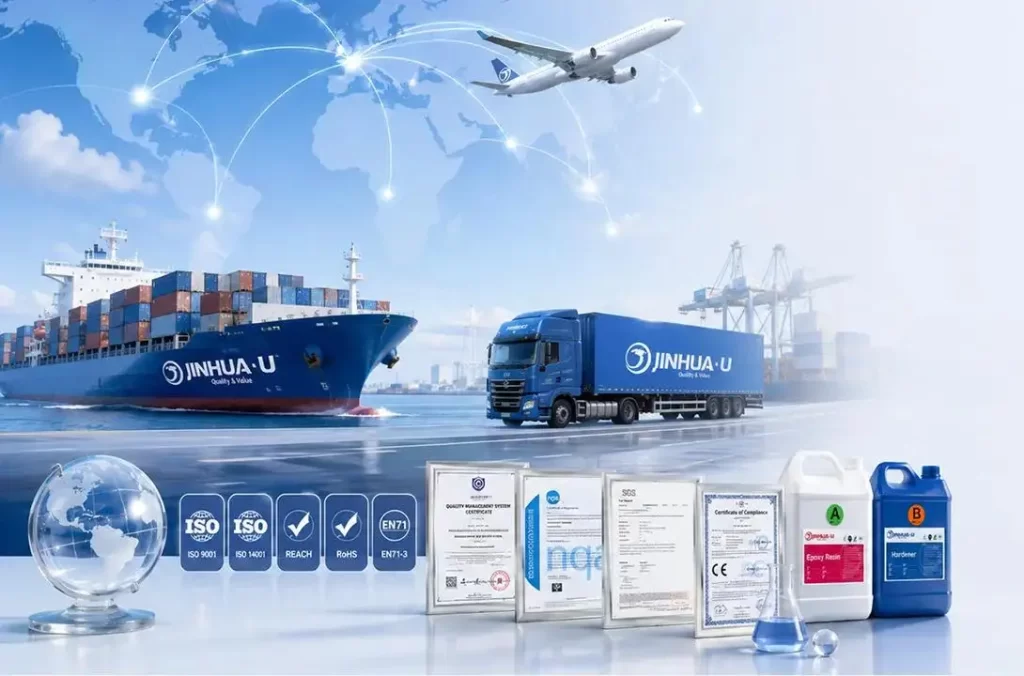
JINHUA coordinates available ISO, SGS, MSDS, REACH and RoHS documentation according to the selected product, formulation, application and destination market.
Reviewing document requirements during sampling helps identify gaps before tooling, qualification or mass production begins. Available documents should always be confirmed against the exact SKU and end-use requirements.
Controlled Formulation Development
JINHUA's R&D team of more than 20 members evaluates the resin, hardener, filler and additive system together. Customization can address:
•Processing viscosity and flow;
•Cure speed and hardness;
•Electrical insulation;
•Thermal conductivity;
•Flame-retardant performance;
•Color and packaging requirements.
Modified formulations should be reviewed and, where necessary, retested rather than relying automatically on a standard-grade report.
Batch Consistency and Traceability
The 20,000 m² manufacturing facility JINHUA has shown to operate houses eight automated production lines with the annual capacity to produce greater than 10,000 tons.
Controls at incoming materials, dosing, mixing, inspection, and packaging mitigate the risk of discrepancies between approved sample units and production lots. This reduces the risk of differences between qualification samples and commercial shipments.
International Project Coordination
JINHUA seeks to support customers in over 70 countries and regions by aiding them in making product selections, preparing samples, as well as complying with packaging and labeling requirements, as well as export documentation. Thus, technical, financial and legal aspects are covered through one Epoxy Encapsulant Manufacturer.
Conclusion
Choosing an Epoxy Encapsulant Manufacturer requires more than finding "REACH" and "RoHS" on a datasheet. Buyers should verify the exact formulation, regulatory basis, tested sample, document scope, batch traceability and change-control process.
Planning an international electronic potting or encapsulation project? Share the application, operating conditions, destination market and required documents with JINHUA. Its technical team can help evaluate suitable epoxy encapsulants, prepare representative samples and confirm available REACH, RoHS, SDS and supporting test documentation before mass production.
FAQs
Q1. What measures does Jinhua use to maintain batch-to-batch consistency?
In the case of Jinhua, Quality Control begins with incoming material, progresses through the process with dosing, mixing, inspection, and packaging, and ends with final product. Some information provided by the company cites 20,000 square meters of Jinhua's production facility, which includes eight fully automated production lines.
Q2. Is it possible to obtain Jinhua's RoHS and REACH documentation?
It is possible to obtain Jinhua's REACH, RoHS, SDS, MSDS, SGS and other supporting documentation for certain products. Documentation must be verified for the specific product, formulation, color, component and (if applicable) the requirements for destination market.
Q3. Are all epoxy encapsulants from Jinhua covered by a single RoHS report?
It is not necessarily true that all epoxy encapsulants issued by Jinhua are covered under a single RoHS report. Epoxy encapsulants may differ by clear, black, thermally-conductive, flame retardant, or flexible epoxy encapsulant. Jinhua can provide buyers further guidance on the applicable report and if additional tests are warranted.
Q4. Is it possible for Jinhua to create a RoHS and REACH focused epoxy encapsulant?
Yes, it is possible to create a RoHS and REACH focused epoxy encapsulant, although Jinhua can create formulations according to the customer's requirements of processing, performance and compliance. These formulations may vary by thermal conductivity, color, flame retardant performance, and electrical insulation.
Q5. What information should be supplied prior to requesting a formulation?
When requesting a formulation, supply the application, target market, operating temperature, the viscosity and curing requirement, hardness, thermal conductivity, flame retardant requirements