


Updated 3 weeks ago
Water-Based Pigment for Terrazzo-Style Gypsum Crafts: Casting, Color, and Surface Control

JINHUA

A terrazzo-style gypsum tray can have the correct color formula and still fail visual inspection after sanding. Colored chips disappear beneath the surface, fragments break away at their edges, or the background develops a muddy tint. These defects often originate before demolding, when chip geometry, slurry consistency, and pigment distribution are not properly coordinated.
Using water-based pigments is just the beginning for producers of decorative trays and candle holders. At JINHUA we study the interaction between colorants, gypsum formulations and processing conditions to get the final appearance.
1. How Does Water-Based Pigment Create a Terrazzo Effect in Gypsum?
Terrazzo effect requires including distinct colored inclusions in a matrix of a contrasting color. Merely blending several water-based pigments in wet gypsum results to streaking or marbling.
The more controllable method is to cast colored gypsum separately, break it into chips, and embed those chips in a fresh gypsum mixture.
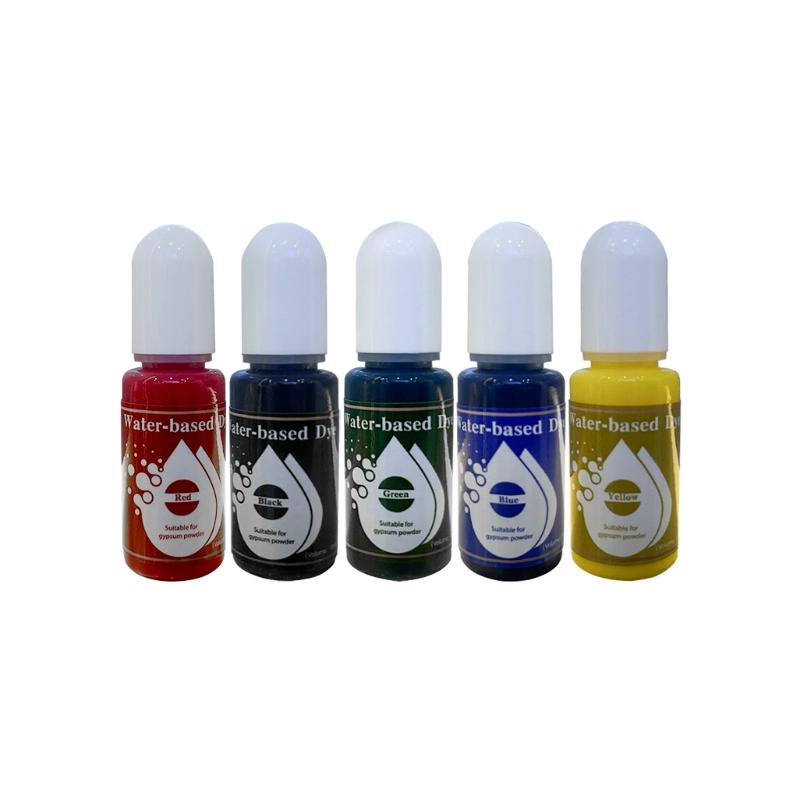
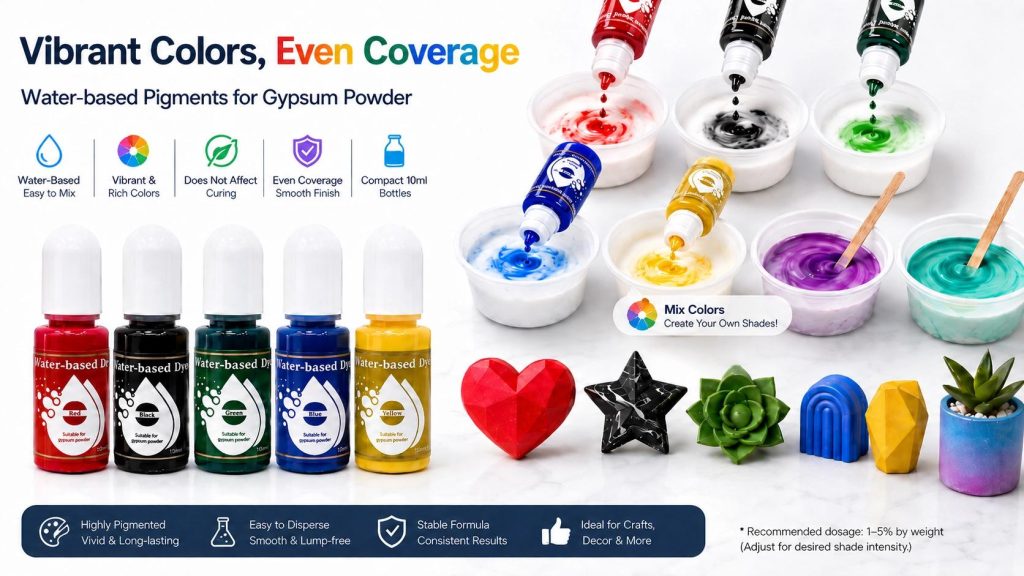
JINHUA offers a water-based colorant for gypsum and plaster. Our formulation is described as a water soluble, transparent tint, with five colors, red, black, green, blue and yellow. The product is available in 10ml dropper bottles and the recommended dosage is 0.5-3% relative to the weight of the gypsum.
Transparent character affects color development. In the case of an opaque pigment paste, a soluble tint allows the gypsum to retain its natural whiteness and, consequently, color development depends on the characteristics of the casting powder.
For terrazzo applications, three elements require separate control:
•Color of the chips: With pigment concentration determining the color.
•Tone of the background: A neutral matrix or a tint that is the same or similar to the color of the chips may provide better background contrast against colored fragments.
•Amount of chips exposed on surface: The chips remain embedded in the matrix until they are brought to the surface through finishing or until they are positioned near the surface of the mold.
A darker matrix can not compensate for inadequate chip exposure.
2. Manufacturing Colored Gypsum Chips
There are ways of preparing gypsum so that, when used in a matrix, the desired repeatability and mechanical integrity of the finished casting can be realized.
In the case of terrazzo, defined fragments can be realized by coloring gypsum, casting it into sheets, and breaking/cutting it after it has developed strength.
Controlling Chip Thickness and Fragment Size
Thinner chips are easier to incorporate into molds. Overly thin or weak fragments can break during the mixing or sanding process.
Large chips create a stronger visual contrast, but can obstruct the flow within mold features. Small particles create a more even distribution, but can be visually lost after the molding process.
An ideal preparation sequence is:
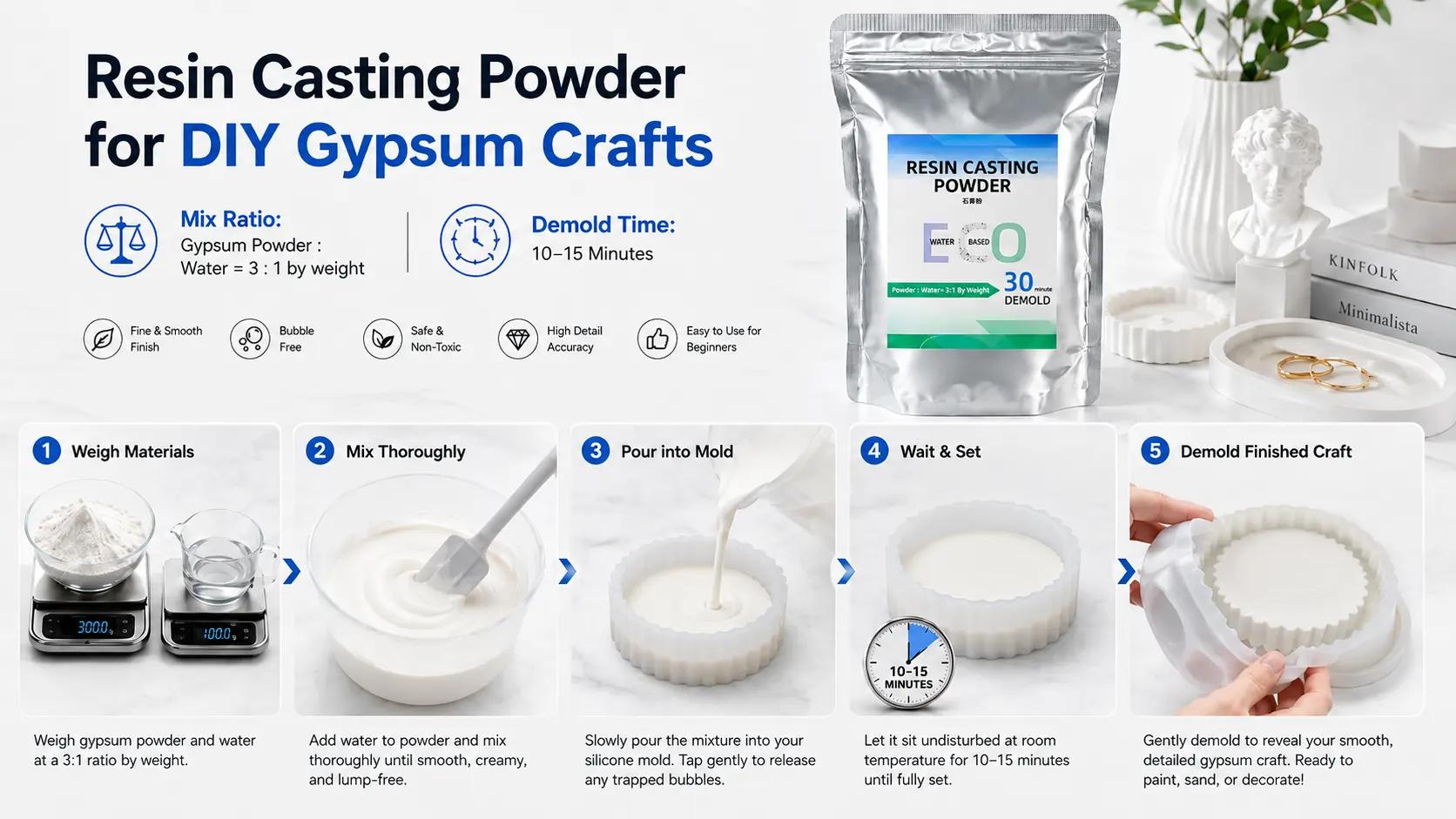
•Weigh the colorants and gypsum components by mass, according to the binder manufacturer’s mixing instructions.
•Cast the colors separately to dry completely.
•Break or cut the sheets to the desired fragment sizes.
•Prior to mixing, remove the powder and fines from the fragments.
Cleanliness of the chips is very important. If colored gypsum dust is present within the fragment, it can disperse into the background matrix during the molding process. This can create unwanted tints along fragment boundaries.
Manufacturers should also assess the absorption of liquid within the surrounding slurry of completely dry chips. Moisture conditioning of chips should be assessed via trials rather than assumed.
3. Does Pigment Dosage Affect Gypsum Setting and Strength?
The hardening of gypsum takes place by dissolution and recrystallization of calcium sulfate phases. The hemihydrate dissolved in traditional plaster systems slowly forms crystals of gypsum dihydrate, and yields an interlocking structure.
On the other hand, the addition of a liquid colorant, apart from modifying the aesthetic appearance of the mix, can also affect the total liquid content, the consistency of the slurry, and the setting response, based on its composition and dosage.
JINHUA affirms the water-based colorant is compatible with gypsum curing. However, compatibility in one formulation does not necessarily imply equivalent behavior in all commercial gypsum binders.
The working time is approximately three minutes. In a system with such a restricted processing window, one cannot delay the preparation of chips and adjustment of color, until after the mixing process has started.
Three controls are recommended:
•Dosage: Using a mass, instead of a volume, measurement for the colorant should reduce variability in the dosage due to differences in liquid properties and dispensing technique.
•Liquid balance: Account for the colorant in the total liquid content of the formulation, since its actual water fraction is not defined.
•Mixing sequence: Where allowed, disperse the colorant in one of the liquids of the gypsum system before following the mixing instructions of the system.
Although water-based colorants are generally compatible with gypsum binding systems, it is suggested that the evaluation of effective liquid ratio be done on a case-to-case basis, comparing pigmented and unpigmented samples.
4. What Controls Chip Distribution During Casting?
Often the largest variation in appearance between two terrazzo samples comes from chip placement and not color distribution.
Factors such as chip size and loading, slurry consistency and mold geometry, affect where chips remain as the matrix sets.
| Process Variable | Visual or Mechanical Effect | Verification Method |
| Chip size | The largest pieces may dominate the pattern and bridge gaps in the mold section | Inspect fragments and check mold fracture |
| Chip Loading | Excessive chip loading may cause fragments to touch and stick together | Compare fracture surfaces and examine chip coverage |
| Slurry consistency | Poor flow may cause under-filling and chip displacement | Observe filling trials and demonstrate slumping |
| Chip moisture | May affect local liquid absorption and surface wetting | Measure and compare conditions of fragments |
| Sanding Depth | Affects the number of chips that become exposed | Measure material removed and inspect |
Surface Placement vs Bulk Mixing
For castings and panels less than 2 inches deep, surface placement can reduce sanding time. Bulk mixing reduces the time needed to remove material from high and low areas.
Irregular spacing can happen with surface placement. Bulk mixing can cause excess chips for a given area, resulting in excess trim.
Always check with the slurry manufacturer to validate the time and intensity of post-placement vibration. While it may remove trapped air, it can break the desired pattern.
5. Why Do Terrazzo-Style Gypsum Surfaces Fail After Sanding?
Sanding reveals cross-sections of embedded fragments, as well as weaknesses hidden in the original cast surface.
Different defects have various causes:
•Dislodged chips may be due to insufficient matrix, weak fragments or poor interfacial contact.
•Pale or indistinct patterns may be due to low color contrast, small fragments or incomplete exposure of chips.
•Colored halos may occur due to loose pigment-bearing fines that contaminate the background during casting.
•Pinholes can be caused by trapped air or incomplete slurry penetration around irregular fragments.
•Variations in gloss and darkening may be caused by uneven sealing or surface treatment.
Increasing sanding pressure usually does not correct poor chip distribution. Abrasion can remove additional material, enlarge voids or damage fragment edges.
Gypsum is sensitive to moisture, and the method of finishing (whether wet or dry) needs to be considered.
6. How Should Buyers Qualify a Repeatable Terrazzo Formula?
For commercial production, a prototype is not acceptable evidence of batch-to-batch consistency.
At JINHUA, we suggest assessing the entire casting process using a fixed gypsum grade, a defined colorant loading, a specific chip preparation and a repeatable finishing condition.
The assessment should include:
•Color Stability: Provide an even lighting condition and seal fully dried samples, then determine if there was a shift in hue.
•Process Compatibility: Evaluate working time and behavior at demold, observe porosity and retained fragments and, if necessary, document the conditioning of the surface.
•Production Traceability: Trace the sanding condition, the chip preparation, the mixing order of the binder, the colorant dosage, and the batch of the binder.
•Instrumental color measurements can help control background color, but patterned surfaces require defined measurement locations as the placement of chips affect measurements.
•Quantitative color tolerances and lightfastness of the finished product should be determined. These are not established by the colorant system alone.
For manufacturers developing terrazzo style plasters, JINHUA has a water based colorant for gypsum crafts. Contact our team to determine if this system is applicable for your product and to request a sample for evaluation before finalizing your production formulation.
FAQs
Q1. Is JINHUA Water-Based Pigment suitable for terrazzo-style gypsum crafts?
Yes. JINHUA's water-based colorant is designed for gypsum and plaster. It can color both gypsum chips and the surrounding casting matrix.
Q2. What is the recommended dosage of JINHUA Water-Based Pigment?
JINHUA recommends 0.5%–3% by gypsum weight. The final concentration should be tested against the required shade and specific gypsum formulation.
Q3. What colors does JINHUA Water-Based Pigment offer?
JINHUA offers five colors: red, black, green, blue, and yellow. They can be blended to create additional shades for decorative gypsum products.
Q4. Can JINHUA Water-Based Pigment produce opaque terrazzo colors?
The product is a transparent, water-soluble tint. Final opacity and color intensity depend on the gypsum base, concentration, and finished surface.
Q5. How can JINHUA Water-Based Pigment be used to make terrazzo chips?
Mix the colorant into separate gypsum batches, cast thin sheets, and break them into fragments after sufficient hardening. Remove loose fines before embedding the chips.