


Updated 3 weeks ago
Silicone Colorant Supplier in China: Quality Checks Before Bulk Orders

JINHUA

An approved color sample might still not pass quality assurance (QA). Different thicknesses in a casting may result in different shades. Variable pigment dispersion may also cause different shades and/or specks. Platinum-cured formulations may also be tacky after coloring.
These issues are not related to the supplier. There could be issues with the customer's silicone formulation, mixing/stirring equipment and curing conditions. When evaluating a Silicone Colorant Supplier in China, customers must assess the colorant's compatibility with their silicone formulation, mixing equipment, curing conditions and finished part requirements before releasing a bulk purchase order.
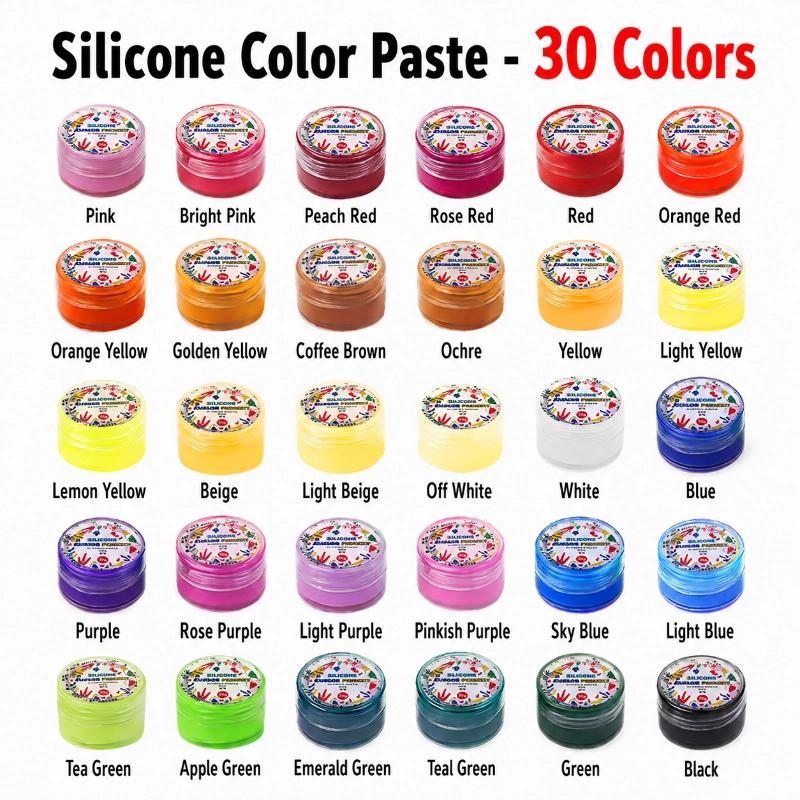
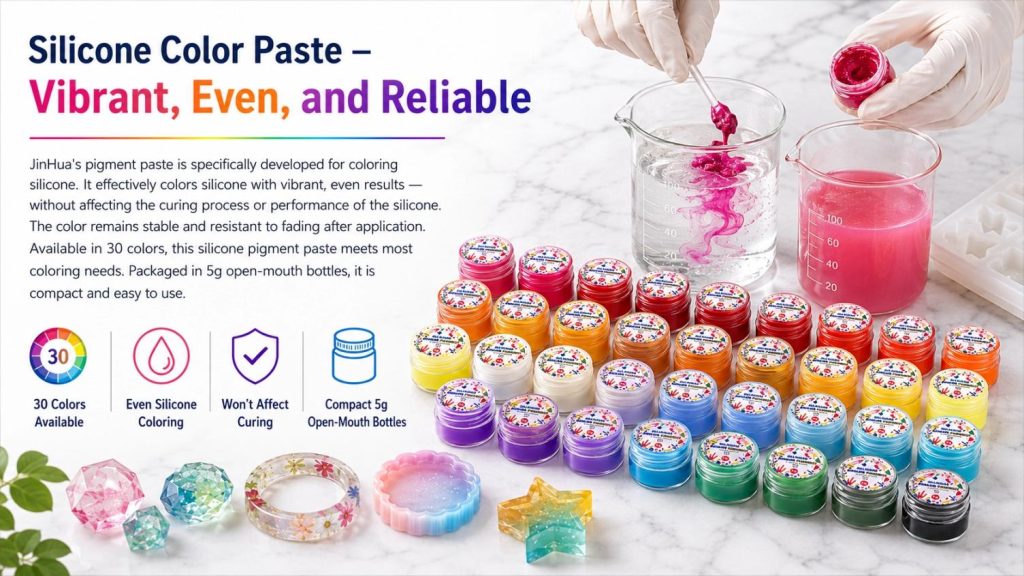
JINHUA provides concentrated silicone pigment paste in 30 colors for opaque coloring of silicone. Our catalog has a 5g package and recommended addition of 1% -4% by weight of silicone.
1. Does the Pigment Interfere With Silicone Curing?
Check the Curing Chemistry Before Approving a Color
Platinum-cured and tin-cured silicones do not respond identically to contaminants.
Addition-cure silicone depends on platinum-catalyzed hydrosilylation. Sulfur-containing compounds, certain amines, and organotin contamination can inhibit this reaction. The result may be incomplete crosslinking, especially around poorly dispersed or contaminated material.
The cure mechanism of condensation-cure silicone is different. Platinum catalysts inhibit cure; therefore, the rate of cure and finished properties are determined by pigment carriers and other additives.
JINHUA's silicone pigment paste is designed to color silicone without affecting the cure. However, this product description should not be considered as proof of compatibility with the customer's silicone grade.
Pigmented and unpigmented control silicone samples should be compared under the same conditions. These may include:
•Cure Response: Observing demolding time, surface tack, and/or incomplete curing of some regions
•Hardness: After allowing the silicone to attain a stable condition, measure its Shore hardness.
•Pigment Concentration: Check the effect of the pigment concentration over the upper acceptable limit.
•Formulation Stability: Ensure that the component ratio of the system is held constant by the silicone manufacturer.
A normal or expected surface appearance may not prove that cure was complete. Other testing may be required to address the properties and the extent of cross-linking.
2. Can the Colorant Maintain Shade and Dispersion Consistency?
Color strength and dispersion quality are related but are different properties.
One problem that can occur with the incorporation of color into silicone is with concentrated pigments. At low loading levels, these pigments may not produce a totally uniform dispersion. Agglomerates may be present in the pigment. If so, when the silicone is cured and optically clear, these pigment aggregates will scatter light and appear as defects such as specks or streaks.
It may seem logical that more pigment would lead to a more uniform dispersion, but adding more pigment increases the viscosity of the silicone and may cause some of the carrier to be released into the silicone.
It is important to evaluate the cured silicone, not the paste, to determine quality.
For a customer to approve a color, we suggest that a series of tests plaques be manufactured using controlled conditions (silicone type, pigment amount, thickness, and curing conditions).
What Should Buyers Look For in Packaging, Storage and Purchasing Cost?
JINHUA MATERIALS states a sealed shelf life of 2 years for its silicone pigment paste. It asks for storage in tightly closed containers in cool and dry places away from excess heat.
This shelf-life statement does not indicate how long an opened container can be stored for use in production. During storage, pigment may have settled and contaminations and/or changes in consistency may occur.
Plaques must be the same thickness and backed by the same material. Transmitting light through a thinned section of silicone may allow the background to influence the measured color.
3. Will Laboratory Performance Survive Production Mixing?
A small sample establishes preliminary compatibility. It does not reflect how the pigment behaves in a larger mixing vessel.
When increasing the batch size, the type of mixer in use, and the distribution of shear affect how the pigment is incorporated. Low-shear regions allow the presence of thick paste, and excess mixing may incorporate air and complicate degassing.
Related to this, the formulation may behave differently at an increased batch size. A formulation that is easily poured in the lab may not fill narrow mold details with the addition of more colorant.
| Production Concern | Typical Failure Mechanism | Verification Method |
| Variation of tint | Variation in shade from pigment dispersion | Compare samples from various locations in the vessel |
| Pigment specks | Agglomerates of pigment that have not been fully wetted | Inspect cured samples |
| Entrapped air | Bubbles introduced during mixing | Evaluate vacuum degassing and inspect cured part for voids |
| Mold filling | Viscosity increases and altered shear | Perform mold filling trials |
| Cure inconsistency | Contamination or incompatibility with other components | Compare cure behavior with unpigmented control |
Components requiring qualification should be produced on the actual production equipment. The addition and degassing sequence, as well as the cure cycle, should be completed during the qualification run.
Users of liquid silicone rubber (LSR) injection molding should also assess metering and dispensing compatibility. JINHUA'S published product description by itself does not prove suitability for all automatic LSR processes.
4. What Quality Evidence Should Accompany a Bulk Shipment?
A sample pigment formulation may qualify for a bulk shipment under specified conditions. However, this does not automatically qualify every subsequent shipment.
One of the main reasons for batch-to-batch differences is the variability in the method used to disperse the pigments in the carrier. Other reasons could be variations in storage conditions and concentrations. For this reason, procurement documents should connect an approved sample to subsequent purchases.
Prior to accepting a bulk shipment, purchasers have to establish:
•Color identification: Acceptable color, sample reference, and color differences.
•Lot tracing: Batch identification, and associated manufacturing information.
•Incoming inspection: Agreed procedures for appearance, color, strength, dispersion, and compatibility of cure.
•Documents: Availability of pertinent TDS and SDS.
•Change control: Notification for changes in pigments and carrier.
For regulated applications, chemical compliance documentation must also be evaluated against the actual end use. A silicone-compatible colorant is not automatically approved for food-contact, medical, or other restricted applications.
5. How Should Buyers Evaluate Packaging, Storage, and Purchasing Cost?
At JINHUA, our silicone pigment paste has a sealed shelf life of two years. We recommend storing the product in a cool, dry place, away from excessive heat, with the container tightly closed to maintain product quality.
This shelf life statement does not clarify the length of time an opened container can be stored for use in production. It is well known that during the storage of pigments, they can settle and contaminations and changes in consistency of the pigment can occur.
The product presentation published by us shows 5g jars. Buyers wishing to procure larger quantities should review bulked packaging (if any) with our team, address minimum order quantities, lead times and shipping conditions.
A lower price per kilogram may not result in a lower coloring cost. Variability in tinting strength may necessitate a change in the dosage, and difficult dispersion in the pigment may increase mixing time and increase scrap.
For a meaningful comparisons with suppliers, calculate the colorant cost per the accepted finished component including pigment consumption, processing losses and waste.
Evaluate JINHUA Silicone Pigment Paste
JINHUA manufactures silicone-specific pigment paste for opaque coloring in various applications outside epoxy resin colorants.
If you are considering bulk purchase of silicone colorants, provide your silicone system, desired color, targeted dosage and your production method to our team for assessment.
To request samples of JINHUA Silicone Pigment Paste and place an order, contact us.
FAQs
Q1. What silicone colorant products does JINHUA supply?
JINHUA supplies concentrated silicone pigment paste in 30 colors. It is formulated for opaque coloring of liquid silicone rubber used in mold making, casting, and decorative applications.
Q2. What is the recommended dosage for JINHUA Silicone Pigment Paste?
JINHUA recommends 1%–4% pigment paste by silicone weight. The final dosage depends on the required color strength, opacity, silicone formulation, and curing conditions.
Q3. Is JINHUA Silicone Pigment Paste compatible with platinum-cured silicone?
JINHUA describes its pigment paste as designed to avoid curing interference. Compatibility with a specific platinum-cured formulation should be verified through comparative curing and hardness tests before production.
Q4. Can JINHUA Silicone Pigment Paste be used in epoxy resin?
No. JINHUA Silicone Pigment Paste is formulated specifically for silicone applications, not AB epoxy resin. JINHUA offers separate resin colorant products for epoxy applications.
Q5. How can buyers evaluate the dispersion quality of JINHUA silicone pigments?
Prepare cured silicone samples using controlled pigment concentrations and mixing conditions. Inspect the samples for streaks, pigment agglomerates, uneven opacity, and visible color differences.