


Updated 3 weeks ago
Deep Pour Epoxy Manufacturer in China: How to Evaluate Factory Suppliers

JINHUA
A supplier advertises a six-inch epoxy pour, but the resin overheats when used in a wide river table mold. The cured casting develops internal cracks, even though the specified thickness was never exceeded.
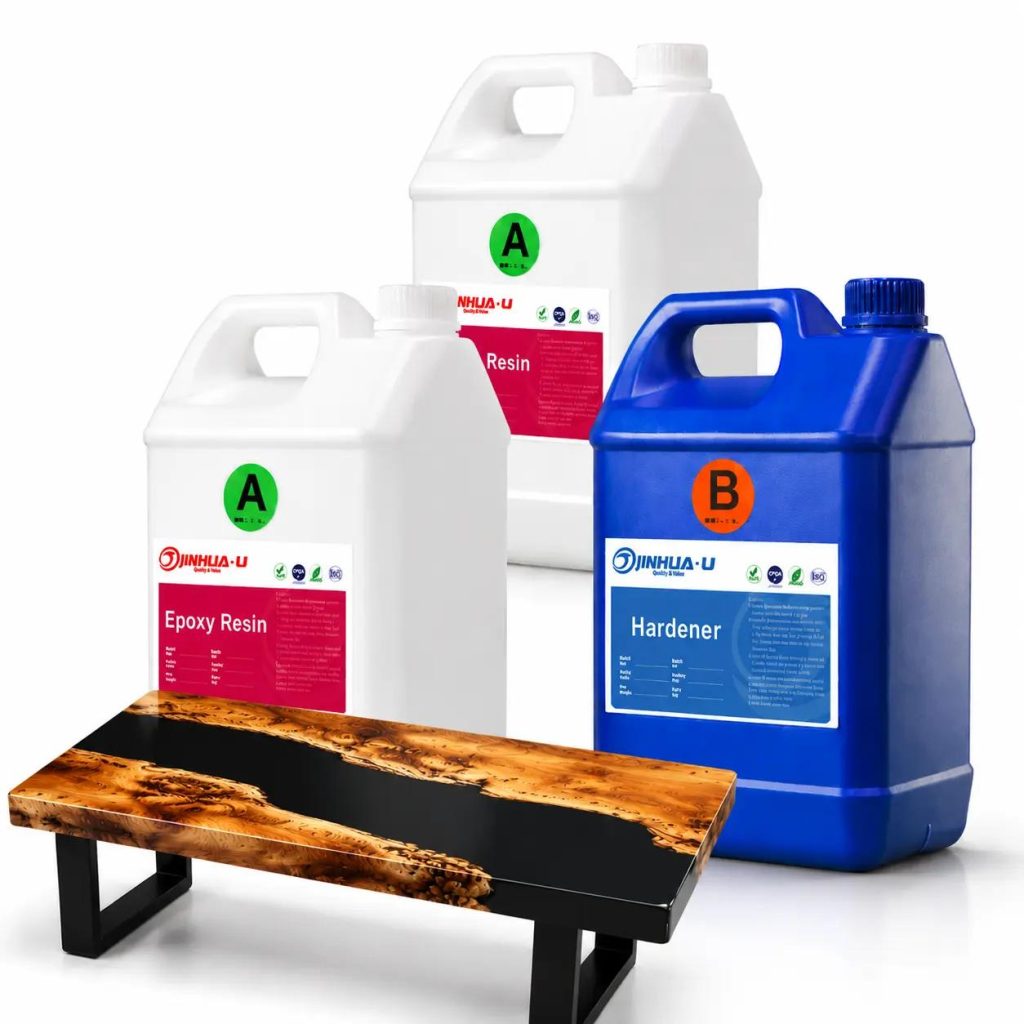
The problem is not necessarily defective resin. Pouring-depth claims often omit casting mass, heat-transfer conditions, and ambient temperature. A formulation that cures successfully in a narrow test mold may behave differently when several kilograms of mixed epoxy are confined in a larger section.
At JINHUA, we suggest evaluating a Deep Pour Epoxy Manufacturer in China based on your actual processing conditions rather than catalogue thickness ratings.
1. Will the Supplier's Epoxy Work with Your Casting Geometry?
Pouring Depth is Limited by Heat Dissipation
When epoxy is used to cast thicker sections, the center of the casting may become over-cured and discolored, and may expand and trap gasses, as shown in the figure below. Excessive heat buildup can result in residual stresses and cracking.
JINHUA has developed formulations for a variety of deep castings in the ranges of 1-2" to 8-9" pouring depths. The intent of these formulations is to indicate the application range and provide a starting point, not to indicate a genuine casting limitation.
It is helpful for potential buyers to determine and provide the following information for better product evaluation:
•Geometry of casting: Max. thickness, width, length, total volume of mixed resin.
•Thermal conditions: Temperature of the workshop, type of mold material, area of the mold that is in contact with the epoxy.
•Processing conditions: Volume of resin mixed, time for epoxy to be poured, time required for mold to be demolded.
•Embedded materials: Wood, pigments, metallic powders, decorative items.
A casting manufacturer's stated limitation should be validated against the current Technical Data Sheet and representative casting conditions.
2. Which Technical Properties Actually Predict Casting Performance?
Pot Life and Cure Time Describe Different Behaviors
Pot life measures the usable time of a mixed quantity under specified conditions. It cannot be interpreted independently of sample mass or temperature.
A large mixing container may retain reaction heat, shortening usable working time compared with a shallow tray containing the same formulation.
Cure time describes another stage of the process. A casting may become rigid enough to demold before its hardness and dimensional stability have fully developed.
| Property | What Buyers Should Examine | Risk if Overlooked |
| Exothermic behavior | Peak core temperature and temperature rise | Cracking, discoloration, internal defects |
| Mixed viscosity | Temperature-dependent flow and air release | Entrapped bubbles, incomplete mold filling |
| Pot life | Test mass, temperature, and gelation behavior | Premature thickening during pouring |
| Hardness development | Shore D results at defined cure intervals | Premature machining or surface deformation |
| Color stability | Defined UV or thermal-aging test conditions | Yellowing during intended service |
Lower viscosity generally helps air escape, but it may allow dense pigments or fillers to settle before gelation.
Similarly, a slower curing system can reduce rapid heat accumulation, yet prolong the time before demolding.
The appropriate formulation is therefore determined by the complete processing window rather than one favorable specification.
3. How Should Industrial Buyers Qualify Factory Samples?
Small Samples Cannot Establish Large-Casting Performance
A thin laboratory coupon can confirm mixing behavior and basic cure characteristics. It cannot reproduce the thermal profile of a large river table.
We recommend separating preliminary screening from application qualification.
•Initial material screening
•Confirm the mixing ratio is measured by weight or volume.
•Measure viscosity at a controlled temperature.
•Inspect cured samples for tackiness, haze, bubbles and contamination.
•Representative casting trial
•Cast a sample to the thickness and under conditions intended to replicate the maximum allowed thickness and relevant heat-dissipation.
•Place a temperature probe near the casting center and log the temperature profile during the exothermic reaction.
•After curing, inspect for internal cracks, voids and discoloration. Also record demolding time and hardness.
Wooden substrates require more attention. Moisture and air trapped in porous wood can produce bubbles that are not related to the resin's initial air content.
The qualification must contain the formulation of the material as well as the operating conditions under which it was qualified.
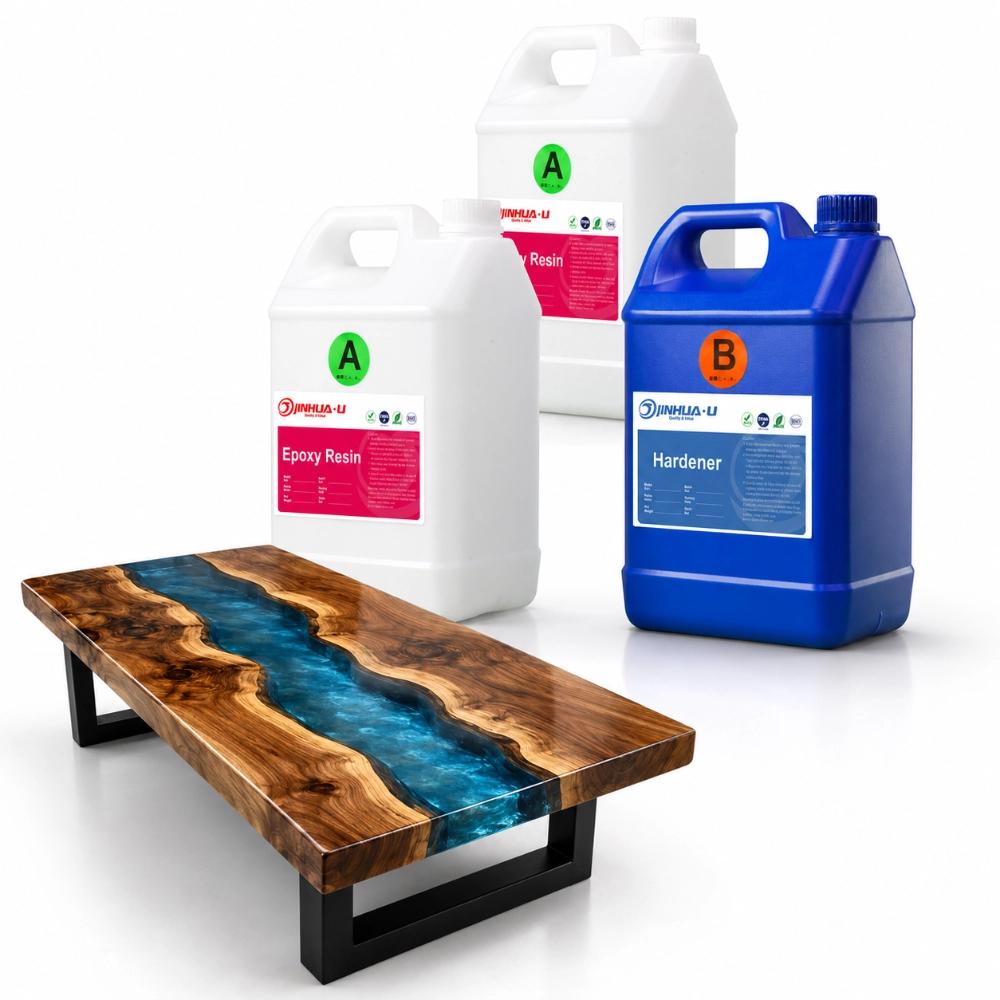
4. How Can Buyers Verify Batch-to-Batch Consistency?
Factory Docs Need to Connect to Finished Material
Variations in the concentration of reactive groups can cause changes in the stoichiometric ratio. Materials produced may show difference in gelation and/or complete hardening.
JINHUA's procedures for quality assurance show that they test raw materials, do in process testing, and sample retention as well as test finished goods.
Purchasing teams need to review these documents to see how JINHUA correlates the resin and hardener to the finished materials.
Relevant audit records include, but are not limited to:
•Incoming specification of resin viscosity, epoxy equivalent weight and curing agent.
•Results of finished-batch inspection with defined acceptance limits.
•Traceability between production lots, labeling on packaging and shipping documentation.
•Procedures and controls for changes to formulation and nonconformance to the formulation.
•Certificates of Analysis reporting batch properties.
For repeat orders, evidence of stronger application-level assurance is comparison of retained samples, or selected production batches, to the approved reference formulation.
5. What Should Be Requalified After OEM Formulation Changes?
JINHUA offers OEM/ODM customization of: viscosity, curing behavior, mixing ratios, packaging, and private label products.
These changes are not fully independent.
Rapidly increasing cure speed may raise the peak temperature in thick sections. Making the resin thinner may improve mold filling, but can change the behavior of pigment suspension.
When customizing formulations, the purchase description should include:
•The measurement temperature for viscosity.
•Working time and the maximum dimension in which the resin is to be cured.
•Mixing ratio and the method of dispensing.
•The hardness and clarity of the cured part.
•Behavior during curing.
•Packaging quantity and agreed shelf-life.
•Changes in the component ratio, curing agents and reactive diluents require requalification testing.
Verifying packaging-only changes does not mandate requalification. Dispensing accuracy, container compatibility and the seal of the package must be tested.
6. Are Export Packaging and Documentation Suitable for Repeat Orders?
Resin performance can deteriorate between the time it leaves the manufacturer and when it reaches the customer's workshop.
Poorly sealed containers can allow admission of moisture and contaminants. Two-component kits can also introduce errors during mixing even if both materials meet their specifications.
For international procurement, we recommend checking:
•Documentation: Current TDS and SDS for both components in the final formulation.
•Packaging: If the container closure integrity is maintained and if the ratio of resin to hardener is correct.
•Traceability: Identity of the product, manufacture date and component lot numbers.
•Shipping Classification: Restrictions and requirements for the transport of the actual formulation.
•Commercial terms: Minimum Order Quantity (MOQ), lead time, Incoterms and pre-shipment inspection.
The least quoted kilogram price does not necessarily represent the least cost production. Longer than anticipated cure times, increased scrap rate, and inconsistent batches can exceed the difference in cost for the initial purchased lot.
Discuss Deep Casting Requirements With JINHUA
JINHUA has a range of epoxy resin formulations for river tables, thick castings and OEM.
Tell us your casting requirements including operating temperature, processing requirements and the quantity you need. We can provide candidate formulations for sample prior to bulk order.
FAQs
Q1. Is JINHUA a Deep Pour Epoxy Manufacturer in China?
Yes. JINHUA manufactures deep casting epoxy resin systems for river tables, thick-section casting, and decorative encapsulation, with OEM/ODM formulation support.
Q2. What pouring depths does JINHUA's deep pour epoxy support?
JINHUA lists formulations for 1–2, 2–4, 4–6, and 6–8-inch pours. Actual suitability depends on casting dimensions, resin volume, and curing temperature.
Q3. How does JINHUA address overheating in deep epoxy casting?
JINHUA offers low-exotherm formulations designed for thick casting. Buyers should verify peak curing temperature using representative mold dimensions and processing conditions.
Q4. Can JINHUA customize deep pour epoxy formulations?
Yes. JINHUA offers OEM/ODM services covering viscosity, curing time, mixing ratios, hardness, and other formulation characteristics, subject to technical evaluation.
Q5. How can buyers verify JINHUA's epoxy curing performance?Request the applicable TDS and test samples under production conditions. Record mixing accuracy, pot life, peak temperature, demolding time, and hardness development.