


Updated 3 weeks ago
Plaster Resin Manufacturer in China: A B2B Sourcing Guide

JINHUA
A casting powder that works in a 200 g trial may behave differently when mixed in a larger production batch. The slurry thickens before the final mold is filled, air remains trapped beneath decorative details, or thin edges break during demolding. Even if the finished surface looks acceptable, inconsistent working time can disrupt an entire production schedule.
For buyers sourcing from a Plaster Resin Manufacturer in China, the main question is not if the supplier provides the fine, white casting powder. The main question is if the supplier can produce consistent results under controlled conditions.
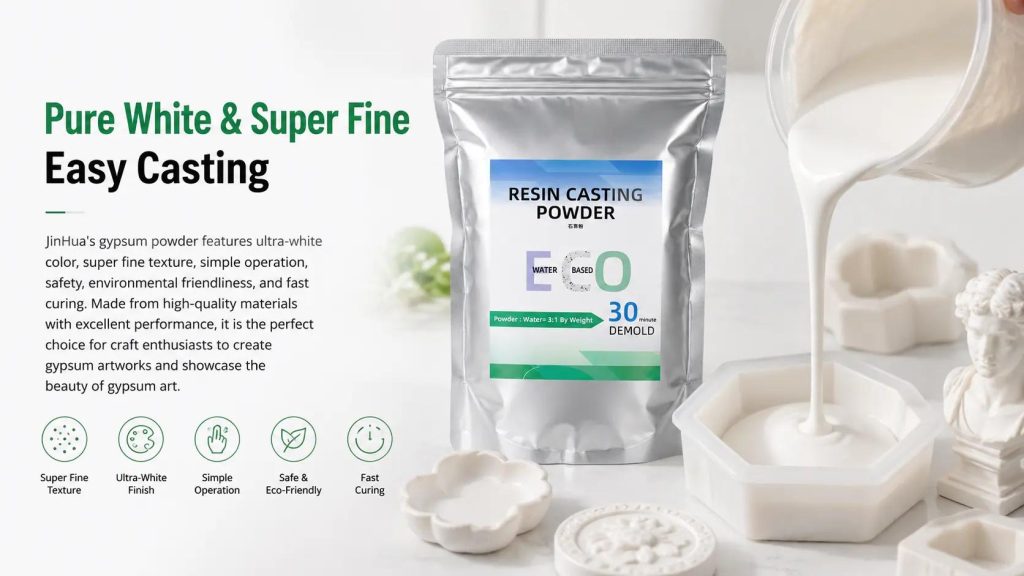
JINHUA provides the 716AB Resin Casting Powder for gypsum crafts and decorations, and small molded products. When it comes to B2B sourcing, we begin with material recognition, process capability, sampling, and repeat order control.
1. Confirm the Material Chemistry Before Comparing Suppliers
"Plaster resin" is a broad commercial term. It may describe gypsum-based casting compounds, polymer-modified mineral formulations, or other decorative materials. These systems should not be evaluated as though they were conventional epoxy resins.
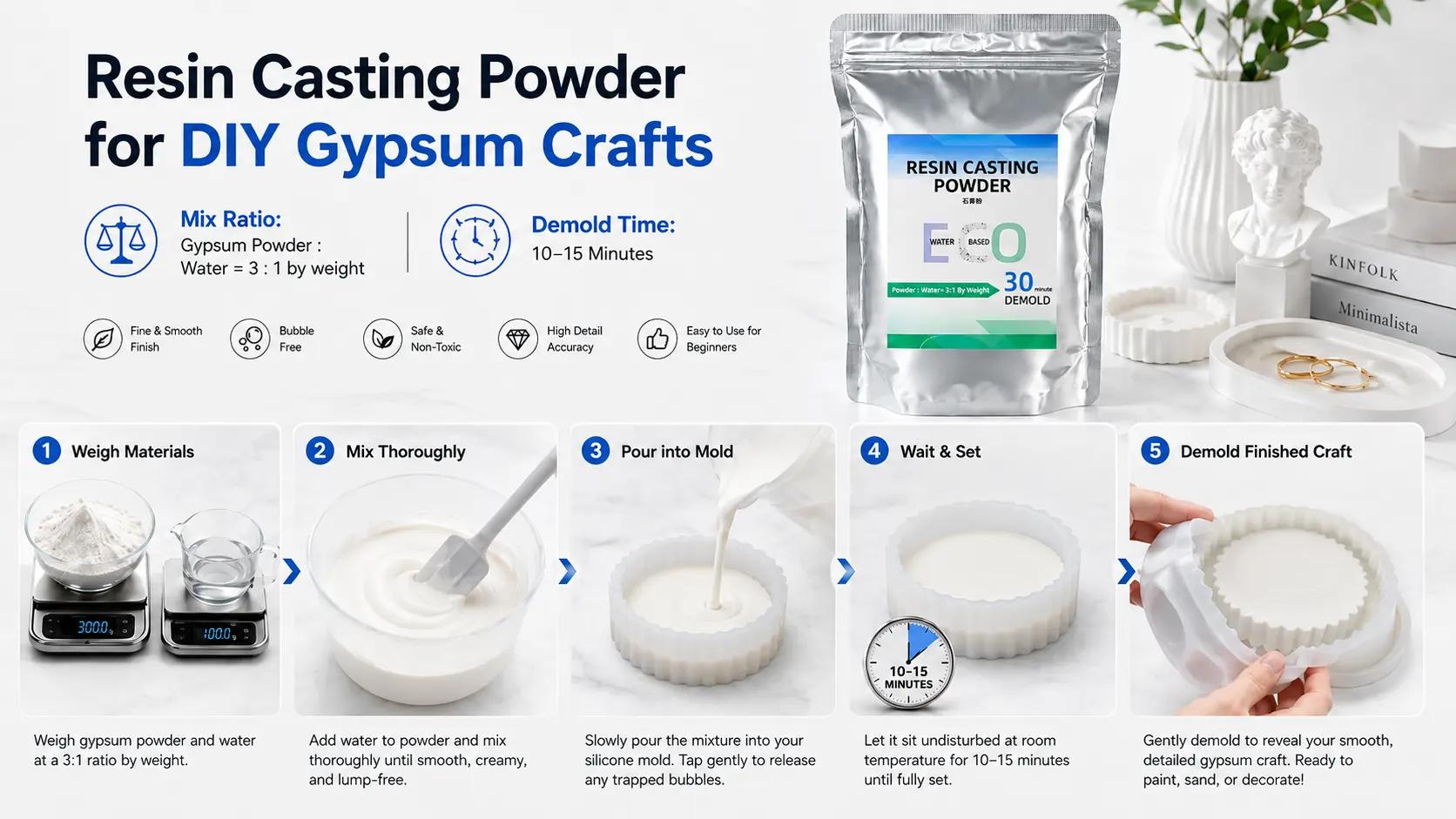
Our 716AB product uses two supplied components: white gypsum-based powder (716A) and a milky-white liquid (716B).
Conventional gypsum systems consist of hemihydrate that reacts with water to produce an interlocking structure of dihydrate crystals. The resulting dihydrate crystal structure gives the system its final shape. Alterations to the system can be made with the use of additives to change the setting rate, the level of dispersion and the formation of pores.
The chemical composition of 716B is not disclosed on our product page, therefore, potential buyers are not able to assume that it can be considered an ordinary plaster-and-water mixture.
Three characteristics of the materials are of greater importance:
•Particle characteristics: To achieve a good, fine and uniform particle distribution, finer particles may need to be used. These, however, may increase the demand for liquid, decrease the working time and increase agglomeration.
•Slurry rheology: The flow of a slurry should be such that it is able to fully fill recessed areas without segregating or trapping air.
•Hardened structure: Residual pores, inadequate dispersion and incomplete drying may adversely affect strength, surface finish and the ability to be coated.
We have specified a whiteness value of 96 and a 2000-mesh powder designation in our specifications. Before these figures are compared to competitive materials, particle-size and optical measurements should be defined.
2. Resolve Mixing Instructions Before Production Trials
Problems caused by misproportioned components may lead to excessive capillary porosity. For gypsum systems, free water may flow too much and may adhere to substrates too little. Too little water may result in lumps and poorly filled regions. The effect of 716B depends on its composition.
Our 716AB information contains specifications that require clarification before qualification.
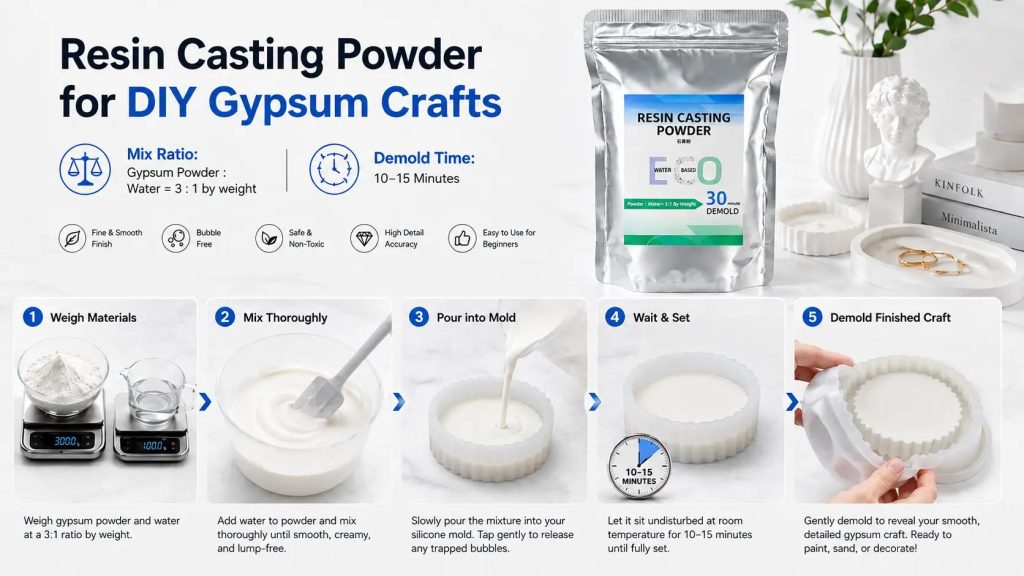
| Parameter | JINHUA information | Buyer verification |
| Mixing ratio | 3:1 by weight in the overview; 100:40 in the specifications | Confirm the approved 716A:716B mass ratio |
| Working time | 3 minutes | Measure from initial component contact under actual mixing conditions |
| Setting | Initial 5–8 min; final 10–15 min | Confirm test method and temperature |
| Demolding | 16–18 minutes | Check part geometry and damage rate |
| Operating temperature | 25°C recommended | Validate at actual workshop temperature |
The overview also states a 30-minute curing time, while the product FAQ references adding water. These instructions need reconciliation in the current technical data sheet.
A three-minute window creates a practical production constraint. The various steps in the production process, from weighing, to mixing, to transfer, to filling the mold, have to be coordinated to ensure that the viscosity of the slurry does not increase while earlier cavities are being filled.
Even if a formulation doesn't change, increasing batch size, without modifying the pouring arrangement, can constrain that window.
3. Test Casting Performance with Actual Mold Geometry
Material qualification tests should use actual mold designs rather than relying on sample blocks.
A thick decorative tray may demold successfully, while a thin walled aromatherapy container may fracture at the rim. The different behavior can be due to a number of things, including local wall thickness and mold-release resistance, and/or insufficient green strength at removal.
We have classified the causes of casting defects as follows:
•Pinholes: This may occur due to incomplete mixing or air incorporation. Air may get trapped in recessed areas and relieve during casting, thus, causing pinholes.
•Broken edges: This may occur due to insufficient strength or local geometry.
•Rough or incomplete details: This may occur due to a number of things, including premature thickening of the slurry, or flow of the slurry.
•Color variation: This can occur due to variation of pigment dispersion or the lot of raw material, or due to varying conditions of mixing and drying.
Make sure all batches are treated the same. Deviations from standard procedure can mask material variability and be confused with operator technique.
Products requiring sealers should be tested for adhesion of the coating. Candle holders also require Heat and Safety Assessment. Decorative Casting suitability alone does not establish candle use safety.
4. How Should Buyers Evaluate Batch Consistency?
Sample testing can only verify feasibility; it cannot guarantee long-term supply consistency.
For materials where powder plays an important role in the final properties (e.g. gypsum casting), the storage conditions before shipping also play a key role. The transport and storage of powder may result in the formation of agglomerates or prehydration of the powder, which may alter the final properties of the product.
For a repeat-order quality agreement, the buyer and the supplier have to agree upon:
•Incoming inspection: The condition of the powder (if powder is exposed to the atmosphere it may result in prehydration), integrity of the packaging, agreement on traceability, identification and component of the lot.
•Process Control: The setting time and behavior (if a powder is used in a mixture and the behavior of the powder affects the setting time and behavior of the mixture)
•Finished part: Appearance, porosity, mechanical behavior (if required) and demolding (if the part is too weak or brittle).
We recommend that the buyer of the product agree to a specimen reference, and compare new lots against the specimen.
In case the buyer requires certain mechanical properties (e.g. impact or flexural strength), the buyer and seller should agree on the test method to be followed and the acceptance criteria of the test.
These values should not be inferred from general claims of high hardness or fast curing.
5. Calculate Procurement Cost Beyond the Powder Price
The lowest quoted price per kilogram does not necessarily produce the lowest cost per acceptable casting.
For overseas buyers, total material cost depends on the approved component ratio, packaging format, transportation, usable shelf life, and production rejection rate.
A useful purchasing metric is:
Material cost per accepted casting = Total material expenditure ÷ Number of accepted castings
This calculation captures losses from trapped air, premature setting, damaged parts, and unusable residual mixtures.
JINHUA provides OEM and private-label services for a range of products. Ensure you verify the product specific packaging, MOQs, lead times and documents for 716AB and do not generalize for other formulations.
Before placing a bulk order, work out your approval of the component ratio, sample acceptance criteria, requirements for identifying lots and procedures for deviations.
For buyers looking for a Plaster Resin Manufacturer for decorative casting or private-label supply, JINHUA can assist in product selection and sample requirements.
Look into our 716AB Resin Casting Powder and share your mold design, target application and purchasing requirements with us.
FAQs
Q1. Is JINHUA a plaster resin manufacturer in China?
Yes. JINHUA supplies gypsum-based casting materials, including 716AB Resin Casting Powder, for decorative molding, crafts, and B2B sourcing.
Q2. What is JINHUA 716AB Resin Casting Powder used for?
JINHUA 716AB is designed for gypsum ornaments, decorative trays, sculptures, candle holders, aromatherapy containers, and small molded crafts. Application-specific testing is needed where heat or liquid resistance is required.
Q3. Is JINHUA plaster resin the same as epoxy resin?
No. JINHUA 716AB is a gypsum-based powder-and-liquid casting system, not a conventional epoxy resin. Its setting behavior, mechanical properties, and finishing requirements differ.
Q4. What is the mixing ratio for JINHUA 716AB?
JINHUA offers 3:1 by weight, while its specification table lists 100:40 for 716A:716B. Buyers should obtain the confirmed ratio and current TDS before mixing.
Q5. How long does JINHUA 716AB take to set and demold?JINHUA offers a 3-minute working time, 5–8-minute initial setting time, 10–15-minute final setting time, and 16–18-minute demolding time. These figures should be verified at the intended processing temperature.