


Updated 4 weeks ago
Resin for Wooden Tables in Live-Edge Furniture: Coating or Deep Pour?

JINHUA

A furniture manufacturer filling a 50 mm river channel cannot select epoxy using the same criteria as a workshop applying a thin, glossy finish. Both require transparency, but the casting must release reaction heat without cracking, while the coating must level before viscosity rises.
Using the wrong Resin for Wooden Tables will create casting defects such as bubbles, inconsistent gloss, and even stresses within the epoxy meeting the wood.
We separate these applications because casting thickness, resin volume, work time, and surface finish determine which resin can be processed reliably.
1. Does the Live-Edge Design Need Coating or Casting Resin?
The first question concerns where the resin will remain after machining.
A natural-edge slab with shallow cracks may need localized filling followed by a transparent coating. A river table containing a continuous gap between two slabs requires a casting resin capable of curing through a substantially thicker section.
These operations place different demands on epoxy chemistry.
Resin should permeate the wood structure of tabletop coatings in order to release trapped air. Excessive viscosity causes drainage, while adequate viscosity stops resin from running.
For deep-pour epoxies, flow, work time, and the build-up of internal heat affect the depth of epoxy penetration. Viscosity also plays a part in depth of epoxy penetration.
It is usually a compromise for manufacturers to use the same universal epoxy formulation to create both conventional live-edge and river tables.
2. How Do the Deep-Pour and Coating Formulations from JINHUA Compare?
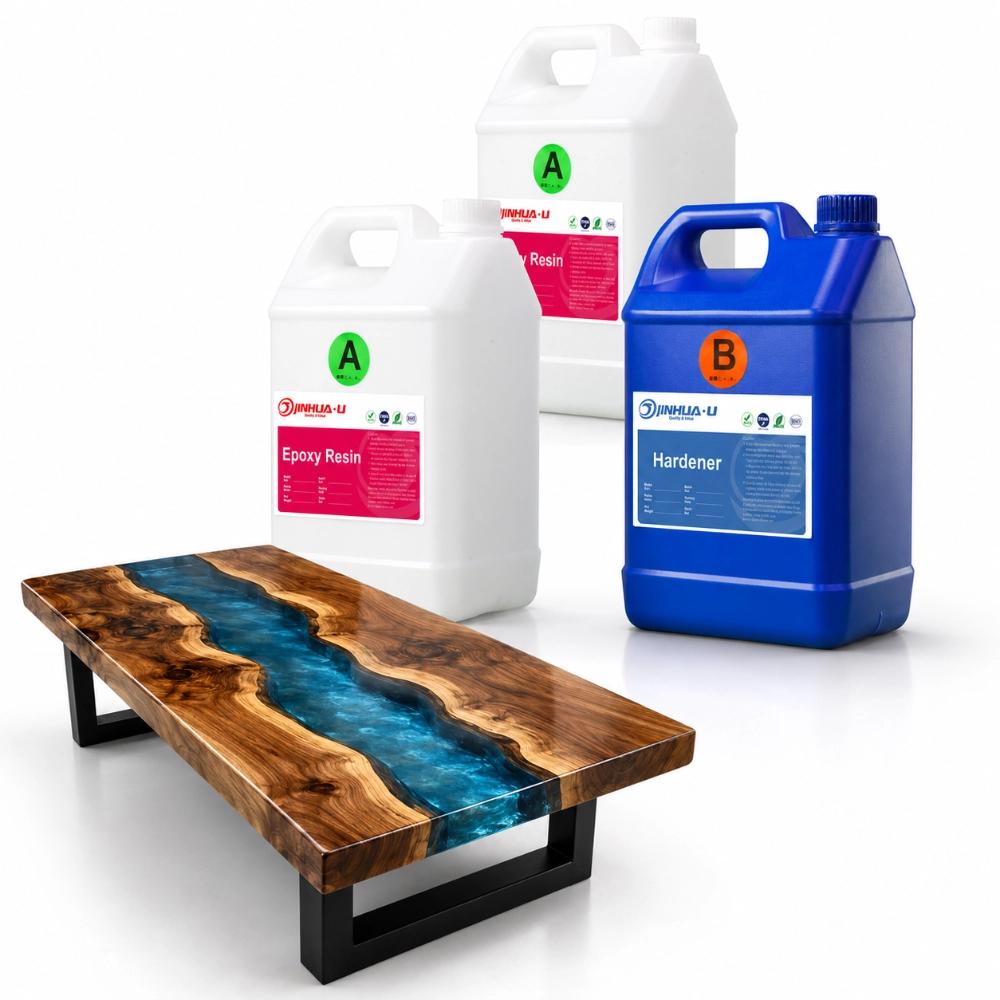
For the surface coatings and river table castings, JINHUA uses various epoxy systems.
| Technical Parameter | 1201AB-LX Tabletop Coating | 318AB-9V-2 River Table Resin |
| Intended operation | Transparent surface coating | River channels and thicker castings |
| Mixing ratio by volume | 1:1 | 2:1 |
| Published pot life | 25 minutes | 3 hours |
| Published curing time | 36–48 hours at 25°C | 36–48 hours at 20°C |
| Cured hardness | Shore D 82 | Shore D 86 |
| Mixed viscosity | Not specified on product page | 500 ± 50 mPa·s at 25°C |
| Main selection concern | Leveling and coating appearance | Exotherm and casting geometry |
Where 1201AB-LX Fits
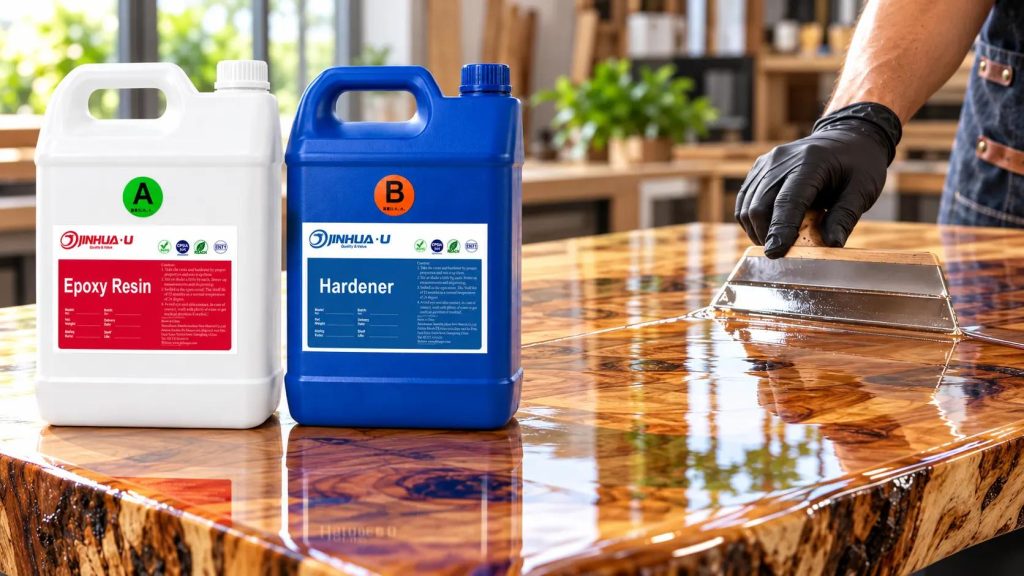
Our Clear Table Top Epoxy Resin is a transparent, self-leveling coating designed for wooden furniture, countertops, and bar tops.
Its 1:1 volume ratio simplifies dispensing, although accurate proportioning and thorough mixing remain necessary. The approximately 25-minute pot life also requires manufacturers to coordinate mixing, spreading, and bubble removal before viscosity increases.
Even though this formulation demonstrates better resistance to yellowing, this should not be misinterpreted as providing complete ultra-violet protection. Customers who want to ensure color stability of the furnishing they purchase for outdoor use should request supporting color stability test data.
Where 318AB-9V-2 Fits
Our Low Viscosity Epoxy Resin is designed for river-table casting and filling irregular wood cavities.
Its lower mixed viscosity aids cavity filling and air release. The longer published pot life offers a wider processing window compared to the coating formulation.
JINHUA recommends 3 to 5 cm layers for river-table applications, while also referencing a higher maximum casting capability. These figures should not be treated as operating limits. For larger pours, actual resin volume, mold insulation and ambient temperature should be evaluated.
3. What Is the Effect of Pour Depth on Curing Reliability?
Heating epoxy past the glass transition temperature initiates cure, and results in a hard, infusible state. A thick casting takes longer to cure than a thin coating, due to the fact that in a thick casting, bulk material has to dissipate the cure energy, as compared to a thin coating where the surrounding materials and the exposed surface of the epoxy are responsible for dissipation.
The temperature of the resin increases the rate of the exothermic reaction. Therefore, a positive feedback system is created whereby faster curing produces more heat and results in an even further increase in the rate of reaction.
Some possible effects may include:
•Internal cracking due to thermal gradients and cure shrinkage
•Discoloration and/or haze due to high peak temperatures
•Entrapment of gas bubbles
•Stress, cracking, and separation at the wood/resin interface
Casting depth alone does not predict peak exotherm. A long, wide river channel may contain more reacting material than a narrow, deep cavity.
Representative samples of mass and dimensions, starting temperature and peak internal temperature should be recorded. Insulated molds and warm workshops should be included in the study.
A long pot life can provide more working time but thermal verification is still required.
4. How Should Live-Edge Wood Be Prepared?
Live edge slabs contain many impurities such as open end grain, knots, cracks, and irregular pores, to name a few. These impurities can cause air to be trapped in freshly mixed epoxy as the wood slabs naturally warm up during the curing process.
Additional variables caused by the presence of moisture can also cause issues. Epoxy adhesive has little to no dimension stability. Wood, on the other hand, has significant dimension stability, and can cause stress across the grain on the interface.
For repeatable production, we recommend controlling the following three conditions prior to casting:
•Wood Moisture: Measure the moisture content at representative areas and condition the wood to the desired moisture content for the environment it will be manufactured in.
•Surface Integrity: Remove unstable bark, dust, and foreign matter and reduce weak wood fibers to improve surface adhesion.
•Pore Sealing: Apply an appropriate sealant to wood pores and cavities, considering the recoat time.
A sealant, to some degree, will reduce air trapped in the wood or epoxy, but it can't completely eliminate it.
In some cases, customers are requesting large river sections or large solid wood slabs, and manufacturers should consider the movement of the wood and how the furniture will be constructed, instead of relying completely on the adhesion of the epoxy.
5. When is a Two-Stage Resin Process More Reliable?
A two stage process gives more control over the system for tables that require a continuous, glossy resin surface, and a river channel that has a resin filled, continuous, fluid surface.
Cast the section of the river channel in the defined geometry. Keep an eye on the ambient temperature and allow a full cure time before post-processing.
Next, level and smooth the surface of the resin/wood, and check for voids, edge/surface separation, and trapped air bubbles.
Finally, if needed, river channel sections may be coated to provide a continuous, high gloss surface.
Intercoat adhesion is of the utmost importance. A fully cured casting may require mechanical means of abrasion and cleaning prior to recoating. Delamination can occur due to cure inhibition (i.e. poor cure), surface contamination, or inadequate surface preparation.
Before bulk purchasing, it is wise to ensure the formulation through composition and design required modifications. Similar epoxy chemistries can be assumed to be compatible, but this is often not the case.
6. What Should Buyers Verify Before Bulk Purchasing?
Evidence of production readiness is multiple finished parts from a trial production run. This is the only means to validate readiness for bulk purchase. We suggest the following be verified:
•Casting readiness: Bubble and shrinkage levels, and evenness of peak exotherm.
•Processing readiness: Usable working time and temperature during mixing.
•Use readiness: Scratch and heat resistance, and color stability.
•Surface readiness: Uniform gloss; defects, adhesion, and separation after finishing.
Shore D hardness should not be assumed to impart resistance to abrasion and/or hot cookware.
Buyers should have the most recent technical data sheet, safety data sheet, and relevant test evidence to ensure bulk order approval.
For manufacturers comparing Epoxy Resins for Wooden Tables for coating and casting operations, JINHUA can evaluate intended table dimensions, processing temperatures and finishing requirements, and suggest an appropriate epoxy resin formulation.
Check out our Clear Table Top Epoxy Resin, or reach out to us for more information.
FAQs
Q1. What JINHUA resin is suitable for coating live-edge wooden tables?
JINHUA 1201AB-LX is designed for clear, high-gloss tabletop coatings. Its 1:1 volume mixing ratio, self-leveling properties, and Shore D 82 hardness make it suitable for decorative wooden furniture finishes.
Q2. Which JINHUA epoxy resin is suitable for river-table casting?
JINHUA 318AB-9V-2 is formulated for river-table casting. It features a 2:1 volume mixing ratio, low mixed viscosity, and approximately three hours of pot life.
Q3. Can JINHUA tabletop coating epoxy be used for deep pours?
JINHUA 1201AB-LX is intended for surface coating. Deep casting requires a formulation with appropriate exotherm control and validated pour-depth limits. JINHUA 318AB-9V-2 is the more suitable product to evaluate.
Q4. What is the recommended pour depth for JINHUA river-table resin?
JINHUA recommends approximately 3–5 cm per layer for 318AB-9V-2 river-table applications. Greater depths require confirmation based on casting volume, mold geometry, and temperature.
Q5. What are the mixing ratios of JINHUA tabletop and deep-pour epoxies?
JINHUA 1201AB-LX uses a 1:1 resin-to-hardener ratio by volume. JINHUA 318AB-9V-2 uses a 2:1 ratio by volume. These ratios are formulation-specific and must not be interchanged.