



Updated 5 days ago
Wood Epoxy Resin Supplier: Technical Guide to Deep Pour Resin for Wood Casting

hqt
Choosing a Wood Epoxy Resin Supplier for river tables, live-edge furniture or large wood castings requires more than comparing clarity, hardness and price.
Wood casting is a coupled process involving resin reaction kinetics, exothermic heat, viscosity, substrate moisture, air release and dimensional movement of timber. A resin that performs well in a 10 mm decorative coating may behave very differently in a 100 mm river-table pour.
From JINHUA's perspective as an epoxy resin manufacturer, correct resin selection should begin with the actual casting geometry and production process.
Pour Depth Is a Thermal Design Question
Epoxy curing generates heat. In a thin layer, this heat can dissipate relatively quickly. In a thick casting, the center of the resin mass retains heat, accelerating the reaction and generating even more heat.
This feedback effect can cause:
• Rapid loss of working time
• Local overheating
• Internal cracking
• Resin discoloration
• Excessive shrinkage
• Foaming or micro-voids
• Uneven cure between the center and edges
For this reason, a professional Wood Epoxy Resin Supplier should define a recommended single-pour thickness rather than simply classify a resin as "deep pour."
JINHUA develops wood-casting systems for different casting ranges, including formulations designed for approximately 1–2 inch, 2–4 inch, 4–6 inch and deeper pours. The objective is not simply slower curing; it is to balance reaction rate with heat dissipation.
| Casting Condition | Main Resin Requirement | Primary Risk |
| Thin crack filling | Good wetting and flow | Air entrapment |
| 1–2 inch pour | Moderate cure speed | Local exotherm |
| 2–4 inch river table | Low exotherm, longer working time | Cracking |
| Thick casting | Extended thermal control | Heat accumulation |
| Large-volume casting | Stable cure profile | Temperature gradient |
Viscosity Must Match the Wood Geometry
Viscosity affects more than ease of pouring.
Adequate low viscosity resin helps penetration through narrow gaps and maneuvers along the irregular shape of wood contours. It can also aid air movement in the aforementioned process and upward before gelling.
A lower-viscosity formulation can improve:
• Wetting of porous wood surfaces
• Filling of narrow cracks
• Air-release behavior
• Flow around embedded objects
• Surface leveling
However, lower viscosity is not automatically superior.
Very fluid resin combined with a long cure cycle can increase pigment or mica settlement. A Wood Epoxy Resin Supplier therefore needs to consider viscosity together with pot life, filler loading and casting depth.
At JINHUA, viscosity is treated as a formulation parameter rather than a standalone selling point. Different wood-resin systems are engineered around different flow, cure and pour-depth requirements.
Wood Moisture Is a Frequent Cause of Failure
Many resin defects blamed on formulation actually originate from the timber.
Wood has natural pores, absorbs moisture and air. When liquid resin comes in contact with the surface of wood, the air in the wood can expand, dissolve, and enter the resin. Moisture can also impact bonding and can decrease the clarity of the resin.
Before casting, manufacturers should control:
• Wood moisture condition
• Surface temperature
• Dust and sanding residues
• Oil or wax contamination
• Loose bark and weak fibers
• Surface porosity
• Seal-coat compatibility
Highly porous timber may benefit from a thin sealing coat before the main casting layer.
From a Wood Epoxy Resin Supplier standpoint, resin specification and substrate preparation must be evaluated together. A technically suitable formulation cannot compensate for wet or contaminated timber.
Pot Life and Cure Time Affect Production Economics
Furniture manufacturers often focus on final hardness, but working time can have an equally large impact on production.
Longer pot life allows operators to:
• Mix larger batches
• Fill complex cavities
• Remove visible bubbles
• Adjust decorative pigments
• Complete large tables without premature gelation
The trade-off is throughput.
A slower deep-pour resin may require considerably more time before demolding, machining or polishing. Faster systems can increase production speed but also raise exotherm risk in thick sections.
This means a Wood Epoxy Resin Supplier should help buyers optimize both technical stability and production cycle time.
2:1 vs. 3:1 Epoxy Systems
Mix ratio should never be used as a simple indicator of resin quality.
| Decision Factor | 2:1 System | 3:1 System |
| Typical positioning | Deep-pour applications | General casting |
| Working time | Often longer | Formula-dependent |
| Exotherm control | Suitable formulations available | Depends on chemistry |
| Production speed | Usually slower in deep pours | Faster options possible |
| Selection basis | Thickness and thermal load | Application and cure target |
JINHUA supplies both 2:1 and 3:1 wood-casting formulations. The correct choice depends on pour depth, ambient temperature, casting volume, required work time and final mechanical properties, not the ratio alone.
Defect Analysis Should Be Part of Supplier Support
For industrial users, troubleshooting capability is an important criterion when evaluating a Wood Epoxy Resin Supplier.
| Defect | Likely Technical Cause |
| Bubbles | Wood outgassing, fast mixing, insufficient wetting |
| Cracks | Excessive exotherm or oversized pour |
| Soft surface | Incorrect ratio or incomplete mixing |
| Yellowing | UV exposure or high curing temperature |
| Cloudiness | Moisture contamination |
| Edge separation | Poor adhesion, moisture or shrinkage |
| Pigment settling | Low viscosity and long gel time |
Understanding root causes prevents manufacturers from treating every production defect as a resin-quality problem.
What Professional Buyers Should Test
Before committing to bulk orders, buyers should evaluate both formulation performance and production consistency.
A qualified Wood Epoxy Resin Supplier should be able to provide or discuss:
• Resin-to-hardener mixing ratio
• Mixed viscosity
• Pot life at a defined temperature
• Recommended pour depth
• Cure and demolding time
• Peak exotherm behavior
• Shore hardness
• Initial color and transparency
• UV/yellowing resistance
• Bubble-release performance
• Batch-to-batch consistency
• Storage stability
For OEM or private-label projects, formulation flexibility becomes equally important.

JINHUA's Approach to Wood Epoxy Resin Manufacturing
JINHUA approaches wood epoxy as a formulation-and-process problem rather than a single-product category.
Its manufacturing and R&D capabilities support adjustments in:
• Mixing ratio
• Viscosity
• Cure speed
• Pot life
• Hardness
• UV resistance
• Casting depth
• Packaging and private labeling
This allows JINHUA, as a Wood Epoxy Resin Supplier, to match formulations more closely to river-table workshops, furniture factories, distributors and private-label brands with different production conditions.
Selecting a Wood Epoxy Resin Supplier
The best wood epoxy is not necessarily the hardest, clearest or fastest-curing resin.
The correct system is the one that balances pour depth, exotherm, viscosity, working time, adhesion, bubble release and final appearance within the buyer's actual production process.
For those manufacturing resin for river tables, live-edge furniture, or deep wood casting, JINHUA brings you a variety of wood epoxy formulations and OEM/ODM services. Customers can explore the options for Wood Epoxy Resins from JINHUA and choose based on the casting depth, production cycle and performance.
FAQs
Q1. Can JINHUA wood epoxy resin be used for live-edge furniture?
Yes. JINHUA wood casting resins can be used for live-edge slabs, river tables, crack filling and decorative furniture applications where good flow, transparency and wood adhesion are required.
Q2. Does JINHUA offer deep-pour epoxy resin for thick wood castings?
Yes. JINHUA provides deep-pour epoxy formulations designed for different casting depths. Buyers should select the resin according to pour thickness, resin volume, ambient temperature and required cure time.
Q3. Can JINHUA customize wood epoxy resin formulations?
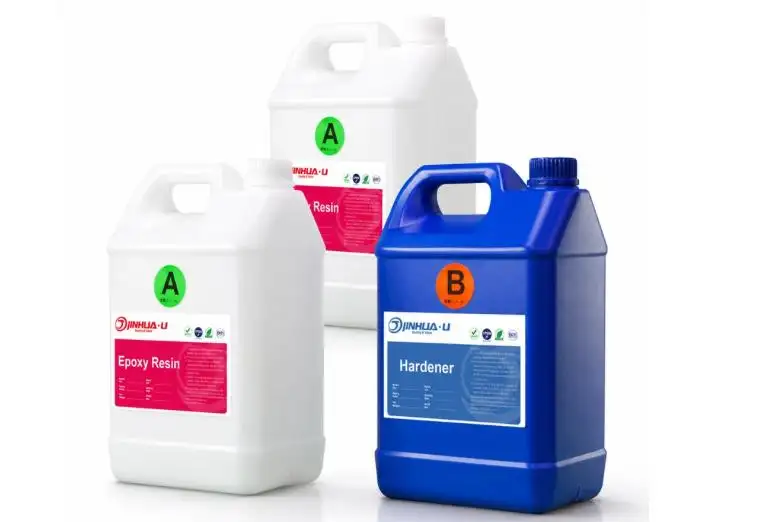
Yes. As a Wood Epoxy Resin Supplier, JINHUA supports OEM and ODM formulation development. Parameters such as viscosity, pot life, hardness, cure speed, mixing ratio and UV resistance can be adjusted for specific applications.
Q4. Does JINHUA provide both 2:1 and 3:1 epoxy resin systems?
Yes. JINHUA offers different resin-to-hardener ratios, including 2:1 and 3:1 systems. The appropriate ratio depends on casting depth, reaction speed, processing time and final performance requirements.
Q5. How does JINHUA control exotherm in deep-pour epoxy resin?
Deep-pour formulations use controlled curing chemistry to reduce excessive heat accumulation during thick casting. Correct pour depth, batch volume and ambient temperature are still important for stable curing.