



Updated 1 week ago
Industrial Floor Resin Manufacturer: Factory Capacity, OEM & Global Supply

hqt
Selecting an Industrial Floor Resin Manufacturer requires more than comparing price, hardness, or production capacity. Industrial floors operate under very different loads, traffic patterns, chemical exposures, substrate conditions, and installation schedules. A resin that performs well in a warehouse may not be suitable for a quartz aggregate floor, food-processing area, or heavy machinery zone.
From JINHUA's manufacturing perspective, the more practical approach is to connect four factors:
• Application conditions
• Resin formulation
• Controlled production
• Repeatable global supply
For international buyers, these factors determine whether an Industrial Floor Resin Manufacturer can support not only the first order, but also long-term project consistency.
Factory Capacity Must Support Process Stability
Large capacity is useful, but capacity alone does not prove resin quality.
A professional Industrial Floor Resin Manufacturer should use production scale to improve repeatability, delivery reliability, and control across multiple batches.
JINHUA operates a 20,000 m² manufacturing facility, with 8 automated production lines and annual production capacity exceeding 10,000 tons. Its R&D team includes more than 20 technical personnel supporting formulation development, pilot production, and mass manufacturing.
For buyers, these capabilities matter in several ways:
| Manufacturing Capability | Practical Impact |
| Automated production | Reduces dosing and mixing variation |
| High annual capacity | Supports project and distributor demand |
| Pilot production | Allows formulation verification before scale-up |
| R&D support | Enables resin modification for specific applications |
| Batch testing | Improves repeat-order consistency |
The key point is that factory scale should support process control—not replace it.
Industrial Floor Resin Formulation Should Match the Application
An experienced Industrial Floor Resin Manufacturer should not recommend one "standard epoxy" for every project.
Different floor systems create different technical priorities.
Warehouses and Logistics Floors
Typical requirements include:
• Forklift abrasion resistance
• Point-load resistance
• Rolling traffic durability
• Controlled cure time
• Good adhesion to prepared concrete
Manufacturing Plants
Additional requirements may include:
• Resistance to oils and process chemicals
• Impact tolerance
• Thermal or mechanical stress
• Reduced maintenance intervals
Colored Quartz and Aggregate Floors
These systems require another set of properties:
• Low enough viscosity for aggregate wetting
• Sufficient open time for mixing and troweling
• Strong resin-to-quartz bonding
• Controlled transparency
• Low void formation
• Stable cure profile
This is why JINHUA treats formulation as an application-driven process rather than simply increasing hardness.
Key Resin Parameters That Require Engineering Control
For an Industrial Floor Resin Manufacturer, several formulation variables directly influence installation and service performance.
| Parameter | Technical Effect | Risk if Poorly Controlled |
| Viscosity | Wetting, penetration, leveling | Poor aggregate wetting or difficult application |
| Pot life | Available installation time | Cold joints or incomplete placement |
| Cure speed | Return-to-service time | Delayed operation or excessive exotherm |
| Hardness | Surface resistance | Excess brittleness if over-prioritized |
| Flexibility | Stress accommodation | Cracking under substrate movement |
| A/B ratio | Crosslinking reaction | Incomplete cure or soft surface |
| Transparency | Decorative appearance | Cloudiness in colored sand floors |
| Yellowing resistance | Long-term appearance | Visual degradation |
JINHUA supports customization of viscosity, hardness, working time, curing time, A/B ratio, flowability, transparency, flexibility, and other application parameters.
For OEM buyers, this is more meaningful than simply selecting a resin from a catalog.
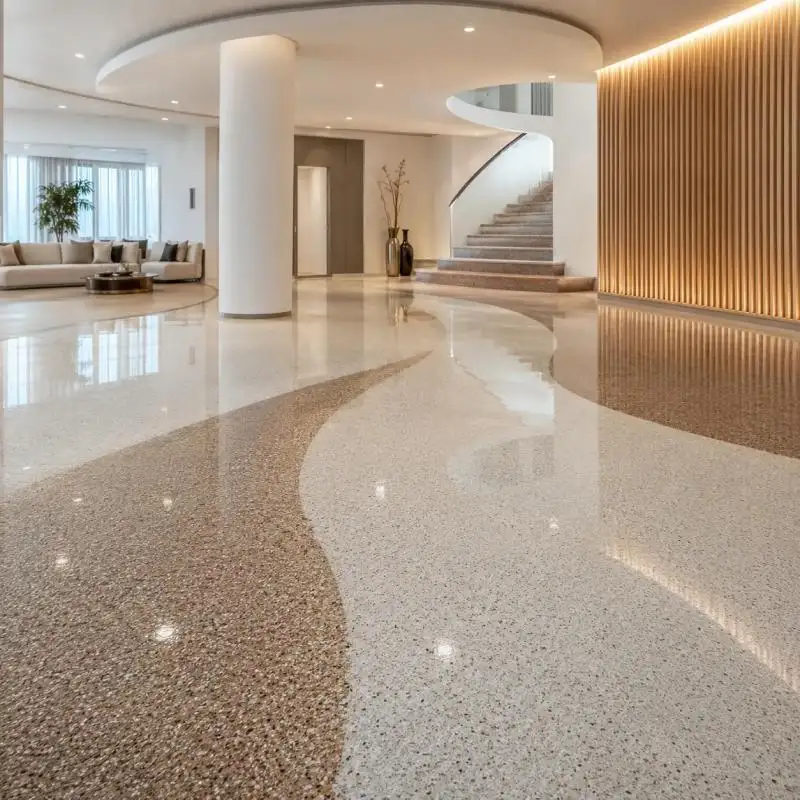
Colored Sand Flooring Demonstrates Application-Specific Resin Design
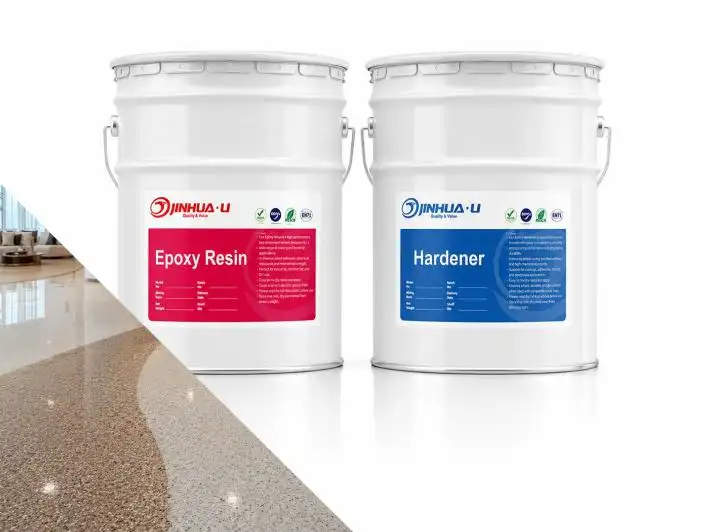
JINHUA's Epoxy Colored Sand Floor Coating is a useful example of how formulation changes according to flooring structure.
In a colored sand floor, epoxy resin is not merely a surface coating. It becomes the continuous matrix connecting graded quartz aggregate.
The resin must:
• Wet the quartz surface effectively
• Fill part of the void structure
• Maintain workable troweling characteristics
• Bond aggregate into a dense matrix
• Transfer compressive and traffic loads
• Preserve the visual effect of colored quartz
JINHUA uses a solvent-free, transparent, low-viscosity epoxy system with colored quartz sand. This design helps produce a dense, seamless industrial floor rather than a simple thin-film coating.
Mechanical Performance Must Be Read as a System
A common purchasing mistake is to judge industrial floor resin by one number.
For example, high compressive strength is important, but real flooring performance also depends on:
• Concrete substrate condition
• Surface preparation
• Primer compatibility
• Resin-to-aggregate ratio
• Layer thickness
• Moisture conditions
• Cure temperature
• Installation quality
JINHUA reports compressive strength of at least 70 MPa for its cured colored sand flooring system.
This level of strength is relevant for areas exposed to:
• Forklift traffic
• Machinery loads
• Dense pedestrian traffic
• Warehouse operations
• Industrial workshops
However, an Industrial Floor Resin Manufacturer should also explain that resin strength cannot compensate for poor concrete preparation, contamination, or excessive substrate moisture.
Batch-to-Batch Consistency Is Critical for Bulk Supply
For overseas buyers, one good laboratory sample is not enough.
Repeat orders must maintain similar:
• Viscosity
• Mixing behavior
• Cure response
• Hardness
• Appearance
• Transparency
• Working time
JINHUA applies quality control across the production sequence:
Raw Material Inspection → Formulation → Mixing → In-Process Control → Filling → Batch Testing → Packaging
This is especially important for contractors and distributors because small formulation changes can alter application speed, leveling behavior, and final cure performance.
A reliable Industrial Floor Resin Manufacturer should therefore be evaluated on process consistency as much as initial product data.
OEM Capability Should Include Chemistry, Not Only Packaging
Many suppliers describe private-label packaging as OEM. From a technical perspective, this is incomplete.
A proper OEM development process should include:
1.Define the application
2.Warehouse, factory, quartz flooring, decorative floor, or commercial system.
3.Set technical targets
4.Viscosity, cure speed, hardness, transparency, working time, and mechanical requirements.
5.Prepare laboratory formulation
6.Conduct sample application testing
7.Adjust formulation based on results
8.Run pilot production
9.Validate repeatability before mass production
10.Finalize packaging, labeling, and private branding
At JINHUA, OEM/ODM can extend beyond packaging into actual formulation adjustment.
Global Supply Is Part of Manufacturing Performance
An Industrial Floor Resin Manufacturer serving international markets must also manage supply risk.
Buyers should evaluate:
• Export packaging
• Documentation
• Sample support
• Repeat-order consistency
• Technical communication
• Logistics coordination
• Lead-time control
• Long-term formulation stability
JINHUA works with more than 2,000 partners across over 70 countries and regions, supporting product sampling, customized packaging, OEM/ODM, technical communication, and international supply.
Final Considerations
For JINHUA, industrial floor resin manufacturing is not simply about producing epoxy in volume. The more important objective is to match formulation behavior with real application conditions and then reproduce that performance consistently at manufacturing scale.
For projects involving colored quartz, heavy-duty industrial floors, or aggregate-based systems, buyers can review JINHUA's Epoxy Colored Sand Floor Coating and discuss application conditions, formulation requirements, sample testing, and production planning before moving to bulk supply.
FAQs
Q1. Is JINHUA an Industrial Floor Resin Manufacturer in China?
Yes. JINHUA manufactures epoxy resin systems for industrial flooring applications and supports both standard products and application-specific formulation development.
Q2. Can JINHUA customize industrial floor resin formulations?
Yes. JINHUA supports OEM/ODM customization covering viscosity, hardness, curing time, working time, A/B ratio, flowability, transparency, flexibility and other application parameters.
Q3. What types of industrial flooring projects can JINHUA support?
JINHUA can support flooring applications such as factories, warehouses, workshops, commercial areas and colored quartz aggregate floor systems.
Q4. Does JINHUA offer epoxy resin for colored sand flooring?
Yes. JINHUA supplies a solvent-free, transparent, low-viscosity epoxy colored sand floor coating designed to bind graded colored quartz aggregate into a dense flooring structure.
Q5. What is the compressive strength of JINHUA's epoxy colored sand flooring system?
JINHUA states that the cured system can achieve compressive strength of 70 MPa or higher, making it suitable for many heavy-duty industrial flooring environments.