




Concrete dust in a factory is often treated as a cleaning problem. In reality, repeated dusting can indicate deterioration of the concrete surface itself.
Forklift tires, carts, pallets and foot traffic gradually abrade weak cement paste and laitance. Sweeping removes the particles already released, but it does not stop the floor from producing more.
A properly designed Dustproof Epoxy Floor Coating works differently: it stabilizes a prepared substrate and creates a continuous resin barrier between the concrete and mechanical traffic. The key, however, is selecting the right flooring system rather than simply applying epoxy over a dusty slab.
Why Industrial Concrete Keeps Producing Dust
Industrial concrete can begin dusting because of:
•Weak or poorly cured surface cement paste;
•Laitance remaining on the slab;
•Porous concrete exposed to repeated traffic;
•Forklift turning and braking forces;
•Pallet dragging and machinery movement;
•Surface deterioration caused by oils or process chemicals.
One practical test is to clean a small area thoroughly and monitor it. If fine mineral powder repeatedly appears along wheel tracks or traffic lanes, deterioration of the concrete surface is likely contributing to the problem.
External production dust is different. A Dustproof Epoxy Floor Coating can control particles released from the floor, but it cannot eliminate airborne dust generated by cutting, grinding or manufacturing processes.
How Dustproof Epoxy Floor Coating Stops Concrete Dust
Dust control depends on both the substrate and the resin system.
Primer Penetration and Mechanical Anchoring
Before coating, grinding or shot blasting should remove loose laitance, weak material and contamination. The prepared surface allows the primer to wet the concrete and penetrate accessible pores.
The sequence is essentially:
Sound Concrete → Suitable Surface Profile → Primer Wetting → Resin Anchoring → Continuous Protective Layer
Applying epoxy directly over a powdery surface can produce misleading results. The epoxy may bond strongly to the top layer while that weak layer later separates from the concrete beneath it.
Continuous Resin Film Formation
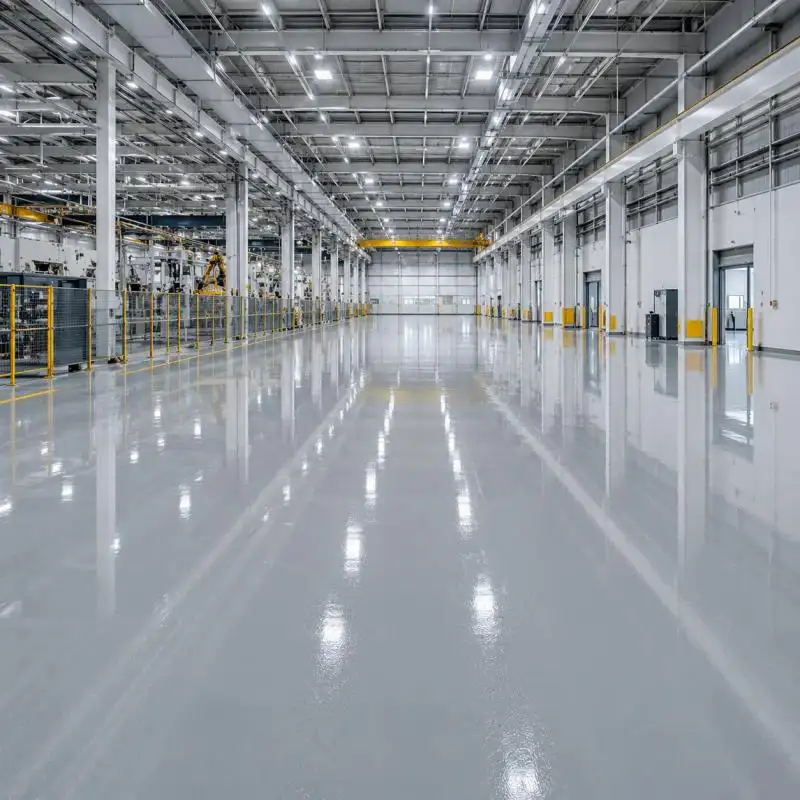
After curing, Dustproof Epoxy Floor Coating creates a dense film that isolates the cementitious surface from wheels, footwear and cleaning equipment.
JINHUA's industrial epoxy is a two-component, solvent-free system containing epoxy resin, curing agents and functional fillers. It is designed to cure into a hard, dense and seamless surface for indoor industrial applications.
The result is not simply "less visible dust." The objective is to interrupt the mechanism that continuously generates concrete particles.
Densifier, Thin Epoxy or High-Build Epoxy?
Not every dusty concrete floor needs the same treatment.
| System | Main Purpose | Better Fit | Key Limitation |
| Concrete densifier | Strengthen the cementitious surface | Basic dust suppression, light traffic | Limited barrier protection |
| Thin-film epoxy | Seal and protect concrete | Light industrial areas | Smaller wear reserve |
| High-build epoxy | Dust control plus mechanical protection | Warehouses and production floors | Higher preparation/material demand |
| Polyurethane | Flexible, abrasion-resistant protection | High-impact or intensive traffic | Different system chemistry |
| Polyaspartic | Fast return to service and UV stability | Renovation, outdoor or fast-track projects | Cost/application requirements |
A densifier may be sufficient where the main problem is mild concrete dusting and the owner wants to retain a natural concrete appearance.
A Dustproof Epoxy Floor Coating becomes more relevant when the floor also requires a continuous barrier against oil, contamination and repeated industrial cleaning.
Match Dustproof Epoxy Floor Coating to the Traffic Load
The same coating build should not automatically be specified throughout a facility.
Light Storage and Pedestrian Areas
Priorities normally include:
•Dust suppression;
•Easy cleaning;
•Economical material consumption;
•Smooth surface finish.
A thin-film epoxy system may be sufficient if the substrate is sound.
Warehouses and Forklift Routes
Forklift areas introduce concentrated wheel loads and turning abrasion. Loading zones and aisle intersections often deteriorate faster than static storage zones.
System design should therefore consider:
•Forklift weight and frequency;
•Wheel type;
•Turning and braking zones;
•Pallet dragging;
•Impact exposure;
•Expected maintenance intervals.
High-build Dustproof Epoxy Floor Coating provides more wear reserve, but thickness alone does not guarantee service life. Resin chemistry, filler system, abrasion resistance, substrate strength and traffic intensity must be considered together.
When Polyurethane Is the Better Engineering Choice
This is an important system boundary.
JINHUA's polyurethane industrial flooring is based on polyol resins and polyisocyanate curing agents. Unlike rigid epoxy, chemical crosslinking produces a more elastic coating with high abrasion resistance, impact tolerance and weather resistance. JINHUA also positions polyurethane for chemically demanding and heavy-duty industrial environments.
That means the decision should not be simplified to "epoxy is better."
Epoxy is typically attractive when hardness, concrete adhesion, seamless finishing and indoor durability are priorities.
Polyurethane becomes relevant where the floor requires greater flexibility, impact resistance, intensive abrasion or improved weather performance.
Polyaspartic systems are another option when rapid curing, UV stability, low-temperature application or reduced shutdown time is important.
The Parameters That Determine Whether the Coating Will Last
A professional Dustproof Epoxy Floor Coating specification should evaluate several linked parameters.
| Parameter | Why It Matters |
| Concrete strength | Weak substrate may fail beneath the coating |
| Surface profile | Controls mechanical anchorage |
| Concrete moisture / RH | Excess moisture can contribute to debonding |
| Surface porosity | Influences primer absorption |
| Volume solids | Affects final film build |
| WFT / DFT | Controls installed protection thickness |
| Pot life | Determines workable application time |
| Recoat window | Controls interlayer bonding |
| Abrasion resistance | Important under mechanical traffic |
| Pull-off adhesion | Evaluates coating/substrate integrity |
For example:
DFT ≈ WFT × Volume Solids
This relationship demonstrates that two products with the same wet film thickness application can yield distinct final dry film builds.
Higher application temperatures can affect both pot life and cure rate. Therefore, application conditions and the guide attached by the manufacturer should be reviewed in combination.
Moisture and Surface Preparation Are Major Failure Risks
Concrete that looks dry can still contain inner moisture.
In order to evaluate the relative humidity within concrete, ASTM F2170 employs in-situ probes. ASTM recognizes that if moisture content of a concrete slab is excessive, it can result in the debonding of coatings and other deterioration of flooring systems.
Common causes of premature Dustproof Epoxy Floor Coating failure include:
•Coating over dust or oil;
•Insufficient grinding or shot blasting;
•Weak laitance remaining on the surface;
•Excessive substrate moisture;
•Incorrect component ratio;
•Applying material beyond pot life;
•Missing the specified recoat window;
•Allowing forklifts back before sufficient cure.
Touch-dry time should never be confused with full mechanical service cure.
Verify Performance, Not Just Marketing Claims
Industrial buyers should request test methods as well as performance numbers.
ASTM D4060-25 is used for evaluating abrasion resistance using a Taber Abraser, but results depend on test conditions such as abrasive wheels and specimen characteristics.
For adhesion to concrete, ASTM D7234 evaluates pull-off strength and identifies failure within the coating/substrate system.
For JINHUA, a Dustproof Epoxy Floor Coating is not intended to solve every flooring problem with one chemistry. Its current industrial flooring range includes epoxy, polyurethane and polyaspartic systems, allowing the resin technology to be matched to indoor hardness, heavy abrasion, flexibility, weather exposure or rapid installation requirements.
The correct starting point is therefore not price per kilogram. It is the actual concrete condition, traffic pattern, chemical exposure, required surface finish and maintenance strategy.
For warehouses, workshops and industrial concrete floors where dust control and a dense seamless surface are priorities, buyers can review JINHUA Dustproof Epoxy Floor Coating solutions and discuss substrate conditions and operating loads before selecting the final flooring system.
FAQs
Q1. What is JINHUA Dustproof Epoxy Floor Coating designed for?
JINHUA Dustproof Epoxy Floor Coating is designed for industrial concrete floors that require dust control, a dense seamless surface, easier cleaning and improved resistance to routine mechanical wear.
Q2. Where can JINHUA Dustproof Epoxy Floor Coating be used?
Typical applications include warehouses, workshops, manufacturing facilities, storage areas and other indoor industrial concrete floors where surface dusting and wear need to be controlled.
Q3. Is JINHUA epoxy flooring suitable for forklift traffic?
It can be used in industrial traffic areas, but the coating system should be selected according to forklift frequency, turning zones, wheel loads, substrate strength and required film build. Heavy-duty areas may require a higher-build or alternative resin system.
Q4. Does JINHUA Dustproof Epoxy Floor Coating simply cover concrete dust?
No. Proper dust control requires removal of weak laitance and contamination before coating. The primer and epoxy system then bond to prepared concrete and form a continuous protective surface that reduces further particle release.
Q5. Is JINHUA epoxy flooring solvent-free?
JINHUA describes its industrial epoxy flooring as a two-component, solvent-free epoxy system. However, solvent-free should not automatically be interpreted as zero-VOC unless supported by the specific product TDS or test report.