



Updated 1 week ago
Custom Epoxy Resin Manufacturer for Private Label & OEM Products

hqt

Launching a private label epoxy resin product involves far more than changing a bottle, adding a logo, or selecting a standard resin from a catalog.
For distributors, coating brands, craft-resin sellers, composite-material suppliers, and industrial buyers, the more important question is whether the resin formulation can deliver repeatable performance under real application conditions.
As a Custom Epoxy Resin Manufacturer, JINHUA approaches private label development from the formulation side first: define the application, establish target performance, verify the resin system, and only then finalize packaging and branding.
This sequence reduces the risk of developing an attractive product that performs inconsistently after market launch.
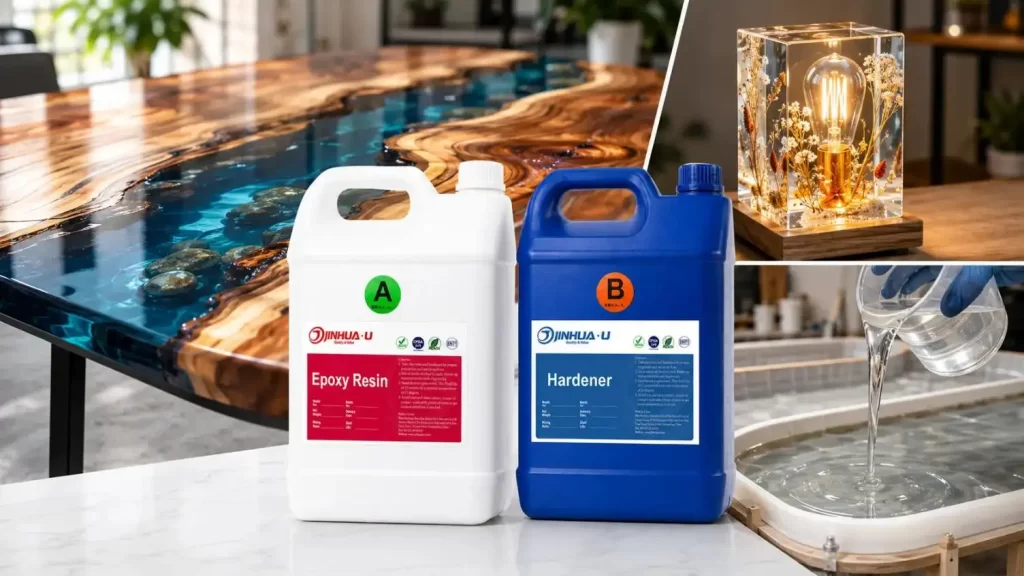
Private Label Epoxy Resin Starts With Technical Specifications
A professional private label project normally contains two interconnected layers:
Product engineering: resin chemistry, curing behavior, viscosity, hardness, clarity, and application performance
Brand engineering: container size, A/B packaging ratio, labels, instructions, cartons, and market positioning
A Custom Epoxy Resin Manufacturer should therefore be able to work beyond simple relabeling.
| Development Area | Typical Variables |
| Mixing Ratio | 1:1, 2:1, 3:1, 4:1 or application-specific |
| Mixed Viscosity | Flow, penetration, wetting and leveling |
| Working Time | Available application window |
| Cure Profile | Gel time, handling cure and full cure |
| Mechanical Performance | Shore hardness, flexibility and strength |
| Optical Performance | Transparency and yellowing resistance |
| Application Behavior | Bubble release, wetting, leveling, exotherm |
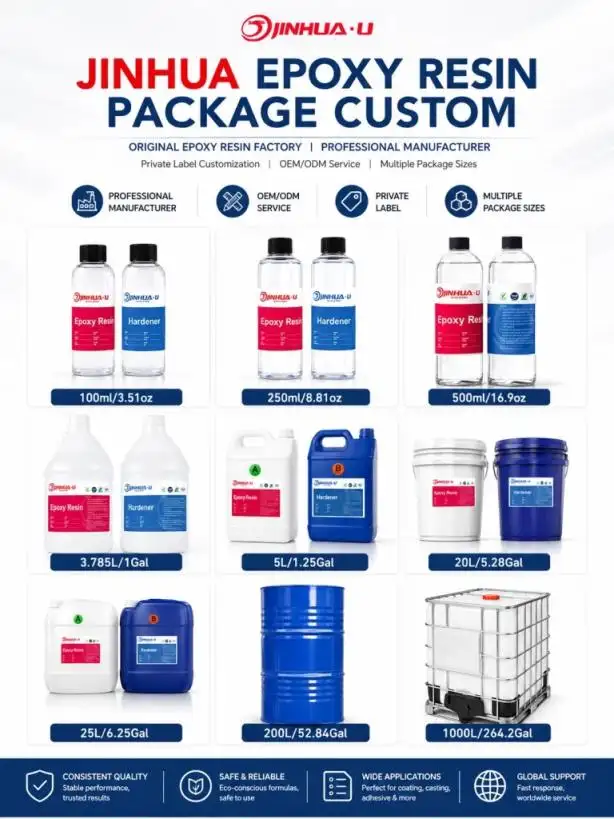
| Packaging | Bottles, jugs, pails and A/B kits |
| Branding | Logo, label, instructions and cartons |
For JINHUA, these parameters can be considered together rather than treating formulation and packaging as separate projects.
Step 1: Define the Final Application
The first task for a Custom Epoxy Resin Manufacturer is understanding how the customer will actually use the resin.
A deep-pour table system, for example, should not be formulated like an electronic potting compound. Likewise, a composite laminating resin requires different flow and wetting characteristics from a decorative coating resin.
| Application | Critical Technical Requirements |
| Art & Craft | High clarity, bubble release, surface finish |
| Deep Pour | Low exotherm, long pot life, controlled cure |
| Flooring | Adhesion, hardness, abrasion resistance |
| Composites | Fiber wet-out, mechanical strength, processing time |
| Electronic Potting | Low void formation, flowability, reliable cure |
| Coating / Doming | Controlled viscosity, leveling, appearance |
JINHUA's epoxy range covers these different application categories, allowing formulation selection to begin with actual use conditions rather than a generic "one-resin-fits-all" approach.
Step 2: Engineer the Formula Around Processing Conditions
Once the application is clear, the next stage is translating end-use requirements into measurable resin parameters.
Mixing Ratio
A 1:1/2:1/3:1/4:1 ratio is not just a preference in packaging.
The ratio is impacted by:
• Resin and hardener chemistry
• Reactive equivalent balance
• Desired crosslink density
• Processing window
• Desired final properties of the cured material
Improper ratio can cause an incomplete cure, soft spots, sticking tack, and unpredictable changing performance.
Viscosity
Viscosity affects much more than how "thick" the resin feels.
Lower-viscosity systems can improve:
• Fiber impregnation
• Bubble escape
• Penetration into small cavities
• Potting around electronic components
• Flow through complex geometries
Higher or controlled viscosity may be preferable for doming, surface coatings, edge retention, and applications where excessive flow is undesirable.
Pot Life and Cure Profile
One of the most important distinctions in custom epoxy development is:
Pot life ≠ full cure time.
A formulation that cures rapidly may improve throughput but can also:
• Reduce working time
• Increase exothermic heat
• Create excessive temperature rise in thick sections
• Increase shrinkage or internal stress
• Limit bubble-release time
A competent Custom Epoxy Resin Manufacturer therefore balances curing speed against application thickness, ambient temperature, working time, and production efficiency.
Step 3: Treat Packaging as Part of Product Engineering
Packaging should be designed around the chemistry—not added after the formulation is finished.
For example, a 2:1 system should use A/B container sizes that help the end user maintain the intended ratio.
Important packaging considerations include:
• Resin-to-hardener volume relationship
• Filling tolerance
• Container chemical compatibility
• Leakage resistance
• Batch traceability
• Storage conditions
• User instructions
• Outer-carton protection
For private label programs, JINHUA can integrate formula selection with branded packaging so that the physical kit matches the actual resin system.
Step 4: Validate the Product Before Scale-Up
A private label sample should not be approved only because its laboratory data looks acceptable.
The resin should be tested under the customer's real application conditions.
A practical development route is:
Application Requirement → Target Specification → Lab Sample → Application Test → Formula Adjustment → Packaging Test → Pilot Batch → Mass Production
During sample validation, buyers should evaluate factors such as:
• Actual working time
• Mixed viscosity
• Bubble release
• Surface finish
• Cure development
• Hardness
• Transparency
• Heat generation
• Application-specific defects
This stage is particularly important because laboratory values do not always predict how a resin behaves in a thick casting, laminate, floor coating, or potting cavity.
Step 5: Control Batch-to-Batch Consistency
For a private label brand, successful sampling is only the beginning.
The bigger manufacturing challenge is reproducing the approved formulation consistently over hundreds or thousands of kits.
A Custom Epoxy Resin Manufacturer should control:
• Incoming raw materials
• Formula weighing accuracy
• Mixing conditions
• Production temperature
• Intermediate inspection
• Filling accuracy
• Packaging
• Final batch testing
Key release parameters may include viscosity, color, clarity, cure behavior, hardness, appearance, and A/B component consistency.
At JINHUA, production control runs from raw-material inspection through formulation, mixing, filling, packaging, and final testing, helping reduce variation between sample approval and commercial production.
How Buyers Should Evaluate a Custom Epoxy Resin Manufacturer
Choosing a supplier only by price per kilogram can create hidden costs later.
| Evaluation Factor | What to Verify |
| R&D Capability | Can the formula actually be modified? |
| Application Knowledge | Does the factory understand the final process? |
| Sampling | Can prototypes be tested before bulk production? |
| Formula Control | Can viscosity, pot life and hardness be adjusted? |
| Private Label Capability | Can packaging and branding match the formula? |
| Production Capacity | Can supply scale as sales increase? |
| QC System | Are critical parameters controlled per batch? |
| Technical Support | Can field problems be analyzed after launch? |
Poor curing, inconsistent viscosity, excessive yellowing, bubbles, leakage, or batch variation can cost far more than a small difference in resin price.
JINHUA's Role as a Custom Epoxy Resin Manufacturer
JINHUA has manufactured epoxy resin since 2009 and operates a 20,000 m² manufacturing facility with eight automated production lines, annual capacity exceeding 10,000 tons, and an R&D team of more than 20 people.
From our perspective as a Custom Epoxy Resin Manufacturer, private label development should connect four capabilities:
• Formulation development
• Application testing
• Private label packaging
• Scalable batch production
JINHUA supports adjustment of parameters including mixing ratio, viscosity, curing time, working time, hardness, flexibility, transparency, yellowing resistance, packaging, and labeling.
Build the Brand Around a Reliable Resin System
A stronger private label development sequence is:
Application → Performance → Formula → Testing → Packaging → Branding → Production
For buyers developing branded epoxy products, working directly with a Custom Epoxy Resin Manufacturer can make formulation, testing, packaging, and production easier to coordinate within one manufacturing process.
JINHUA provides custom epoxy resin systems for multiple industrial and commercial applications together with OEM, private label, sampling, and scalable manufacturing support. Explore JINHUA Epoxy Resin Solutions to evaluate suitable options for your next branded epoxy product.
FAQs
Q1. Does JINHUA provide samples before bulk production?
Yes. Samples can be used to verify viscosity, pot life, curing behavior, hardness, appearance, transparency, and application performance before moving into pilot or mass production.
Q2. Does JINHUA provide private label epoxy resin services?
Yes. JINHUA supports private label epoxy resin projects, including custom formulations, branded labels, logos, packaging sizes, product instructions, and outer cartons according to customer requirements.
Q3. Can JINHUA customize epoxy resin formulations?
Yes. Depending on the application, JINHUA can develop or adjust parameters such as mixing ratio, viscosity, working time, curing time, hardness, flexibility, transparency, and yellowing resistance.
Q4. What epoxy resin applications does JINHUA support?
JINHUA supplies epoxy resin systems for applications including art and crafts, river tables, deep pouring, flooring, composite materials, electronic potting, coating, doming, and other industrial uses.
Q5. Can JINHUA customize the epoxy resin mixing ratio?
Yes. As a Custom Epoxy Resin Manufacturer, JINHUA can provide different resin-to-hardener systems, including 1:1, 2:1, 3:1, 4:1, and application-specific formulations where technically appropriate.