



Updated 5 days ago
Private Label Doming Resin Packaging Trends: Small Kits, Bulk Packs and Brand Customization

hqt

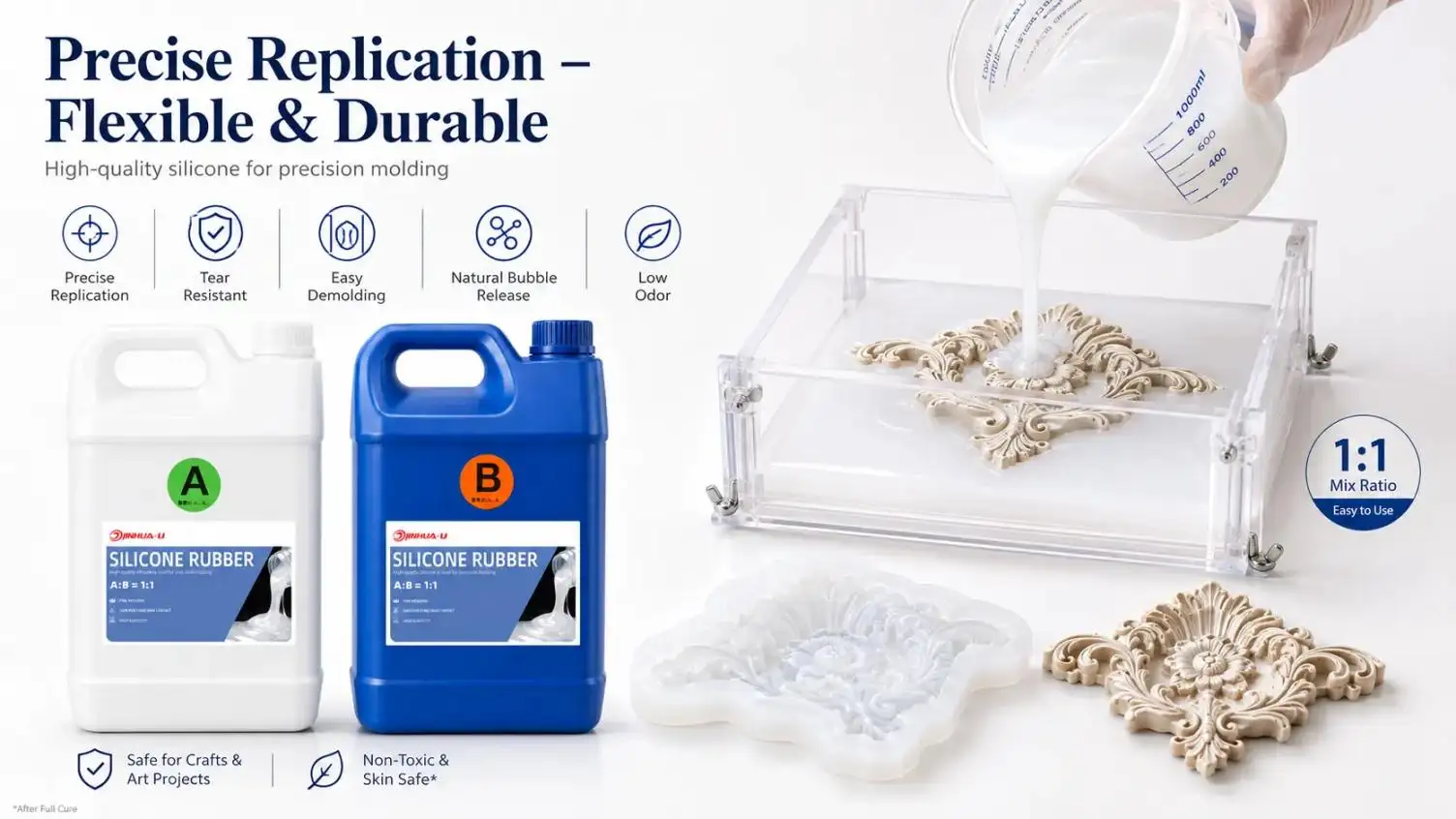
For a Private Label Doming Resin program, packaging is not only a branding decision. The package must support accurate A/B dosing, stable storage, efficient dispensing, safe transport and clear end-user instructions.
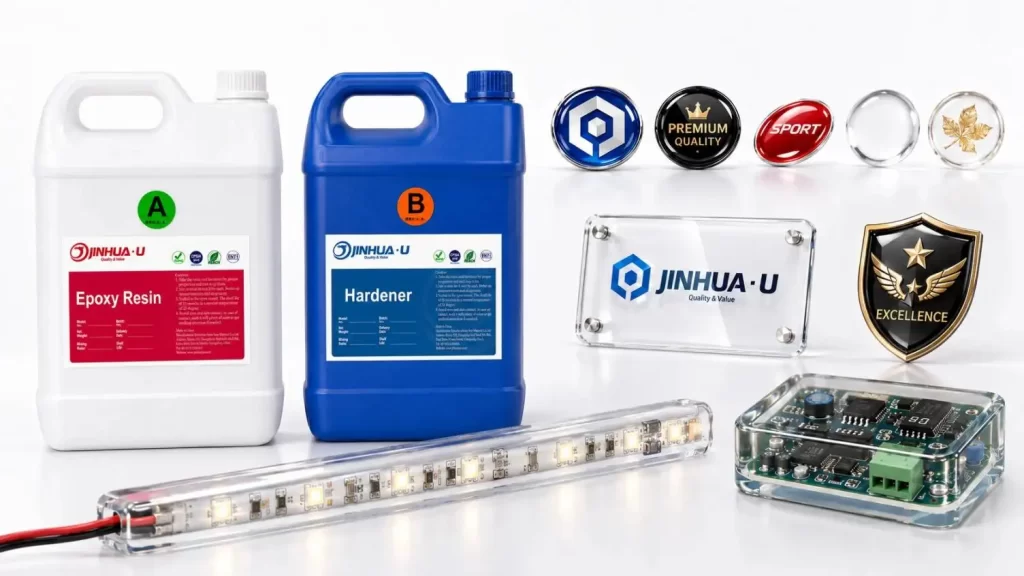
This is especially important for soft epoxy doming systems used for 3D stickers, badges, nameplates, labels and decorative resin drops. A packaging format that works well for a 500 g retail kit may be inefficient—or technically unsuitable—for a factory consuming several kilograms per shift.
From JINHUA's manufacturing perspective, Private Label Doming Resin packaging should therefore be designed around the resin chemistry and the customer's production process before bottle size, artwork or carton design is finalized.
Packaging Starts with the A/B Mixing System
JINHUA 308AB-3S1 soft epoxy doming resin uses an A mixing ratio of 3:1 by weight.
At 25°C, typical published parameters include:
| Parameter | Part A / System | Part B / System | Packaging Impact |
| Mixing Ratio | 3 | 1 | Determines paired fill weight |
| Viscosity | 550–750 cP | ≤150 cP | Affects pouring and pump selection |
| Specific Gravity | Approx. 1.07 | Approx. 0.96 | Affects weight-to-volume conversion |
| Pot Life | Approx. 50 min | — | Limits practical mixed batch size |
| Cure Time | 10–18 h at 25°C | — | Influences production scheduling |
| Hardness | Shore A 58–72 | — | Suitable for flexible doming applications |
A critical point is that 3:1 by weight is not the same as 3:1 by volume.
Because Part A and Part B have different densities, packaging should not encourage users to assume that equal bottle graduations represent the correct mixing ratio. For a Private Label Doming Resin, the label, measuring method and user instructions must all follow the validated dosing method.
Incorrect ratio control can lead to:
• Incomplete curing;
• Tacky or soft surfaces;
• Inconsistent hardness;
• Reduced optical clarity;
• Poor adhesion;
• Variation between production batches.
Small Kits Reduce Dosing Risk but Increase Packaging Cost
Small Private Label Doming Resin kits are suitable for retail brands, e-commerce sellers, sample programs and low-volume workshops.
Their main advantage is control. Part A and Part B can be packed in matched quantities, reducing the chance that users consume one component faster than the other.
Small kits are particularly useful when:
• Resin consumption is intermittent;
• Operators mix manually;
• Customers require simple instructions;
• Opened-container storage time should be minimized;
• Product consistency is more important than the lowest cost per kilogram.
However, small kits create more bottles, caps, labels, cartons and filling operations per kilogram of resin.
This means buyers should not compare resin price alone. A more realistic calculation is:
Resin Cost + Filling Cost + Container Cost + Label Cost + Carton Cost + Freight + Residual Waste
Medium Packs Often Provide the Best Balance
For small factories and professional workshops, medium-sized packs can offer a practical compromise between handling efficiency and inventory risk.
Compared with small kits, they reduce packaging frequency. Compared with drums or large pails, they are easier to weigh, move and reseal.
Medium packs are often appropriate when:
• Daily resin consumption is predictable;
• Operators use digital scales;
• Production remains partly manual;
• The container can be consumed within a reasonable period after opening.
For many Private Label Doming Resin customers, this format can reduce total packaging cost without introducing the metering complexity associated with bulk supply.
Bulk Packs Require Better Process Control
Bulk Private Label Doming Resin packaging is most suitable for continuous industrial production.
The benefit is not simply "lower cost." Bulk supply reduces container handling and allows resin to be integrated into metered dispensing systems.
However, it also transfers more responsibility to the production line.
Buyers should verify:
• Pump compatibility with Part A and Part B viscosities;
• Separate feed lines for each component;
• Metering accuracy;
• Hose and fitting resistance;
• Mixing-head design;
• Dead volume within the system;
• Prevention of A/B cross-contamination;
• Cleaning procedures during shutdown.
Because Part A is significantly more viscous than Part B, identical pump settings do not automatically produce the correct output ratio.
For automatic dispensing, the correct question is not simply whether a pump can move the resin, but whether the complete system can maintain the required 3:1 weight ratio consistently.
Match Packaging to the Dispensing Method
The packaging format should follow the actual dosing process.
| Dispensing Method | Best-Fit Packaging | Main Control Point |
| Manual weighing | Small or medium packs | Scale accuracy and operator discipline |
| Metered pumps | Medium or bulk packs | Pump calibration |
| Automatic dispensing | Bulk supply | Ratio stability at mixing head |
For manual production, pre-portioned or clearly labeled packaging reduces mistakes.
For automated production, container size becomes less important than flow consistency, pump compatibility and supply continuity.
This is why JINHUA recommends evaluating Private Label Doming Resin packaging together with the customer's dispensing method rather than treating packaging as a separate purchasing decision.
Pot Life Sets the Practical Mixing Limit
A common mistake is to connect package size directly to mixing batch size.
A 20 kg supply pack does not mean operators should mix several kilograms at one time.
The 308AB-3S1 system has an approximate pot life of 50 minutes. Practical working time may also change with mixed quantity, ambient temperature and heat accumulation.
A more reliable production sequence is:
• Determine hourly resin consumption;
• Define the practical dispensing rate;
• Calculate a safe mixed batch size;
• Then select the most suitable supply package.
This reduces waste and helps maintain more consistent doming quality.
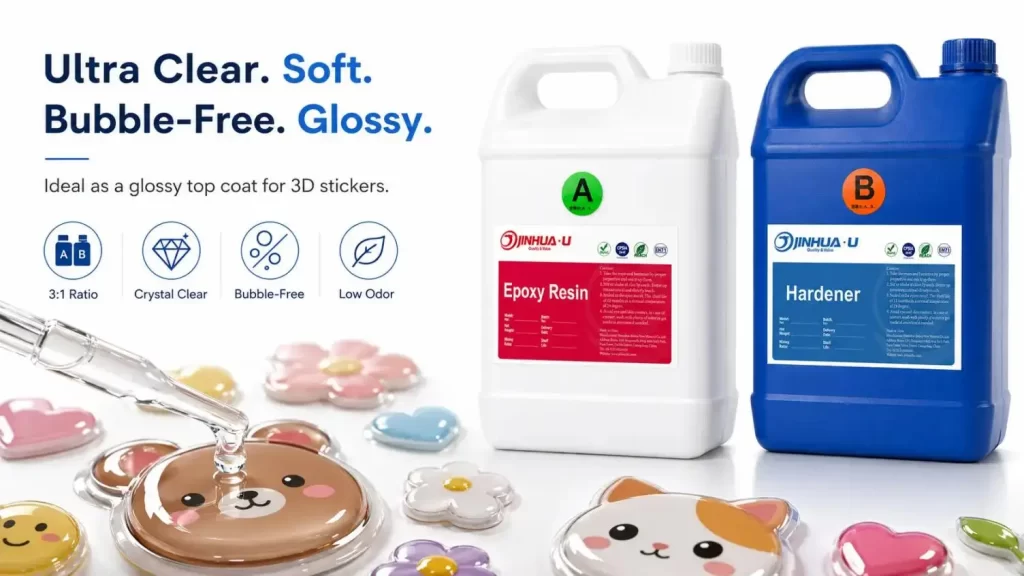
Storage and Resealing Affect Usable Resin Yield
For Private Label Doming Resin, inventory control should focus on usable material rather than only purchased weight.
Part A and Part B should be:
• Stored in a cool, dry environment;
• Protected from direct sunlight and excessive heat;
• Resealed immediately after dispensing;
• Kept free from moisture and foreign material;
• Handled with separate tools and transfer equipment.
Cross-contamination is particularly important. Even a small amount of the opposite component entering a storage container can create localized reaction or gel formation.
For bulk users, routine inspection of pumps, hoses, seals and fittings should therefore be part of the resin handling procedure.
Private Label Packaging Must Include Compliance Review
A Private Label Doming Resin package must also work as a technical and regulatory communication tool.
Depending on the destination market and chemical classification, buyers may need to verify:
• Product identification;
• Manufacturer or supplier information;
• Net quantity;
• Batch number;
• Mixing instructions;
• Storage conditions;
• Hazard pictograms;
• Signal words;
• Hazard and precautionary statements;
• UFI or other regional information where applicable.
Documents should also be reviewed before mass production, including:
• TDS;
• SDS for both components;
• COA requirements;
• Applicable test reports;
• Transport classification;
• Destination-market labeling requirements.
Private-label artwork should therefore be approved only after the technical label content has been confirmed.
Final Words
JINHUA's 308AB-3S1 soft epoxy doming resin provides a practical base for private-label applications requiring transparent, flexible doming performance. Its 3:1 weight ratio, controlled viscosity and Shore A 58–72 cured profile are suitable for applications such as 3D stickers, badges, signs and nameplates.
For buyers developing or upgrading a Private Label Doming Resin program, JINHUA can be evaluated not only as a resin supplier, but as a manufacturing partner for matching resin performance, packaging format and production requirements. Review the JINHUA Soft Epoxy Doming Resin specification as a starting point for your packaging and private-label project.
FAQs
Q1. Does JINHUA offer Private Label Doming Resin for OEM brands?
Yes. JINHUA supports OEM and private-label resin projects, including formula matching, packaging requirements, branding and production-related customization.
Q2. What mixing ratio does JINHUA 308AB-3S1 Soft Epoxy Doming Resin use?
The 308AB-3S1 system uses an A:B ratio of 3:1 by weight. Buyers should clearly distinguish weight-based dosing from volume-based mixing when preparing private-label instructions.
Q3. Can JINHUA customize packaging sizes for Private Label Doming Resin?
JINHUA supports packaging customization for OEM projects. The final package size should be selected according to sales channel, daily resin consumption, dosing method and shipping requirements.
Q4. Is JINHUA Private Label Doming Resin suitable for small retail kits?
Yes. Small matched A/B kits can be useful for retail, e-commerce, sample programs and low-volume users because they simplify handling and reduce opened-container storage.
Q5. Can JINHUA supply Private Label Doming Resin for industrial bulk use?
JINHUA can support larger-volume projects, but industrial buyers should confirm packaging, pump compatibility, metering accuracy and dispensing requirements before finalizing bulk supply.