





Higher-power EV charging creates a difficult materials problem: more electrical power must be handled in a smaller enclosure while transformers, inductors, DC/DC converters and power semiconductor modules continue to generate heat.
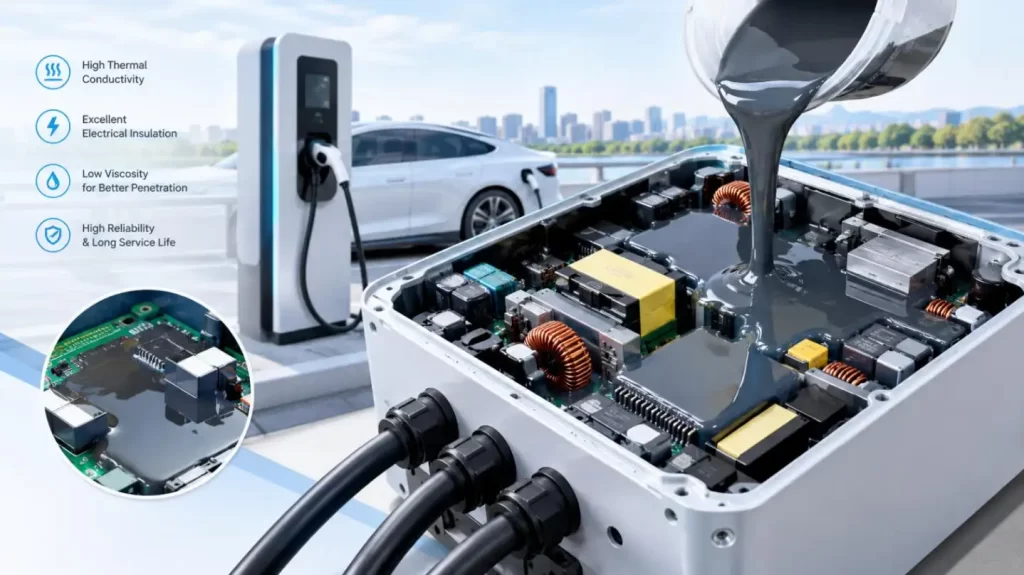
For JINHUA, the role of an Epoxy Potting Compound Supplier is therefore not simply to provide a two-component resin. The potting system must work as part of the charger's thermal path, electrical insulation system and mechanical protection structure.
Selecting the right material means balancing thermal conductivity with viscosity, dielectric performance, cure stress and production efficiency.
Why EV Charger Potting Requires a System-Level Approach
Inside a high-power charger, epoxy may surround components with very different thermal expansion rates and electrical requirements.
Typical design concerns include:
• Heat removal from transformers, inductors and power modules;
• Dielectric isolation between energized components;
• Penetration into narrow PCB and coil gaps;
• Vibration and mechanical fixation;
• Moisture and contamination resistance;
• Repeated heating and cooling during charging cycles.
This is why an experienced Epoxy Potting Compound Supplier should begin with the assembly and operating environment—not with one isolated resin specification.
| EV Charger Area | Primary Risk | Potting Priority |
| Power module | High local temperature | Thermal transfer + insulation |
| Transformer | Heat + high voltage | Dielectric strength + low voiding |
| Inductor/choke | Heat + vibration | Gap filling + mechanical support |
| Control PCB | Moisture/contamination | Low viscosity + encapsulation |
| DC/DC assembly | Dense geometry | Flowability + thermal cycling |
Thermal Conductivity Must Be Balanced With Processability
Increasing thermal conductivity usually requires adding ceramic or mineral fillers to the epoxy system. However, higher filler loading can change more than thermal performance.
In practical formulation work:
Higher Filler Loading → Higher Viscosity → More Difficult Dispensing → Greater Void Risk
The objective is therefore not simply the highest W/m·K value.
A usable formulation must provide sufficient heat transfer while still reaching narrow spaces around coils, leads, solder joints and PCB components.
An Epoxy Potting Compound Supplier should evaluate at least:
• Mixed viscosity at dispensing temperature;
• Thermal conductivity after cure;
• Filler sedimentation stability;
• Working time;
• Maximum casting thickness;
• Degassing requirements;
• Compatibility with automated dispensing equipment.
At JINHUA, viscosity, flowability, curing time, working time, hardness and formulation performance can be adjusted as part of OEM/ODM development.
Air Voids Can Defeat a High-Conductivity Formulation
A resin can show good laboratory thermal conductivity and still perform poorly inside an EV charger.
The reason is often the interface.
Air has very low thermal conductivity. Voids between epoxy and a transformer winding, PCB or metal housing interrupt the intended heat-transfer path. Poor wetting can create the same problem.
A robust potting process normally follows:
Metering → Mixing → Degassing → Dispensing → Penetration → Cure → Inspection
Key process controls include:
• Correct A mixing ratio;
• Controlled resin temperature;
• Vacuum degassing where required;
• Slow filling around complex geometries;
• Avoidance of excessive dispense height;
• Sufficient time for resin penetration before gelation.
This is where material formulation and production process must be developed together.
Electrical Insulation Cannot Be Sacrificed for Heat Transfer
EV charger electronics may operate around substantial voltage differences. A thermally conductive potting compound must therefore remain electrically insulating.
Important qualification data can include:
| Property | Engineering Purpose |
| Dielectric strength | Resistance to electrical breakdown |
| Volume resistivity | Bulk electrical insulation |
| Moisture absorption | Long-term insulation stability |
| Thermal conductivity | Heat-transfer capability |
| Adhesion | Interface reliability |
| Cure shrinkage | Stress control |
A professional Epoxy Potting Compound Supplier should not describe a grade only as “thermally conductive.” Thermal and electrical properties must be evaluated together.
CTE, Tg and Modulus Control Thermal-Cycling Stress
EV charger potting materials experience repeated temperature changes.
Copper, aluminum, PCB laminates, ceramics and cured epoxy expand at different rates. When the assembly heats and cools, this mismatch generates internal stress.
Three factors warrant some analysis:
• CTE — Coefficient of Thermal Expansion: Evaluates dimensional change due to temperature
• Tg — Glass Transition Temperature: Identifies when the polymer mechanical behavior starts to undergo significant changes.
• Modulus/Hardness: Influences the amount of stress that the cured resin will impart on the components.
Possible failure modes include:
• Resin cracking;
• Interface delamination;
• Solder-joint stress;
• PCB deformation;
• Moisture pathways created after cycling.
Therefore, increasing hardness is not automatically an improvement. JINHUA's formulation capability includes adjustment of hardness, flexibility, viscosity and cure behavior, allowing an application-specific balance rather than relying on a fixed general-purpose resin.
Pot Life, Cure Speed and Exotherm Affect Production
The curing system also determines whether a resin works on the production line.
A short pot life may improve throughput but make automated dispensing difficult. Conversely, a very long cure can increase work-in-process inventory.
Large-volume potting introduces another issue: exotherm. Epoxy curing is exothermic, and excessive resin mass can create a substantial temperature rise inside the casting.
An Epoxy Potting Compound Supplier should therefore discuss:
• Pot life at actual shop temperature;
• Cure schedule;
• Dispensing cycle;
• Maximum pour volume;
• Peak exotherm;
• Cure shrinkage;
• Post-cure requirements.
These factors become particularly important when moving from laboratory samples to full EV charger modules.
Epoxy vs. Polyurethane vs. Silicone for EV Chargers
Epoxy should not be selected automatically.
| Material | Main Advantage | Main Limitation | Typical Fit |
| Epoxy | Adhesion, rigidity, insulation, chemical resistance | Can create higher mechanical stress | Power modules, transformers, rigid electronics |
| Polyurethane | Greater flexibility | Thermal and chemical performance vary by formulation | Assemblies needing stress absorption |
| Silicone | Excellent flexibility across temperature cycles | Lower rigidity and often higher material cost | High thermal-cycling applications |
The correct decision depends on temperature range, vibration, thermal cycling, chemical exposure, mechanical stress, repairability and target cost.
A credible Epoxy Potting Compound Supplier should recognize when epoxy is appropriate—and when another chemistry may better suit the assembly.
What EV Charger Manufacturers Should Ask a Supplier
Before qualifying an Epoxy Potting Compound Supplier, engineering and sourcing teams should request data around:
• Thermal conductivity;
• Mixed viscosity;
• Dielectric strength;
• CTE and Tg;
• Hardness/modulus;
• Pot life and cure profile;
• Moisture resistance;
• Thermal-cycle performance;
• Batch consistency;
• Formulation customization.
Prototype modules should then be subjected to thermal, electrical, moisture and thermal-cycling validation before mass production.
JINHUA's Manufacturing Approach to Electronic Potting
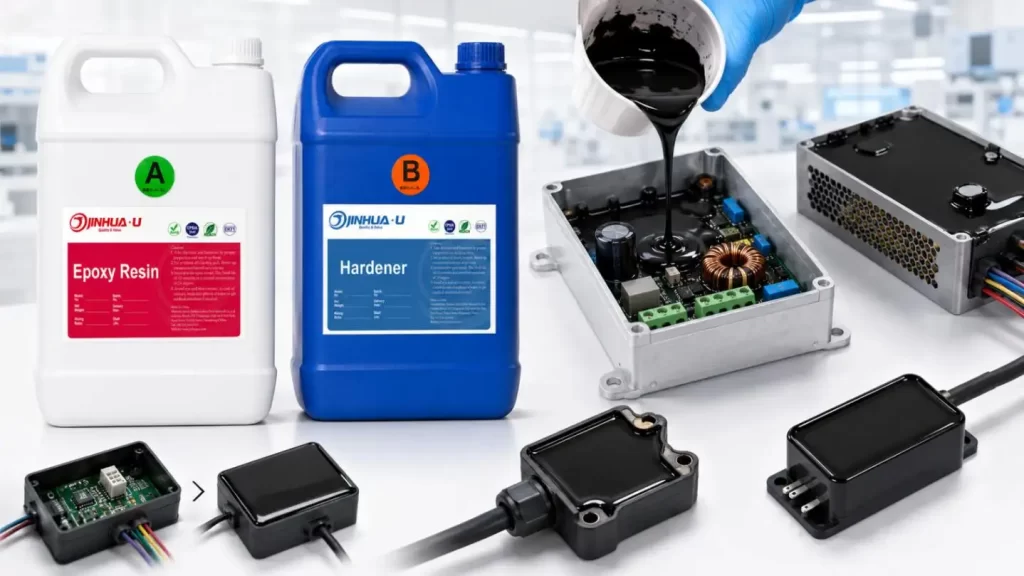
JINHUA develops epoxy resin systems and lists electronic potting resin among its industrial applications, including clear, black and customized systems for electronic insulation, protection, fixing and encapsulation.
From an Epoxy Potting Compound Supplier perspective, JINHUA combines formulation development with scalable manufacturing. Its stated manufacturing platform includes a 20,000 m² facility, eight automated production lines, annual capacity above 10,000 tons and an R&D team of more than 20 members.
Quality control covers raw-material inspection through formulation, mixing, filling and final batch testing, while formulation services include viscosity, curing time, hardness, flexibility and application-performance adjustments.
For EV charging projects, however, specific thermal-conductivity, dielectric and thermal-cycling targets should always be confirmed through the selected formulation's technical data and module-level validation.
Selecting an Epoxy Potting Compound Supplier for EV Charging
A successful EV charger potting material is not defined by one impressive number.
It requires a controlled balance of thermal conductivity, dielectric insulation, viscosity, void control, CTE, Tg, cure behavior, mechanical stress and production compatibility.
JINHUA can assist manufacturers of EV charger encapsulation systems in epoxy formulation, samples, and large-scale epoxy production. Contact JINHUA for epoxy resin solutions concerning the viscosity, curing profile, mechanical properties, and electronic potting for your specific project.
FAQs
Q1. Does JINHUA supply epoxy potting compounds for electronic applications?
Yes. JINHUA develops epoxy resin systems for electronic potting, encapsulation, insulation, fixing and environmental protection applications.
Q2. Can JINHUA customize epoxy potting compounds for EV charger electronics?
Yes. JINHUA can support formulation adjustments based on application requirements, including viscosity, curing behavior, hardness, flexibility and other processing characteristics.
Q3. Can JINHUA provide thermally conductive epoxy potting solutions?
JINHUA can evaluate formulation requirements for applications where thermal management is important. Specific thermal-conductivity targets should be confirmed through technical data, samples and application testing.
Q4. Can JINHUA adjust the viscosity of an epoxy potting compound?
Yes. Viscosity can be adjusted to support different dispensing processes, component gaps and potting geometries, subject to the overall formulation requirements.
Q5. Does JINHUA support low-viscosity epoxy for PCB and electronic module potting?
JINHUA can develop flowable epoxy systems for electronic encapsulation where penetration into narrow gaps and controlled filling are important.