



Updated 3 days ago
Liquid Silicone Rubber Supplier for Fine-Detail Mold Replication

hqt
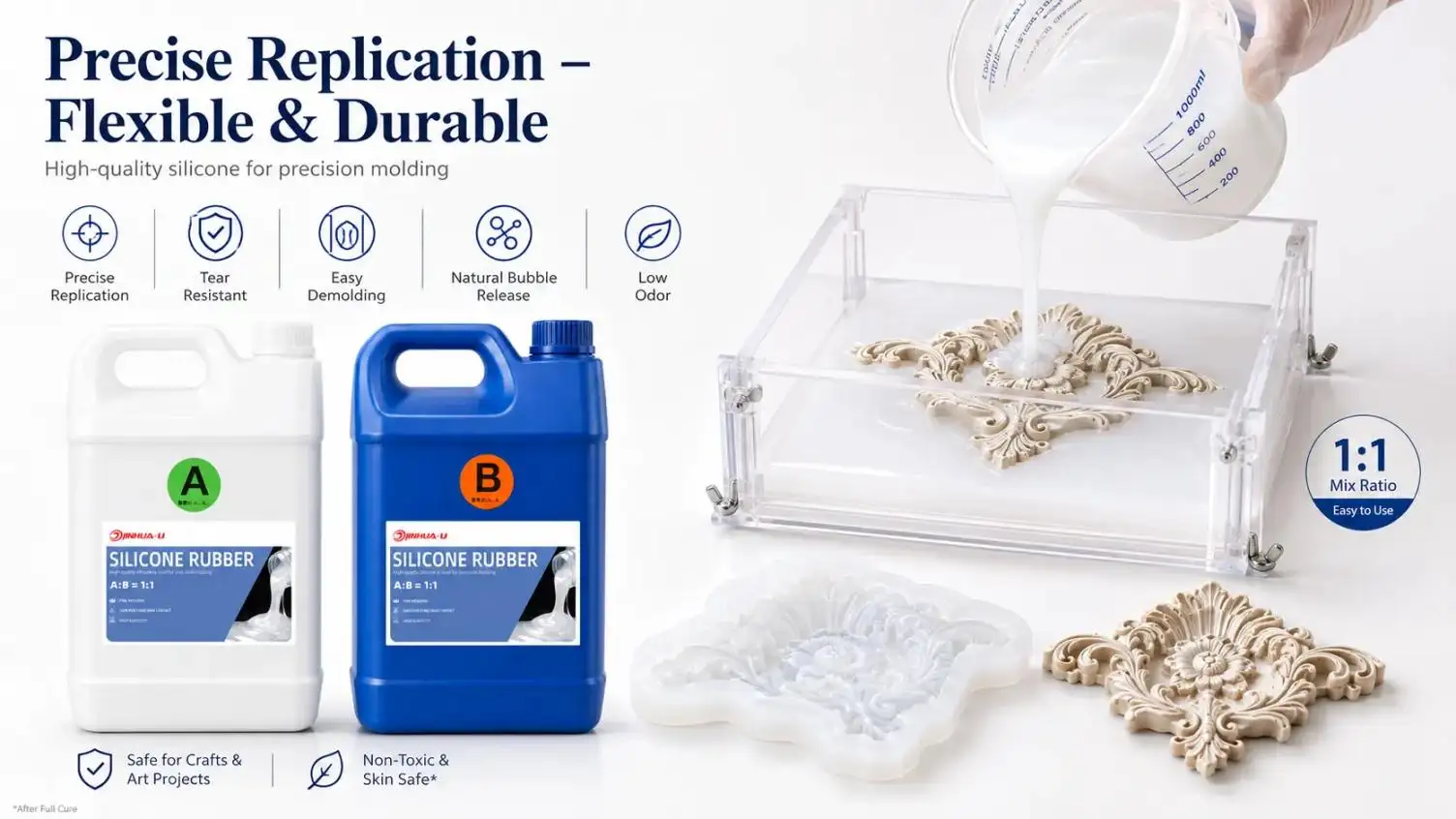
Fine-detail mold replication is not simply a matter of choosing the softest or lowest-viscosity silicone. In practical mold production, small lettering, textured surfaces, narrow grooves, sharp edges, and deep undercuts create different flow and demolding challenges.
From JINHUA's perspective as a Liquid Silicone Rubber Supplier, silicone selection should be treated as a complete processing decision:
Viscosity → Flowability → Working Time → Air Release → Temperature → Shore A → Tear Strength → Batch Consistency
A material that flows well but tears during demolding is unsuitable. Likewise, a mechanically strong silicone that cannot wet fine geometry before gelation may lose surface detail.
Viscosity Determines How Easily Silicone Enters Fine Geometry
Viscosity refers to the resistance of a fluid to flow; it has a unit of mPa·s or cP. It affects how well mixed material flows into fine channels and fills intricate patterns of the masters in mold lines.
| Material Behavior | Process Impact | Typical Concern |
| Lower viscosity | Easier filling of fine grooves | Leakage from poorly sealed mold boxes |
| Moderate viscosity | Balanced flow and handling | Suitable for many general molds |
| Higher viscosity | Greater resistance to movement | Air pockets and incomplete detail filling |
| Rapid viscosity build-up | Short effective filling window | Detail loss before gelation |
A qualified Liquid Silicone Rubber Supplier should therefore provide viscosity together with the test temperature and working-time conditions.
JINHUA's 717AB-F platinum-cured RTV-2 silicone has a listed dynamic viscosity of approximately 1500 ± 500 mPa·s, designed to provide relatively easy pouring and detail penetration for mold-making applications.
Flowability Is More Important Than a Single Viscosity Number
Viscosity is a laboratory measurement. Flowability describes actual behavior during processing.
Good flowability means the silicone can:
• Wet the master surface instead of bridging over fine structures
• Enter engraved lettering and narrow recesses
• Flow around corners and protrusions
• Self-level before gelation
• Allow entrapped air to migrate upward
For this reason, buyers comparing a Liquid Silicone Rubber Supplier should not select material from viscosity alone.
Important questions include:
• How quickly does viscosity increase after A/B mixing?
• Is the material sufficiently self-leveling?
• How long is the practical pouring window?
• Is vacuum degassing required for complex molds?
• How does the formulation behave around narrow and deep recesses?
Fine-Detail Replication Has Two Separate Requirements
At JINHUA, we consider fine-detail reproduction as a two-stage engineering problem.
1. Liquid-Stage Replication
Before the silicone is cured, it must reach every necessary feature.
The important features are:
• Initial viscosity
• Surface wetting
• Flowability
• Working time
• Bubble release
2. Cured-Mold Retention
After curing, the silicone must survive demolding without tearing or permanently deforming the replicated feature.
Critical properties include:
• Shore A hardness
• Tensile strength
• Elongation
• Tear strength
• Mold-wall geometry
This explains why lower viscosity is not automatically better.
A successful Liquid Silicone Rubber Supplier must balance processing behavior with cured mechanical performance.
Working Time Defines the Real Filling Window
Silicone does not maintain its initial viscosity indefinitely.
After mixing, the process typically follows:
Mixing → Pouring → Wetting → Air Release → Viscosity Increase → Gelation → Cure
If the formulation begins building viscosity too quickly, operators may lose the ability to fill deep or complicated details even though the original viscosity specification looks attractive.
JINHUA's 717AB-F uses a 1:1 mixing ratio and provides an operating time of approximately 0.5 hour at 25°C, followed by room-temperature curing in approximately 4 hours.
The practical value of this working window is that it gives time for:
• Uniform mixing
• Controlled pouring
• Surface wetting
• Air migration
• Flow into recessed geometry
Air Entrapment Can Destroy Detail Even With Low-Viscosity Silicone
Pinholes and missing edges are often blamed on viscosity, but air entrapment is frequently the real cause.
Common sources include:
• Fast or aggressive mixing
• Deep cavities
• Narrow blind grooves
• Porous master materials
• Rapid bulk pouring
• Insufficient working time
For detailed molds, JINHUA recommends controlled handling rather than relying on material flow alone:
• Mix Parts A and B slowly and completely
• Scrape the container wall and bottom
• Pour from one location and allow the silicone front to advance
• Use a thin stream where practical
• Apply vacuum degassing when mold complexity requires it
• Avoid unnecessary delay after mixing
Temperature Changes Both Flow and Cure Behavior
Workshop temperature is another critical variable often missed when selecting a Liquid Silicone Rubber Supplier.
At lower temperatures:
• Viscosity usually increases
• Flow into fine features becomes slower
• Bubble movement becomes more difficult
At higher temperatures:
• Initial flow may improve
• Reaction speed may increase
• Working time may shorten
Therefore, viscosity, working time, and curing data should always be interpreted under defined temperature conditions.
Match Viscosity With Shore A and Tear Strength
Flowability determines whether silicone reaches the detail. Mechanical properties determine whether the mold keeps that detail.
JINHUA's 717AB-F range covers 0–30 Shore A, with reference mechanical values including:
| Property | Reference Value | Why It Matters |
| Dynamic viscosity | 1500 ± 500 mPa·s | Fine-feature filling |
| Mixing ratio | 1:1 | Processing consistency |
| Tensile strength | ≥2 MPa | Overall mold durability |
| Elongation | ≥300% | Flexibility during demolding |
| Tear strength | ≥12 kN/m | Resistance around sharp details |
| Hardness | 0–30 Shore A | Flexibility vs. dimensional support |
Softer silicone can simplify removal from deep undercuts, while higher Shore A grades may provide better support for larger molds.
The correct choice depends on the geometry rather than on a single specification.
Production Differs from Prototypes
Prototyping is not an accurate gauge of how manufacture will go.
When fabricating a mold by repetitive molding, alterations in viscosity or cure of the material affect the following:
• Filling Speed
• Time needed to release air
• Surface finish
• Demolding
• Cycle time
• The reject rate
As a manufacturer of Liquid Silicone Rubber, JINHUA, inspects raw material and controls production by formulation, mixing, filling, packaging, and inspecting quality at the batch level. The control parameters for the production of samples include viscosity, hardness, curing, appearance, and behavior.
What Buyers Should Ask a Liquid Silicone Rubber Supplier
Before bulk purchasing, verify:
• Viscosity and measurement temperature
• Working time and cure time
• Available Shore A range
• Tensile, elongation, and tear strength
• Recommended degassing method
• Compatibility with the master material
• Batch-to-batch consistency
• Sample testing procedures
• OEM viscosity or hardness adjustment
• Packaging and production-volume support
Price per kilogram should not be the only comparison.
The more useful calculation is:
Material Cost + Processing Time + Mold Reject Rate + Mold Life + Detail Accuracy
Selecting Silicone as a Complete Processing System
The best material for fine-detail mold production isn't always the lowest-viscosity silicone; it is often the formulation that can reach the geometry before gelation without losing the needed flexibility, tear resistance, and dimensional stability after curing.
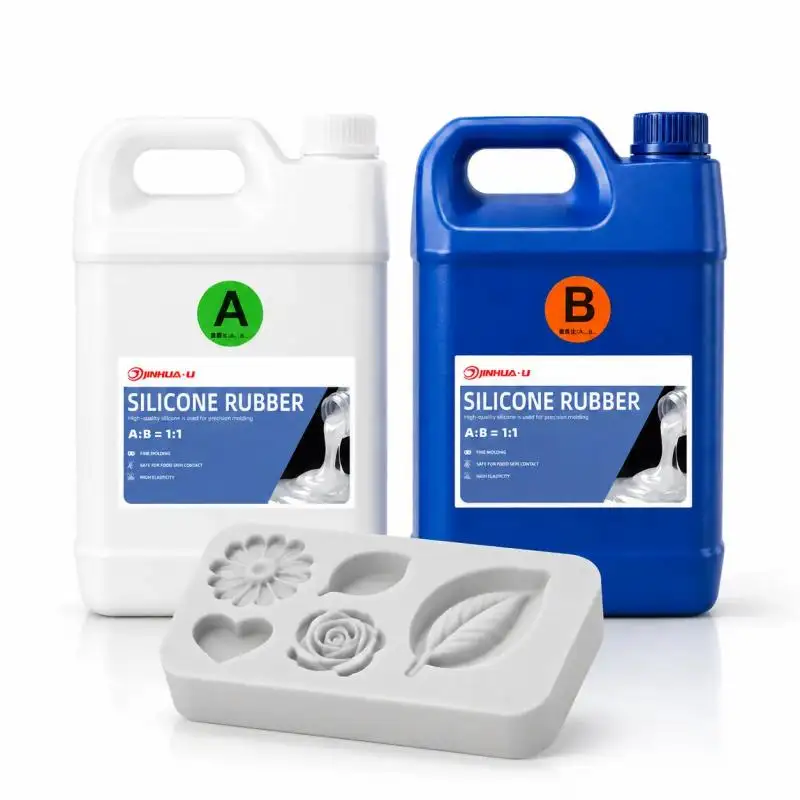
For a supplier of Liquid Silicone Rubber, JINHUA has a range of options for making smaller resin crafts, wax casting and gypsum molding as well as more detailed mold-making products. Their 717AB-F RTV-2 silicone is platinum-cured and has a range of hardness from 0–30 Shore A.
Before committing to larger orders, potential clients will appreciate the JINHUA 0–30 Shore A Silicone Rubber specifications and be able to match the master geometry and process with viscosity, hardness, working time and the mechanical properties of the silicone.
FAQs
Q1. What Type of Liquid Silicone Rubber Does JINHUA Supply?
JINHUA supplies platinum-cured RTV-2 liquid silicone rubber designed for mold-making applications, including resin crafts, wax casting, gypsum molds, decorative parts, and detailed reproduction work.
Q2. What Shore A Hardness Options Are Available From JINHUA?
JINHUA's 717AB-F liquid silicone rubber is available in a 0–30 Shore A hardness range. Buyers can select softer grades for complex undercuts or higher-hardness grades where greater dimensional support is required.
Q3. What Is the Viscosity of JINHUA Liquid Silicone Rubber?
The reference dynamic viscosity of JINHUA 717AB-F is approximately 1500 ± 500 mPa·s. This relatively low viscosity supports pouring, surface wetting, and penetration into fine mold details.
Q4. Is JINHUA Liquid Silicone Rubber Suitable for Fine-Detail Mold Replication?
Yes. The formulation is designed for good flowability and detailed surface reproduction. Actual results also depend on master geometry, mixing quality, temperature, pouring technique, and bubble control.
Q5. What Is the Mixing Ratio of JINHUA 717AB-F Silicone Rubber?
JINHUA 717AB-F uses a convenient 1:1 Part A to Part B mixing ratio, which helps simplify weighing, mixing, and repeatable mold-production processes.