



Updated 3 days ago
High Gloss UV Resin vs. Epoxy Resin: Cure Speed, Hardness & Clarity

hqt
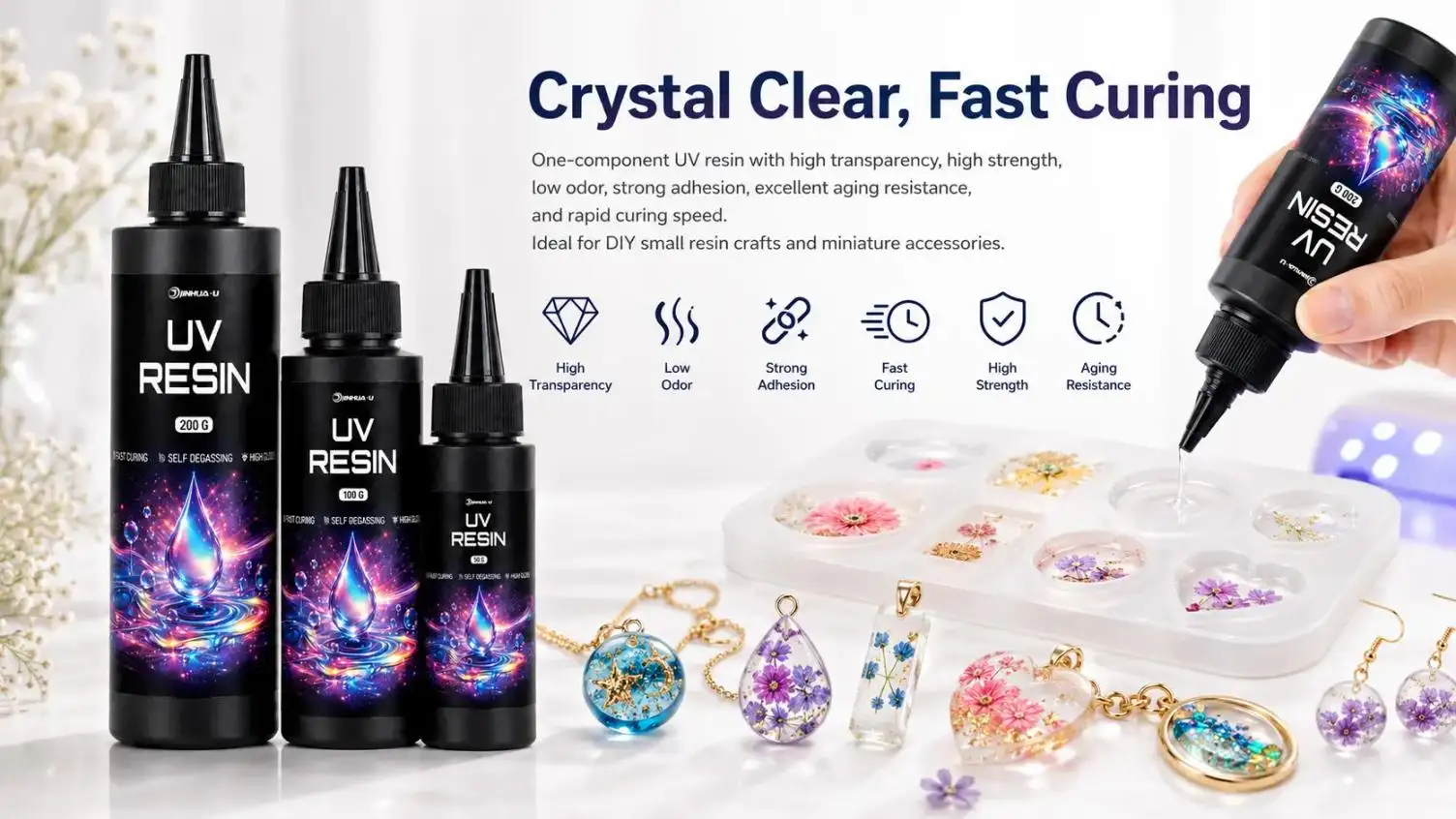
For manufacturers choosing between High Gloss UV Resin and conventional epoxy resin, cure speed is only one part of the decision. The better system depends on layer thickness, UV access, viscosity, surface hardness, optical stability, substrate adhesion, working time and production throughput.
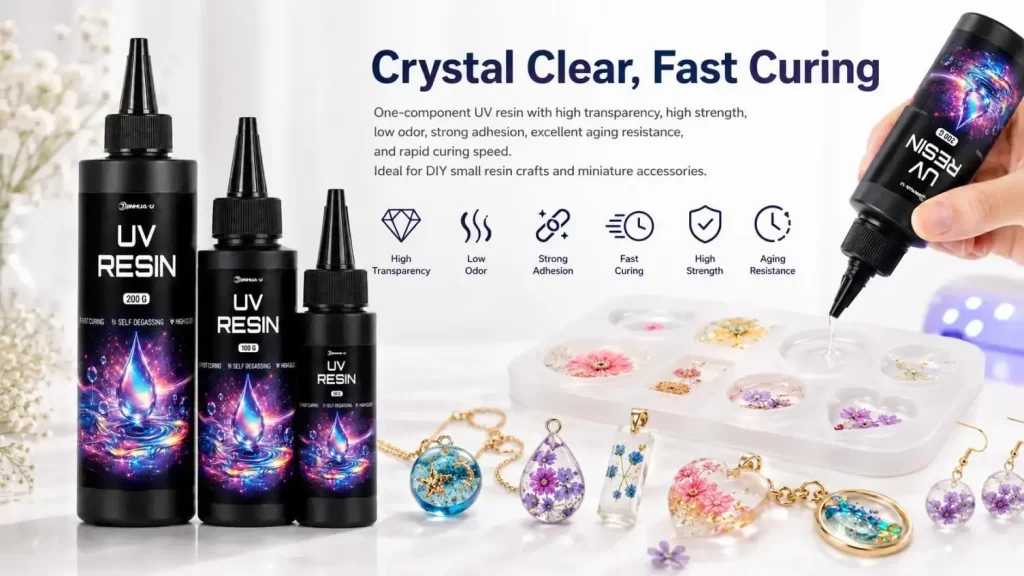
From JINHUA's manufacturing perspective, High Gloss UV Resin is particularly useful for small transparent coatings, jewelry surfaces, decorative parts and repair applications where rapid curing and one-component processing can reduce production steps. Epoxy resin, however, remains more practical for many thick casting and deep-pour applications.
Different Cure Mechanisms Create Different Process Windows
The biggest difference between High Gloss UV Resin and epoxy resin is how polymerization starts.
A one-component UV resin contains photoinitiators. When exposed to suitable UV energy, these photoinitiators generate reactive species that rapidly form a crosslinked polymer network.
A two-part epoxy system follows a different route:
Epoxy Resin + Hardener → Chemical Crosslinking → Final Polymer Network
This difference changes daily production.
High Gloss UV Resin Typically Offers
• No A/B weighing for a single-component system
• No mixing-ratio error
• No conventional mixed-resin pot life
• On-demand curing after positioning
• Faster transfer to the next production step
Epoxy Resin Typically Offers
• Longer working time
• Better suitability for large-volume pours
• No requirement for direct UV exposure
• More flexibility for complex or light-blocked geometries
The trade-off is therefore not simply fast versus slow, but light-controlled curing versus chemically driven curing.
UV Dose, Wavelength and Thickness Control Cure Quality
A High Gloss UV Resin only performs correctly when the resin and curing equipment operate as a matched system.
A useful process relationship is:
UV Dose ≈ Irradiance × Exposure Time
But actual cure quality also depends on:
• Photoinitiator absorption range;
• UV wavelength;
• Distance between lamp and part;
• Resin transparency;
• Layer thickness;
• Pigments or fillers;
• Substrate transmission.
Increasing exposure time cannot always compensate for poor wavelength matching or excessive thickness.
This is one reason why a thin High Gloss UV Resin coating can cure rapidly while a thick section may develop a hard surface but remain incompletely cured underneath.
High Gloss UV Resin vs. Epoxy Resin
| Technical Factor | High Gloss UV Resin | Epoxy Resin |
| Cure trigger | UV energy | Resin-hardener reaction |
| Mixing | Usually not required for 1K systems | Required |
| Pot life | No conventional mixed pot life | Limited after mixing |
| Thin coatings | Highly suitable | Suitable but slower |
| Deep casting | Limited by UV penetration | Generally more practical |
| Process speed | Very fast | Slower |
| UV equipment | Required | Not required |
| Light-blocked areas | Potential cure risk | Less affected |
This comparison is especially important for buyers evaluating whether High Gloss UV Resin can replace epoxy in an existing production line. In many cases, replacement is possible only for specific coating thicknesses or component geometries.
Hardness Does Not Equal Toughness
High hardness is often associated with premium surface performance, but this can be misleading.
Shore D hardness measures indentation resistance. It does not directly measure:
• Impact resistance;
• Abrasion resistance;
• Flexibility;
• Crack resistance;
• Adhesion strength.
Higher conversion and crosslink density can increase hardness, but a very rigid polymer network can also become less tolerant of impact or dimensional movement.
JINHUA's 1121S High Gloss UV Resin is specified at Shore D ≥86 with tensile strength of ≥20 MPa. These figures are useful for screening, but production qualification should still include application-specific testing.
For decorative surfaces, buyers should evaluate hardness together with:
• Scratch behavior;
• Edge chipping;
• Adhesion;
• Repeated handling;
• Thermal cycling.
High Gloss and High Clarity Are Different Requirements
A High Gloss UV Resin can produce a very smooth reflective surface while still showing optical defects.
High gloss mainly depends on surface smoothness and specular reflection. Clarity depends on additional factors such as:
• Haze;
• Light transmittance;
• Bubbles;
• Contamination;
• Internal micro-defects;
• Yellowing during aging.
This distinction matters when the finished product must remain visually clear over time.
A strong optical validation plan should separate:
| Property | What It Evaluates |
| Gloss | Surface reflection |
| Haze | Light scattering |
| Transmittance | Light passage |
| Yellowness Index | Color change during aging |
For transparent High Gloss UV Resin, initial appearance should never be the only acceptance criterion.
Viscosity Determines Flow, Leveling and Bubble Release
Viscosity has a direct influence on process behavior.
If viscosity is too low:
• Resin may run off edges;
• Doming control becomes difficult;
• Film thickness becomes harder to maintain.
If viscosity is too high:
• Leveling becomes slower;
• Bubbles are harder to release;
• Narrow details may not fill easily.
JINHUA specifies its 1121S High Gloss UV Resin at 1100–1400 CPS, a range intended to balance flow control with transparent surface finishing.
For buyers, viscosity should always be evaluated at a defined temperature because resin flow can change significantly with temperature.
Surface Preparation Often Determines Adhesion
Even a high-hardness resin can fail if the substrate is poorly prepared.
Before applying High Gloss UV Resin, manufacturers should control:
• Oil and grease;
• Dust;
• Moisture;
• Mold-release residue;
• Surface energy;
• Substrate roughness.
Glass, metal and engineering plastics can behave very differently.
For this reason, adhesion should be validated on the actual production substrate rather than assumed from a generic product description.
Common UV Resin Defects and Their Likely Causes
Sticky or Soft Surface
Possible causes:
• Insufficient UV dose
• Incorrect wavelength
• Excessive layer thickness
• Oxygen inhibition
• Contaminated surface
Haze or Cloudiness
Possible causes:
• Trapped bubbles
• Moisture
• Contamination
• Incomplete cure
• Incompatible substrate or additive
Yellowing
Possible causes:
• UV aging
• Thermal exposure
• Photoinitiator chemistry
• Formulation stability
Cracking or Edge Pullback
Possible causes:
• Polymerization shrinkage
• Internal stress
• Excessive cure speed
• Poor substrate compatibility
Troubleshooting should therefore examine both the High Gloss UV Resin and the UV curing process.
Production Cost Should Be Calculated Per Finished Part
Resin price per kilogram is not enough for a useful comparison.
A better model is:
Material Cost + Mixing Labor + Waste + Cure Time + Equipment + Rework + Reject Rate
For small components and thin transparent coatings, High Gloss UV Resin can reduce waiting time and eliminate A/B mixing operations. For deep casting, however, the UV equipment and penetration limitations may outweigh these benefits.
When High Gloss UV Resin Is the Better Choice
A High Gloss UV Resin is generally a stronger candidate when the application requires:
Thin transparent coatings:
• Rapid curing
• High-gloss decorative surfaces
• One-component processing
• Short production cycles
• Precise on-demand positioning
Epoxy resin may remain the better choice when:
• Sections are thick
• UV light cannot reach the full resin volume
• Long open time is required
• Deep casting is the primary process
Validate the Resin Before Scaling Production
Before bulk purchasing, buyers should request and verify:
• TDS and SDS;
• Viscosity;
• Hardness;
• Recommended UV source;
• Curing conditions;
• Shelf life;
• Substrate compatibility;
• Optical stability;
• Batch consistency;
• Sample performance.
JINHUA's 1121S High Gloss UV Resin provides a practical one-component option with 60–120 second listed curing time, Shore D ≥86 and 1100–1400 CPS viscosity. For manufacturers evaluating a transition from epoxy to UV curing, the most reliable approach is to test the resin using the actual substrate, layer thickness and UV equipment before scaling production.
For technical details and product information, visit the JINHUA High Gloss UV Resin product page.
FAQs
Q1. What type of High Gloss UV Resin does JINHUA supply?
JINHUA supplies a single-component UV hard resin designed for transparent, high-gloss applications such as jewelry coating, small decorative parts, surface repair and handmade products.
Q2. Does JINHUA High Gloss UV Resin require a hardener?
No. JINHUA 1121S is a one-component High Gloss UV Resin, so it does not require the A/B mixing process commonly used with two-part epoxy resin.
Q3. How fast does JINHUA High Gloss UV Resin cure?
JINHUA lists a curing time of approximately 60–120 seconds. Actual curing performance can vary with UV intensity, resin thickness, light transmission and curing conditions.
Q4. What is the hardness of JINHUA High Gloss UV Resin?
JINHUA specifies a cured hardness of Shore D ≥86 for its 1121S UV hard resin. Buyers should still evaluate scratch, impact and adhesion performance separately.
Q5. What is the viscosity of JINHUA High Gloss UV Resin?
The listed viscosity is 1100–1400 CPS, providing a balance between flow, leveling, edge retention and surface finishing for small transparent applications.