




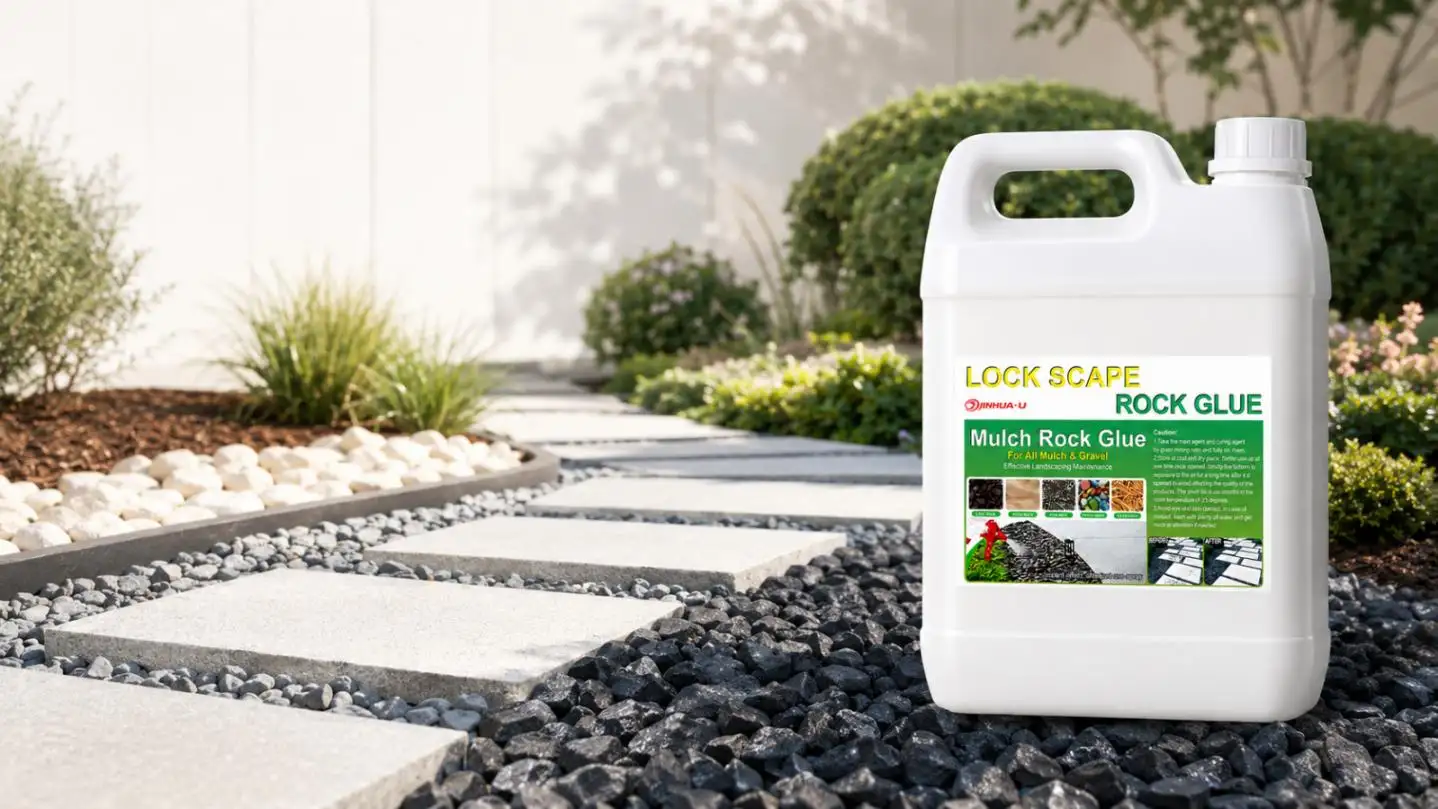
A Gravel and Mulch Binder is not simply a glue used to stop loose stones from moving. In professional landscaping, the binder becomes part of a complete surface system involving aggregate size, void structure, drainage, traffic load, climate, application depth and maintenance strategy.
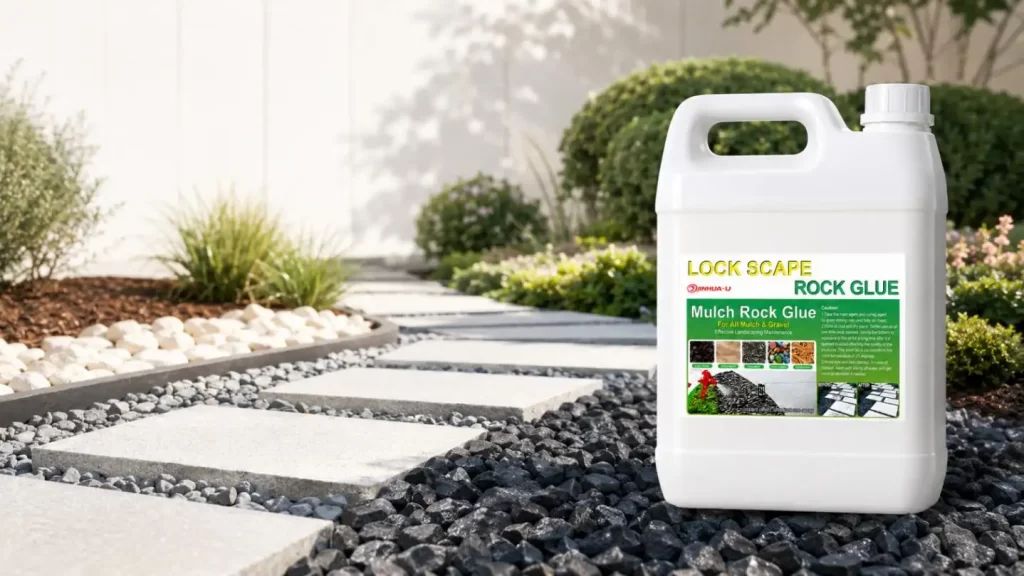
From JINHUA's formulation perspective, selecting between a water-based acrylic Gravel and Mulch Binder and a polyurethane system should begin with the actual performance requirement rather than assuming that the strongest chemistry is automatically the best choice.
Why Gravel and Mulch Surfaces Fail
Loose gravel can migrate under rainfall, runoff, foot traffic, vibration or slope-induced shear. Wood mulch can be displaced by wind and heavy rain.
Common failure causes include:
• Insufficient Gravel and Mulch Binder dosage
• Binder remaining only on the top surface
• Dust or moisture preventing proper wetting
• Poorly graded aggregate with unstable void structure
• Premature rain before curing is complete
• Excessive slope or concentrated drainage flow
• Using a decorative binder where a structural paving system is required
A successful system therefore depends on both binder chemistry and surface engineering.
Water-Based Acrylic and Polyurethane Work Differently
A water-based acrylic Gravel and Mulch Binder contains polymer dispersed in water. During curing, water evaporates and polymer particles coalesce into a continuous film that bridges gravel, stone or mulch particles.
Polyurethane systems cure through chemical reactions. Depending on the formulation, some one-component PU binders react with atmospheric moisture to form a crosslinked network.
This difference affects:
• Cure sensitivity
• Film formation
• Mechanical strength
• Penetration
• Recoatability
• UV behavior
• Installation complexity
Solid Content Matters More Than Wet Product Weight
One of the most useful specifications for a Gravel and Mulch Binder is solid content.
In simplified terms:
Dry polymer loading ≈ Wet binder dosage × Solid content
This means two binders applied at the same wet dosage may leave very different amounts of polymer after curing.
However, a higher solid-content Gravel and Mulch Binder is not automatically stronger. Performance still depends on polymer design, particle contact, surface preparation and dosage.
Viscosity Controls Binder Distribution
Viscosity influences how easily a binder penetrates through gravel voids.
A lower-viscosity system can penetrate deeper, but excessive downward migration may leave insufficient binder near the surface. A very high-viscosity system may create strong bonding near the top while leaving loose particles below.
The objective is therefore not simply "low viscosity" or "high viscosity," but controlled penetration.
Water-Based vs. Polyurethane Gravel and Mulch Binder
| Performance Factor | Water-Based Acrylic | Polyurethane |
| Cure mechanism | Water evaporation and film formation | Chemical crosslinking |
| Application control | Generally simpler | Usually more demanding |
| Penetration | Good when viscosity is controlled | Formulation dependent |
| Decorative landscaping | Very suitable | Suitable but may be unnecessary |
| Higher pedestrian load | Requires evaluation | Usually stronger option |
| Repair and recoating | Generally easier | Surface preparation may be greater |
| UV behavior | Formulation dependent | Highly chemistry dependent |
| Material cost | Generally lower | Generally higher |
| Cleanup | Usually simpler before cure | Product dependent |
For many residential and commercial landscape areas, a water-based Gravel and Mulch Binder provides sufficient stabilization without the installation complexity associated with high-performance PU systems.
Not All Polyurethane Binders Are the Same
A key purchasing mistake is treating all polyurethane systems as equivalent.
Aliphatic PU
Typically preferred where:
• UV stability is important
• Light-colored stone is used
• Yellowing must be minimized
• Long-term visual appearance matters
Aromatic PU
Often provides good mechanical performance but may yellow or darken under UV exposure.
For white marble chips, pale decorative gravel or architectural landscaping, buyers should therefore specify the polyurethane chemistry rather than simply requesting "PU Gravel and Mulch Binder."
Aggregate Size Changes Binder Performance
The same Gravel and Mulch Binder can behave differently with 4 mm gravel, 10 mm gravel or irregular crushed stone.
Key relationships include:
Smaller Aggregate
• Higher total surface area
• More particle contact points
• Potentially higher binder demand
Larger Aggregate
• Larger voids
• Fewer contact points
• Greater risk of deep binder drainage
Angular Aggregate
• Better mechanical interlocking
Rounded Gravel
• Less mechanical interlock
• Greater dependence on polymer bonding
The binder dosage should therefore be validated with the actual aggregate rather than copied from another project.
Strength and Permeability Must Be Balanced
More Gravel and Mulch Binder does not always mean a better surface.
Excessive binder may fill open voids, which can:
• Reduce water infiltration
• Change surface texture
• Create glossy or uneven areas
• Increase material cost
• Affect drainage performance
A permeable gravel surface depends on the entire system:
Aggregate gradation + Binder distribution + Application depth + Base drainage
The Gravel and Mulch Binder cannot compensate for a poorly designed sub-base.
Spray, Pour-On and Premix Require Different Controls
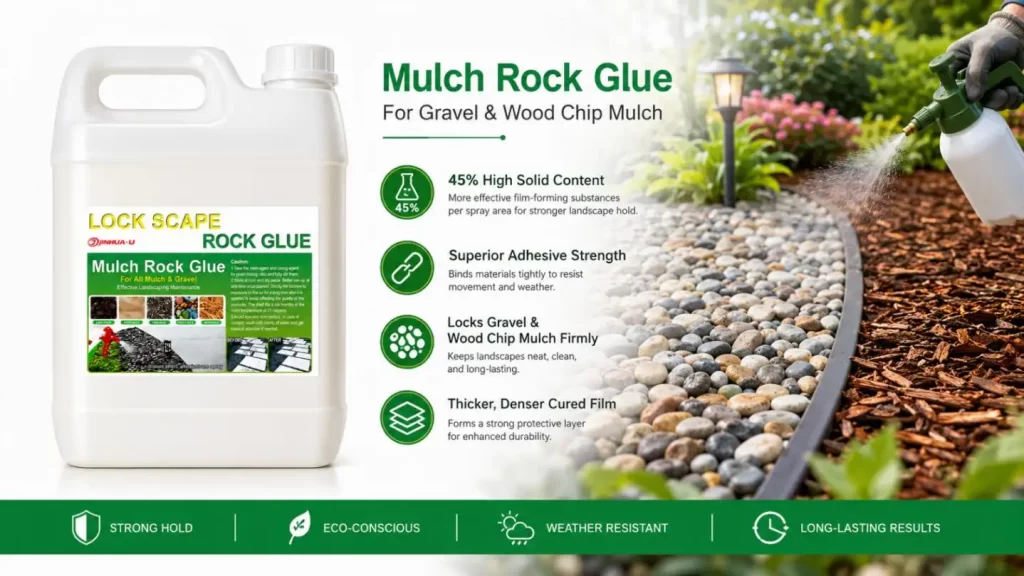
Spray Application
Suitable for:
• Mulch beds
• Decorative gravel
• Surface stabilization
• Fast landscape maintenance
Critical risk: insufficient depth of penetration.
Pour-On Application
Can deliver more binder into the gravel structure but requires controlled distribution to avoid pooling.
Premix Application
Aggregate and binder are combined in a batch prior to being put in place.
Features:
• Coating of aggregate
• Optimum spread of binder
• Knowledge of the bonded structure
This causes greater binder consumption and necessitates careful control of the process.
JINHUA's Water Based Gravel and Mulch Binder
JINHUA has emphasized the practical application behavior of its water-based adhesive systems over the single strength criterion for the development of landscape binding systems.
For example, JINHUA's JH616-45 water-based acrylic Gravel and Mulch Binder is designed around several key parameters:
• 45% solid content
• 60 ± 40 mPa·s viscosity
• Approximately 19 hours initial cure at 25°C
• Approximately 25 hours final cure at 25°C
• 10–70°C operating temperature range
The relatively low viscosity supports penetration through gravel or mulch structures, while the higher solid content increases the amount of polymer remaining after water evaporation.
For buyers, these parameters are more meaningful when evaluated together than when one number is used as a marketing claim.
What Buyers Should Verify Before Ordering
A professional Gravel and Mulch Binder RFQ should request:
• Polymer chemistry
• Solid content
• Viscosity
• Density
• Initial and final cure time
• Recommended aggregate size
• Application rate
• Binder-to-aggregate ratio
• Water-resistance data
• UV-weathering information
• TDS and SDS
• Batch quality documentation
For larger projects, JINHUA recommends testing the binder with the customer's actual gravel, mulch and application method before full-scale installation.
Choosing the Right Gravel and Mulch Binder
A water-based acrylic Gravel and Mulch Binder is generally well suited to decorative gravel, mulch beds, landscape borders and light-duty pathways where simple application, maintenance and cost control are important.
Polyurethane becomes more attractive when higher mechanical durability, greater traffic resistance or more demanding outdoor exposure justifies the additional cost and installation requirements.
The most reliable decision is not based on binder chemistry alone. It should consider aggregate structure, solid content, viscosity, dosage, drainage, UV exposure, curing conditions and maintenance requirements as one complete system.
For landscape contractors, distributors and private-label buyers evaluating a water-based Gravel and Mulch Binder, JINHUA can support product specification, sample testing and formulation matching for different gravel and mulch applications. Visit JINHUA for more information about its landscape adhesive and resin solutions.
FAQs
Q1. What type of Gravel and Mulch Binder does JINHUA supply?
JINHUA supplies water-based acrylic Gravel and Mulch Binder products designed for stabilizing decorative gravel, crushed stone, mulch, wood chips, garden borders, and similar landscape materials.
Q2. Is JINHUA Gravel and Mulch Binder water-based?
Yes. JINHUA offers water-based acrylic binder systems, including formulations designed to provide particle bonding while maintaining relatively simple application and cleanup.
Q3. What is the solid content of JINHUA Gravel and Mulch Binder?
JINHUA's JH616-45 Gravel and Mulch Binder is specified with approximately 45% solid content, helping provide a higher amount of polymer remaining after water evaporation.
Q4. What is the viscosity of JINHUA JH616-45?
The published viscosity of JH616-45 is approximately 60 ± 40 mPa·s, supporting penetration through gravel and mulch structures while maintaining practical application behavior.
Q5. How long does JINHUA Gravel and Mulch Binder take to cure?
At approximately 25°C, JH616-45 has a published initial cure time of about 19 hours and a final cure time of approximately 25 hours. Actual curing can vary with temperature, humidity, layer thickness, and application conditions.