



Updated 3 days ago
Pigment Paste Dispersion: How Particle Size Influences Color Strength and Surface Quality

hqt
In resin and silicone manufacturing, poor color quality is often blamed on insufficient Pigment Paste dosage. In practice, the real cause is frequently more complex.
A Pigment Paste can contain enough pigment and still produce streaks, coarse particles, uneven opacity or surface defects if the pigment is not properly wetted, deagglomerated and stabilized.
For JINHUA, evaluating a Pigment Paste means looking beyond color concentration. Dispersion quality, carrier compatibility, viscosity behavior, storage stability and performance in the final polymer system all matter.
Why Pigment Paste Creates Streaks, Specks and Uneven Color
Pigment particles naturally tend to associate with each other. During production or storage, they can form agglomerates or flocculated structures.
If these structures remain in the Pigment Paste, the finished product may show:
• Visible dark or light streaks;
• Pigment specks or coarse points;
• Inconsistent opacity;
• Reduced tinting efficiency;
• Lower gloss;
• Rough cured surfaces;
• Sedimentation during storage;
• Batch-to-batch shade variation.
This is why simply adding more Pigment Paste is not always the correct solution.
If the actual issue is dispersion, increasing dosage can raise viscosity, modify cure behavior or increase formulation cost without eliminating the defect.
Pigment Paste Dispersion Is More Than Mixing
A proper pigment dispersion process normally involves three stages.
1. Wetting
The liquid carrier must replace air around the pigment surface and fully wet the pigment.
Poor wetting makes later dispersion difficult and may leave persistent agglomerates.
2. Deagglomeration
Mechanical energy breaks pigment clusters into smaller structures.
The required energy depends on:
• Pigment chemistry;
• Agglomerate strength;
• Carrier viscosity;
• Pigment loading;
• Mixer geometry;
• Shear rate;
• Residence time.
3. Stabilization
Dispersion is the separation of pigment particles. For a Pigment Paste to function properly, separated pigment particles must remain apart.
Unstable Pigment Paste may begin to reflocculate during storage and may change color strength, viscosity and produce undesirable surface appearance.
This is important to note:
Good mixing may not result in good dispersion.
Particle Distribution Directly Affects Color Performance
The performance of Pigment Paste is influenced by how pigment structures are distributed throughout the carrier.
| Dispersion Condition | Color Result | Surface Result | Production Risk |
| Large agglomerates | Weak or uneven color | Specks, roughness | Poor consistency |
| Well-dispersed particles | Stronger tinting efficiency | Smoother finish | More predictable dosing |
| Reflocculated particles | Shade drift | Possible gloss reduction | Storage instability |
| Stable distribution | Uniform shade | Consistent surface | Better batch repeatability |
A common misconception is that smaller particle size is always better.
In reality, extremely high pigment surface area can also increase particle interaction and change rheology. For industrial Pigment Paste, the objective should be:
Controlled dispersion + Stable distribution + Suitable viscosity + Polymer compatibility
Rather than simply the smallest possible particle size.
Fineness of Grind Is Not the Same as Particle Size
This distinction matters when comparing Pigment Paste suppliers.
Fineness of grind identifies agglomerates and coarse particles that affect smoothness.
Fineness of grind should not be confused with D50 or D90 size distribution.
For example, fineness of grind defines larger residual particles or agglomerates.
• D50 defines the median particle size of a measured distribution.
• D90 states that 90% of the measured particles are smaller than a particular size.
A Pigment Paste buyer should therefore avoid evaluating dispersion quality from one number alone.
How Dispersion Changes Tinting Strength, Opacity and Viscosity
Pigment dispersion affects several formulation properties at the same time.
Tinting Strength
Better dispersion exposes more usable pigment surface, which can improve color development.
A poorly dispersed high-pigment-loading paste may perform worse than a properly dispersed formulation with lower nominal pigment loading.
Hiding Power
Hiding power depends on the type of pigment, its particle distribution, its optical properties, and the final dosage.
Pigment paste is suitable for solid color resin applications giving satisfactory hiding power with a minimal increase in loading.
Viscosity
Pigment-pigment interaction can increase viscosity, especially at high pigment loading.
Therefore, high viscosity should not automatically be interpreted as higher pigment concentration.
Viscosity is also affected by:
• Carrier chemistry;
• Temperature;
• Shear rate;
• Particle interaction;
• Dispersant system.
Manual Mixing, High-Shear Dispersion and Milling
Different production routes solve different problems.
| Method | Suitable For | Main Limitation |
| Manual Mixing | Small batches and final color adjustment | Limited deagglomeration |
| High-Shear Dispersion | Industrial blending and moderate agglomerate breakup | Requires controlled shear and temperature |
| Milling | Finer dispersion and difficult pigments | Higher equipment and processing cost |
| Pre-Dispersed Pigment Paste | Repeatable dosing and simpler manufacturing | Carrier must match the final resin |
From a manufacturing perspective, pre-dispersed Pigment Paste reduces dust handling and simplifies color addition, but supplier quality becomes more important because dispersion work has already been performed upstream.
Pigment Paste Must Match the Polymer System
Dispersion quality alone does not guarantee compatibility.
Pigment Paste for Epoxy and UV Resin
For epoxy and UV applications, JINHUA recommends evaluating:
• Carrier compatibility;
• Tinting strength;
• Opacity;
• Viscosity change;
• Cure performance;
• Final surface quality.
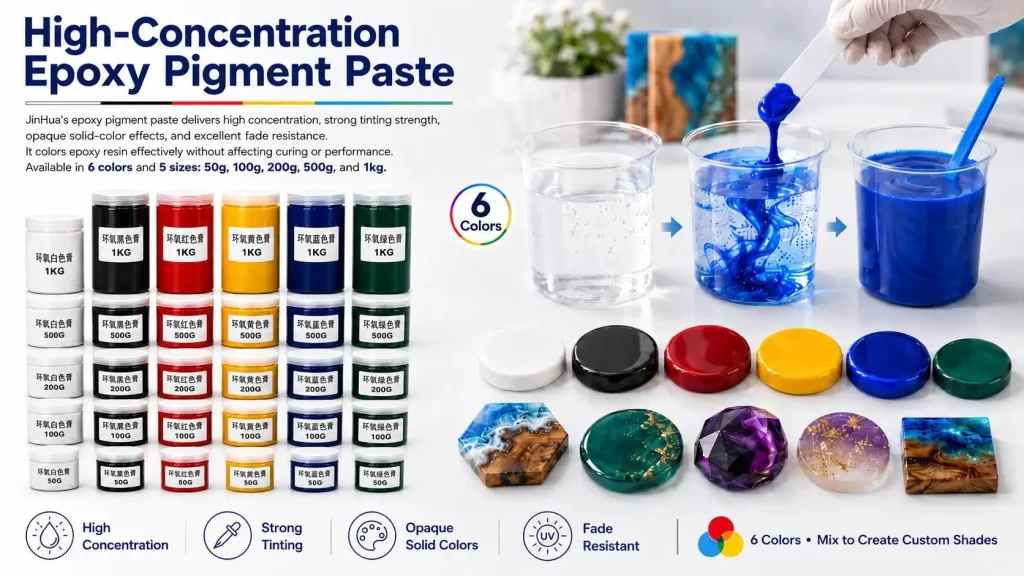
JINHUA Resin Pigment Paste is designed for applications including epoxy resin, UV resin and gypsum, with emphasis on high-concentration opaque coloring.
For UV resin, excessive Pigment Paste addition should still be verified because high opacity may reduce light penetration and affect curing depth.
Pigment Paste for Silicone Rubber
Silicone requires a different carrier system.
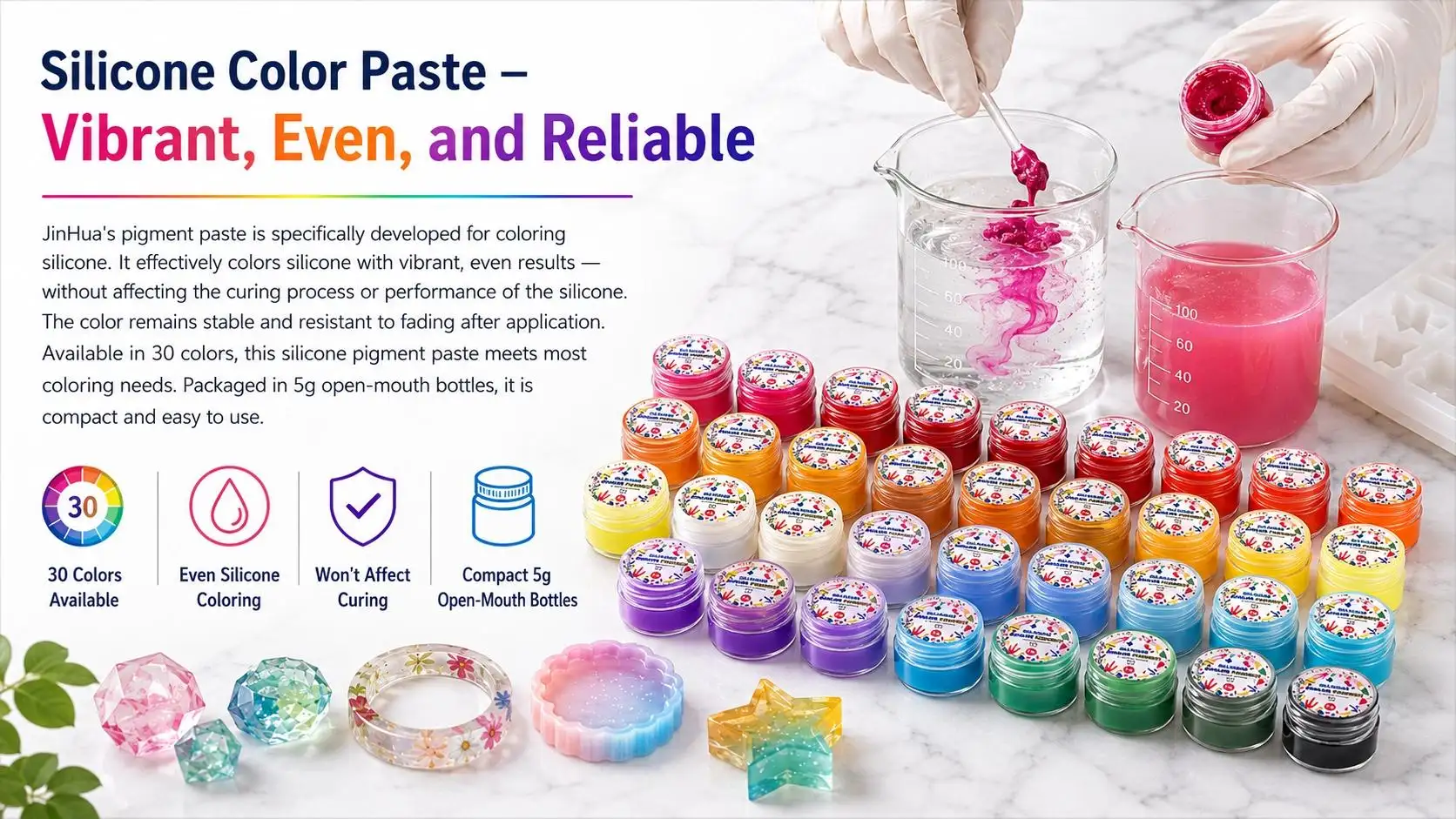
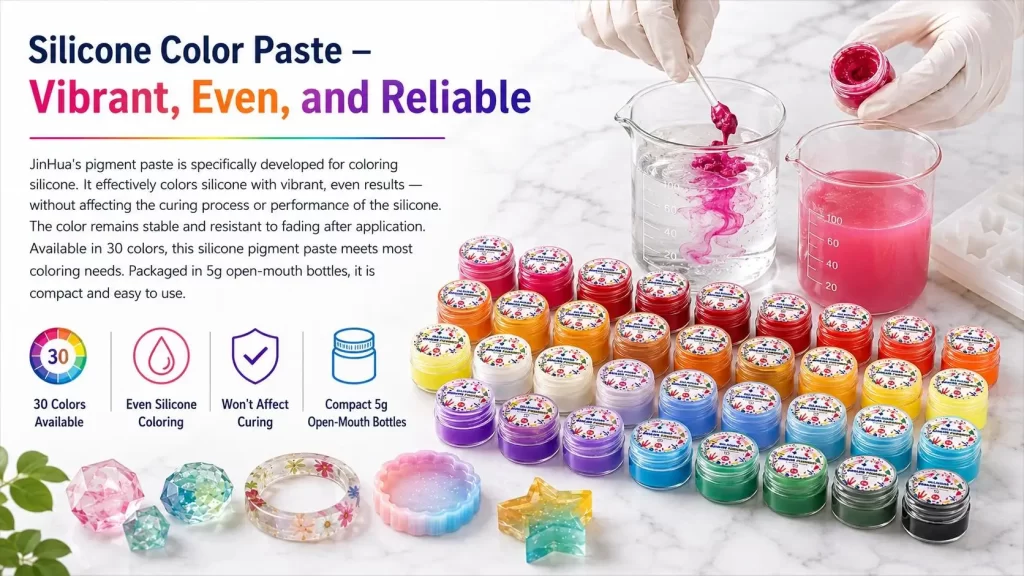
JINHUA Silicone Pigment Paste is formulated specifically for silicone rubber rather than AB epoxy.
This separation matters because the wrong carrier can affect:
• Silicone crosslinking;
• Cure speed;
• Hardness;
• Elasticity;
• Color uniformity.
A Pigment Paste should therefore be selected according to polymer chemistry first and color second.
How to Use Pigment Paste Without Reintroducing Defects
Even a well-manufactured Pigment Paste can perform poorly if process control is weak.
For more consistent production:
• Verify batch number and color before use;
• Inspect for abnormal settling or separation;
• Weigh Pigment Paste instead of relying on volume;
• Add gradually into the main resin;
• Scrape vessel walls and dead zones;
• Use sufficient but controlled shear;
• Avoid unnecessary air entrainment;
• Confirm the final color after curing;
• Keep containers sealed between uses.
Storage conditions also matter because contamination, heat exposure and repeated air contact can change paste condition over time.
How Buyers Should Verify Pigment Paste Quality
A professional Pigment Paste approval process should include more than a visual color match.
Useful checks include:
• Fineness of dispersion;
• Viscosity at defined conditions;
• Tinting strength;
• Opacity or hiding power;
• ΔE against an approved standard;
• Sedimentation behavior;
• Re-dispersibility;
• Cure compatibility;
• Final gloss and surface appearance.
For B2B purchasing, the most important question is not simply:
"Is the color correct?"
It is:
"Will this Pigment Paste remain consistent when used in our actual resin, process and production scale?"
Selecting Pigment Paste with JINHUA
At JINHUA, resin and silicone coloring are treated as different application systems rather than one universal colorant category.
For epoxy, UV resin and other opaque resin applications, buyers can evaluate JINHUA Resin Pigment Paste according to tinting strength, opacity, dosage and final cure behavior.
For silicone rubber, JINHUA Silicone Pigment Paste provides a dedicated compatibility route for silicone-based manufacturing.
The first step should be testing the selected Pigment Paste in production formulation, checking color consistency and surface finish, and checking dosage for potential issues in curing and mechanical properties.
For silicone or resin applications, find out more about the Resin Pigment Paste and Silicone Pigment Paste for colorant systems from our catalog.
FAQs
Q1. What types of Pigment Paste does JINHUA offer?
JINHUA offers separate Resin Pigment Paste and Silicone Pigment Paste systems. The two products are designed for different polymer chemistries rather than being treated as universal colorants.
Q2. What applications are suitable for JINHUA Resin Pigment Paste?
JINHUA Resin Pigment Paste is intended for applications including epoxy resin, UV resin and gypsum, especially where opaque and solid-color effects are required.
Q3. Can JINHUA Silicone Pigment Paste be used in epoxy resin?
No. JINHUA Silicone Pigment Paste is formulated specifically for silicone applications and is not intended for AB epoxy systems. Buyers should select Pigment Paste according to polymer compatibility.
Q4. Why does JINHUA separate resin and silicone Pigment Paste?
Different polymer systems have different carrier and curing requirements. Using a dedicated Pigment Paste helps reduce compatibility risks related to dispersion, curing, hardness and final surface performance.
Q5. How should buyers determine the correct Pigment Paste dosage?
The appropriate dosage depends on the target shade, opacity, base resin, pigment color and processing conditions. JINHUA recommends testing the Pigment Paste in the actual formulation before bulk production.