


Updated 1 month ago
Plaster Resin Mixing Ratios: How to Prevent Casting Defects

JINHUA

A decorative tray may look flawless immediately after demolding but develop chipped edges during sanding. Another casting from the same mold shows pinholes or incomplete filling around narrow corners. When these defects appear inconsistently, the first question we ask at JINHUA is whether the powder and liquid were measured correctly.
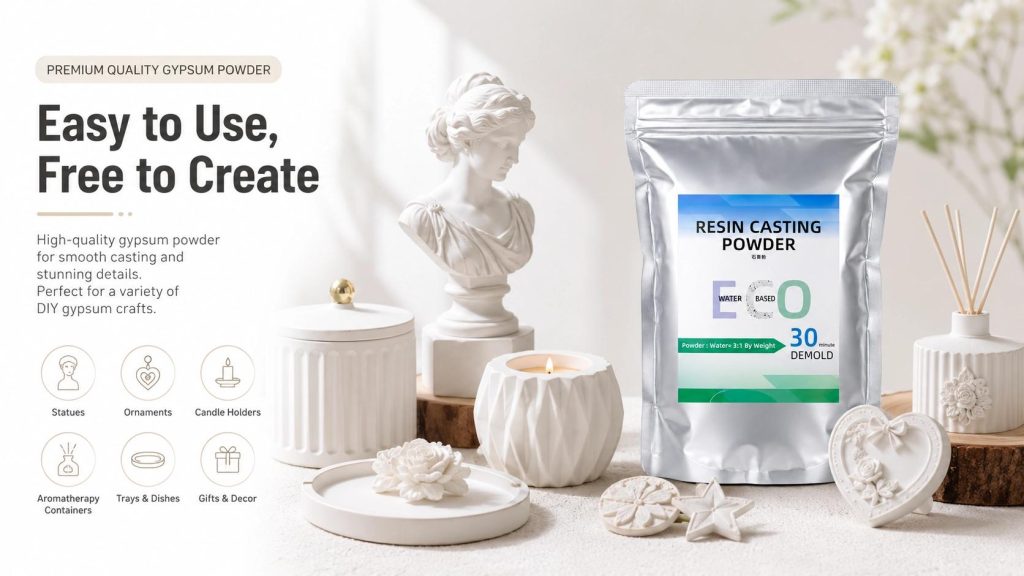
Precise measurement of plaster resin components is important for consistent flow of slurry, complete hydration of plaster particles, proper release of trapped air and formation of an integral hardened casting. Use of excess liquid in the mixing may improve flow ability of the slurry but porosity in the castings and increased thin sections may occur.
At JINHUA, we suggest establishing a proven mixing ratio before modifying pouring techniques, vibration or time of demolding.
1. What Is the Correct Plaster Resin Mixing Ratio?
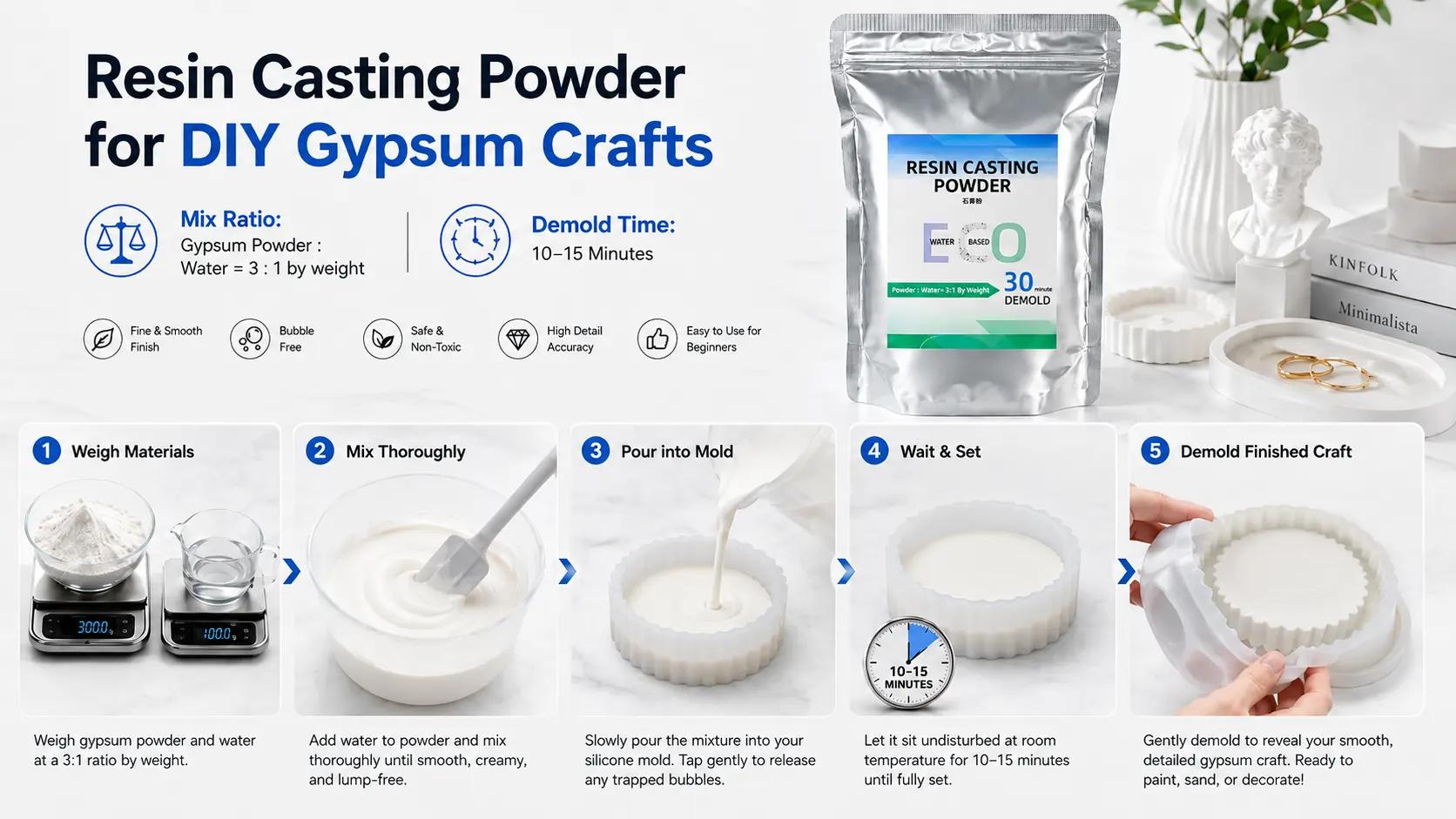
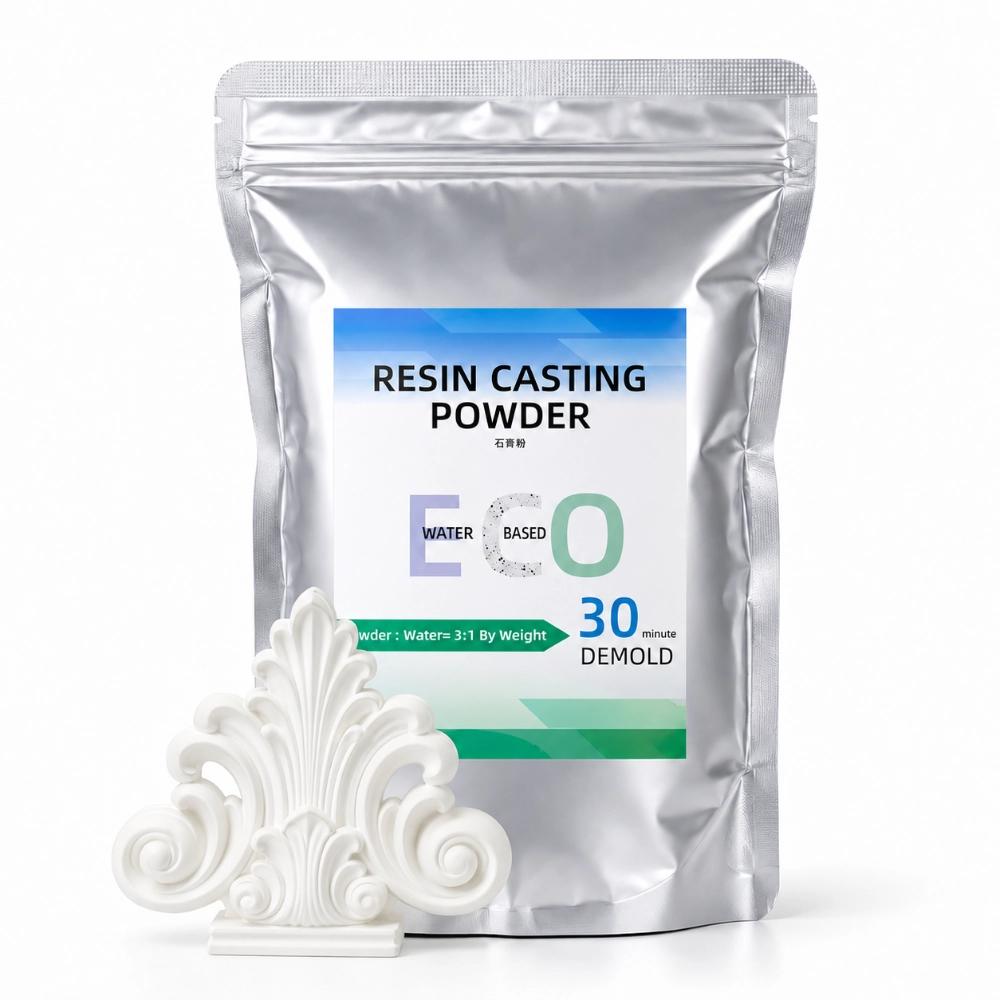
The JINHUA 716AB casting system consists of 716A (white) gypsum based powder and 716B (clear) mixing liquid.
We currently provide two different weight-based mixing ratios. These require clarification before either can be adopted as a production specification.
| Specification | Powder-to-liquid ratio | Liquid for 1 kg powder |
| Product overview | 3:1 | Approximately 333 g |
| Technical specification table | 100:40 | 400 g |
The difference is approximately 67 g per kilogram of powder, equivalent to 20% of the lower liquid quantity.
We advise customers to confirm the current approved ratio with our technical team before preparing production batches. The two published values should not be treated as alternative recommended formulations.
We also recommend weighing both components rather than using measuring cups. Powder bulk density changes with settling, handling, and particle packing. Equal powder volumes do not necessarily contain equal masses.
2. How do surface quality and casting strength relate to mixing ratio?
The structure of our gypsum casting material gets changed and strengthened during the process of hydration. Calcium sulfate hemihydrate loses water and forms Calcium sulfate dihydrate and interlocking crystals.
Mixing liquids promotes and supports the overall reaction and the process by wettling the powder, but using too much takes away control over pore formation, and the casting material dries with pores.
Trade-Off: Strength vs. Flow
Using too much liquid creates a high liquid content slurry, which can reach narrow mold features, but creates high capillary porosity, lowers dry density and strength, increases sensitivity to edge damage, and produces unpredictable changes in the setting behavior of the material. Often, a slurry with the right properties does not give the expected outcome.
Not Enough Liquid: Poor Wettability, Detail Replication
As the liquid content decreases, the solid content and yield stress and viscosity increase. This increases the energy of mix, and promotes agglomeration and clumping.
The slurry may become too thick to completely fill fine details. Adequate dispersion is crucial, as lack thereof may lead to powder agglomeration and casting defects.
3. How Can Casting Defects be Reduced During Mixing?
JINHUA's 716AB has about 3 minutes of working time and recommends a 25°C operating temperature.
Because of the short working time we suggest preparing all molds, tools, and measured components, prior to combining the components.
Our Mixing Controls
Confirm Components: Weigh components on an approved and calibrated balance to confirm they are within the prescribed powder to liquid ratio.
•Standardize Powder Addition: Add powder components in the prescribed sequence.
•Control Agitation: Agitate slurry to break up agglomerates.
•Eliminate Residue: Scrape the bottom and inner wall of the mixer to eliminate sticky residue.
•Stop Mixing: Stop mixing once the ingredients are evenly distributed.
•Keep Equipment Clean: Remove hardened gypsum deposits.
There are detrimental effects of over mixing. Mixing can create a vortex, which can incorporate air into the slurry making it thicker.
Continuous agitation can also disrupt the particle structure of the gypsum and shorten the time in which the slurry can be poured.
It is best to evaluate the actual working conditions of the gypsum and determine the usable working time based on conditions of the workshop rather than relying on the assumptions of the test data published.
4. Which Casting Defects Are Related to Mixing Ratios?
Not every defect is caused by the presence of wrong proportions. At JINHUA, we advise customers analyze the location of the defects, the processing records and the geometry of the mold prior to modifying the material proportions.
| Casting defect | Possible technical cause | Recommended verification |
| Surface pinholes | Entrained air or inadequate mold venting | Compare mixing intensity and air release methods |
| Chipped edges | Excess porosity or early demolding | Check mixture weights and edge strength |
| Unfilled corners | High viscosity or delayed pouring | Measure slurry flow at fixed elapsed time |
| Rough, powdery surfaces | Inadequate powder dispersion or incorrect proportion | Inspect mixing residue and fracture surfaces |
| Visible flow lines | Interrupted pour or changing slurry viscosity | Record time from mixing to mold filling |
Our application notes for narrow mold recesses suggest spreading a small quantity of slurry to fill details before completion of the mold filling.
For air release, gentle tapping and controlled vibration work well. Excessive vibration can cause segregation of the mixture.
Repeating defects in the same location of a mold suggests a geometry or venting problem. Defects in multiple, random molds suggests mixing problems.
5. How Should Manufacturers Verify Plaster Resin Before Bulk Production?
We suggest evaluating the casting materials using your actual mold geometry, rather than small sample evaluations, before bulk production.
A successful production validation involves evaluating the fresh slurry behavior, and assessing part performance and quality.
Flow-Spread Measurements
Record component masses, material temperatures, and times and delays in agitation and pouring. Flow-spread measurements can help identify changes in consistency from batch to batch.
During the Setting and Demolding Processes
As the casting sets, it develops sufficient strength to permit handling without damage to corners and/or fine details. Our published descriptions of curing times need to be confirmed, so the buyer should distinguish initial setting from safe demolding and final dry strength.
Dry-Density Measurements
Perform dry-density measurements, determine surface porosities, and evaluate mechanical performance, if required, after standardized drying.
Repeated castings under uniform conditions are suggested. It is difficult to determine from the results of test programs which specific changes in processes resulted in the reduction of casting defects.
Final Comments
Prior to approving the material, industrial buyers involved in repeated casting production should verify the following:
•The 716AB powder-to-liquid ratio.
•The requirements for working time and demolding.
•Recommended procedures for preparation and pouring.
•The requirements for storage of the material.
•Acceptance criteria for surface finish and casting integrity.
Different products (e.g., a thick decorative sculpture as compared to a thin walled aroma tray) require different properties of the material in terms of flow, edge strength, and demolding. Evaluation of the material should therefore be made against the final product geometry.
JINHUA produces gypsum-based casting materials for decorative trays and moulded products. Buyers can visit JINHUA for 716AB technical information and for sample evaluation for their production needs.