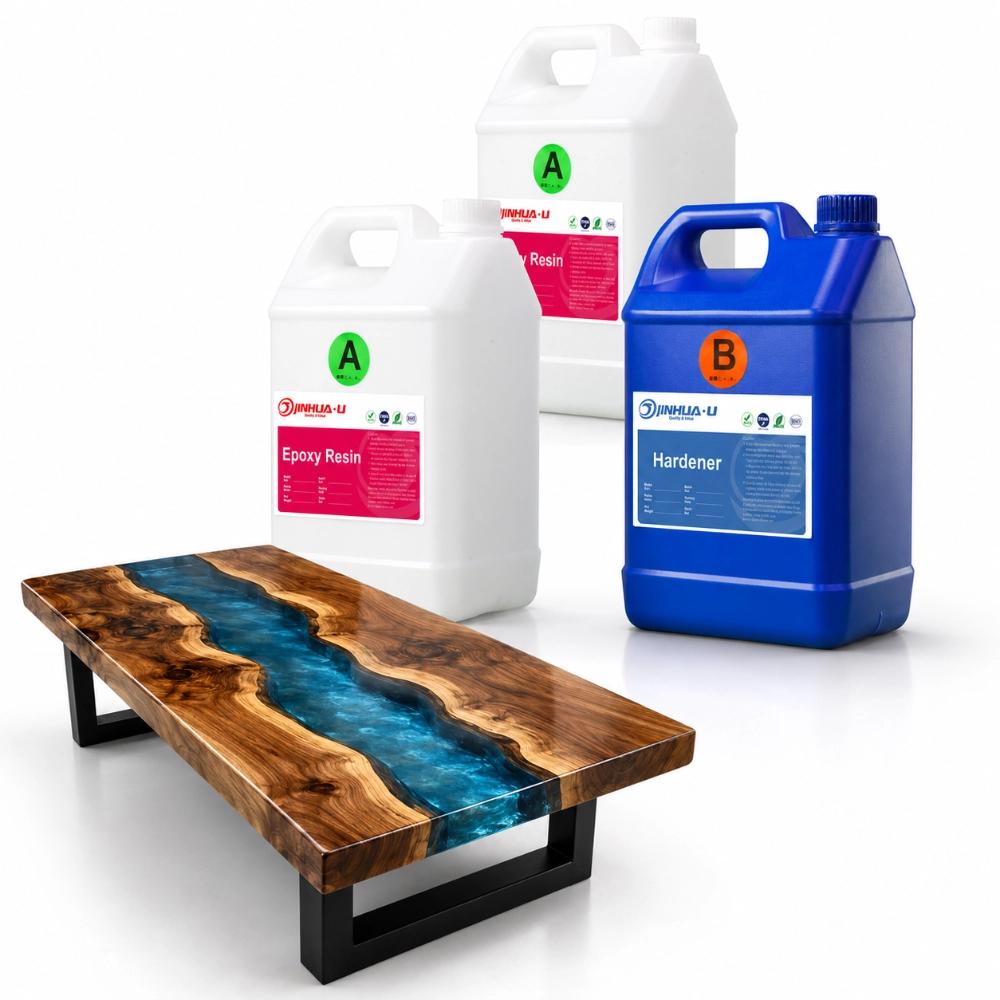



A production team may measure a 2:1 epoxy mixture accurately yet still end up with soft sections, internal cracks, or excessive heat during curing. Sometimes the problem is incomplete mixing. In other cases, the dispensing equipment uses a weight ratio when the formulation requires volume measurement.
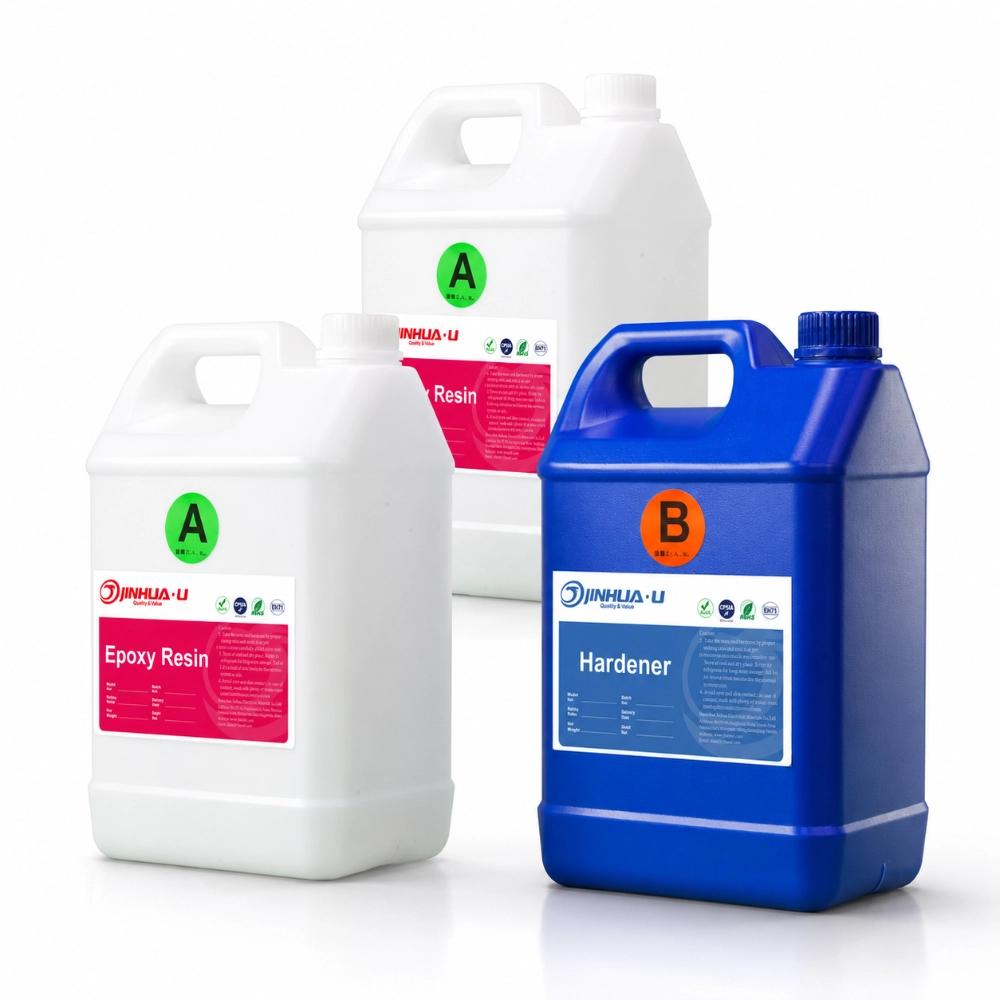
For customers using Clear Casting Resin, the mixing ratio is just the starting point. A 1:1 system is not necessarily more difficult to cure. In fact, a 3:1 system can take longer to harden. Resin chemistry, casting thickness, batch size, and environmental conditions play a large role in how a casting resin system behaves after it is dispensed.
JINHUA's epoxy systems encompass a range of mixing ratios for various casting requirements. The appropriate system is dependent on the manufacturing process, and not the ratios printed on the containers.
1. Why Do Clear Casting Resin Mixing Ratios Differ?
The proportions required for epoxy hardening are primarily determined by the equivalent weights of the epoxy and amine groups. The EEW and AHEW weights can vary among amine groups.
A commercial formulation can also include reactive diluents, modifiers and other ingredients. Concentrations of these can also affect the required proportion of resin and hardener.
Thus, the following can occur:
•Insufficient hardener: Results in under-cured, soft resin.
•Excess hardener: Results in an over-cured resin, and may affect surface quality, hardness, and moisture absorption.
•Ratios affect curing speed: Adjusting proportions to change the curing time is not always guaranteed to work. This also alters the formulation balance.
2. Comparing 1:1, 2:1, and 3:1 Epoxy Systems
JINHUA offers formulations with different handling characteristics. Three products illustrate why the numerical ratio alone is insufficient for selection.
| Parameter | 1:1 System | 2:1 System | 3:1 System |
| JINHUA model | 1201AB-1 | 318AB-TS2 | 312AB-8 |
| Mixing ratio | 1:1 weight/volume* | 2:1 by volume | 3:1 by weight |
| Curing time | 12–24 h at 25°C | 36–48 h at 20°C | 8–10 h at 25°C |
| Intended applications | Crafts, coasters, ornaments | Deep casting, river tables | Small molds, badges, keychains |
| Main process consideration | Metering accuracy | Heat accumulation in thick pours | Exotherm in larger batches |
JINHUA recommends volume mixing for 1201AB-1. Its component densities differ, so weight-based automated dosing requires confirmation.
The curing figures describe different formulations under different conditions. They are not directly comparable measurements of reaction speed.
Why Does the 2:1 System Suit Deep Casting?
JINHUA's 318AB-TS2 has a mixed viscosity of 380 ± 100 cP at 25°C. Lower viscosity facilitates mold filling and gives entrained air more opportunity to escape before gelation.
The formulation is intended for larger castings, with product guidance describing single pours up to 15 cm under controlled conditions.
That depth is not an unconditional processing limit. Thick sections retain more reaction heat, especially where mold walls restrict heat transfer.
JINHUA recommends an ambient temperature of 20–25°C with adequate mold heat dissipation. The guidance warns that temperatures above 28°C may accelerate heat accumulation.
By comparison, our 312AB-8 is intended for small castings. Its 8–10-hour curing time should not be interpreted as evidence that it can safely cure a large resin block.
3. Can Weight and Volume Mixing Ratios Be Interchanged?
Not without accounting for component density.
For JINHUA's 318AB-TS2, the specific gravities are:
•Part A: 1.07
•Part B: 0.98
•Required proportion: 2:1 by volume
If an operator dispenses 2 liters of Part A and 1 liter of Part B, the approximate masses are 2.14 kg and 0.98 kg.
Equivalent weight ratio ≈ 2.18:1
A gravimetric dispenser incorrectly programmed at 2:1 would therefore deliver too much hardener relative to the specified volumetric formulation.
The opposite mistake is possible when converting weight-based systems to volume dispensing.
There are some issues that JINHUA's 1201AB-1 already addresses, such as the specific gravities of the components, 1.15 and 0.96. The product description states that the components are suitable for both weight and volume mixing. It should also be noted that there are confirmed production dosing specifications. Measurement methods should be determined only after a confirmed production dosing specification is provided.
As for automated systems, precise calibrations of the pumps should take into consideration, among other factors, the component density and viscosity, the operating temperature and the accuracy of the dispensing system.
4. Why Can a Correctly Mixed Resin Still Fail?
Internal Cracking and Thermal Runaway
Epoxy resins and other curing agents used for composite manufacturing are exothermic. As curing of the epoxy resin progresses and accelerates, the component temperature increases, causing further reaction and acceleration.
Large mixing containers and thick molds have a relatively small surface area for heat transfer and can lead to thermal hot spots and premature curing. The hot spots can lead to cracking and other defects.
These defects are primarily due to processes and can be controlled by reducing the amount held in the mixing container. Other controls can include staged pours and validating molds before increasing production.
Haze and Stuck Regions
Haze can be caused by moisture or other reactions that occur on the surface of the resin and can occur due to improper mixing, leaving resin along the side of the mixing container. Moisture can also be trapped in a mold and lead to defects. Entrained air in the resin can coalesce and lead to large, irregular defects.
For manual systems, the defects can be combated by controlling the mixing time and thoroughly mixing the components.
5. What Should Buyers Verify Before Bulk Purchasing?
There are additional considerations for bulk purchasing beyond samples. A formulation cured in a small, shallow sample may not represent performance in a large deep mold.
As a potential qualified candidate, we recommend using a system that represents the geometry and the equipment used for dispensing.
There are a few acceptance checks.
•Mixing- confirm the batch size and examine the deviation during dispensing
•Working time- is the system thixotropic enough to be worked?
•Thermal behavior- note internal temperatures and gradients during the cure.
•Cure uniformity- hardness and other physical properties
•Optical quality- are there bubbles, haze, yellowing and internal cracking?
•Repeatability of the process- compare samples from different batches
Purchase orders should request the latest revision of the technical data sheet, state shelf life, storage requirements and provide information on shipment and packaging.
Clear Shore D Hardness does not guarantee a thick casting is fully cured.
Discuss Your Casting Requirements with JINHUA
JINHUA has several epoxy systems with different cast depths, working times and dispensing requirements. Furthermore, we can adapt the packaging and formulation of our products to your needs.
For evaluation of our epoxy systems, it is helpful if you provide us information on your mold dimensions, target cure schedule, operating temperature, and mixing method.
Additional information on our Clear Casting Resin for Large Casting can be found here.
FAQs
Q1. What mixing ratios does JINHUA offer for clear casting resin?
JINHUA offers 1:1, 2:1, and 3:1 epoxy systems. The correct ratio depends on the specific formulation, casting depth, working time, and intended application.
Q2. Which JINHUA clear casting resin is suitable for deep pours?
JINHUA 318AB-TS2 is designed for large-volume casting and uses a 2:1 volume ratio. It supports pours up to 15 cm under controlled temperature and heat-dissipation conditions.
Q3. Can JINHUA 1:1 epoxy resin be mixed by weight or volume?
JINHUA 1201AB-1 offers both methods, although volume mixing is recommended. For production equipment, buyers should confirm the approved weight ratio because component densities differ.
Q4. What is the curing time of JINHUA 2:1 clear casting resin?
JINHUA 318AB-TS2 has a curing time of 36–48 hours at 20°C. Actual curing behavior depends on temperature, casting dimensions, and heat dissipation.
Q5. Is JINHUA 3:1 epoxy resin suitable for large castings?
JINHUA 312AB-8 is primarily intended for small molds, badges, and decorative components. Large pours require separate thermal validation or a formulation designed for greater casting volumes.