


Updated 4 weeks ago
China Art Resin Manufacturer: Private Label Craft Resin Kits

JINHUA

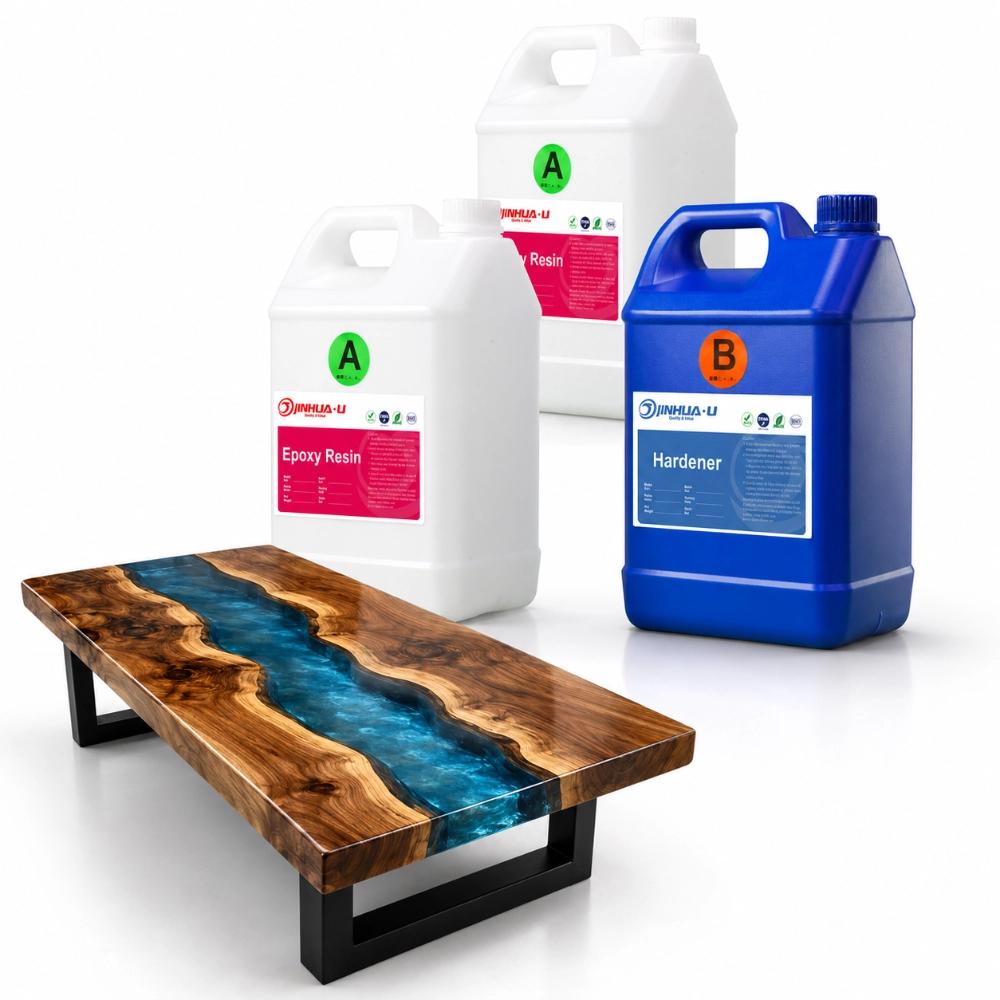
A private label epoxy kit can still yield soft, sticky castings, even if the bottles in the kit are filled correctly. There are a variety of reasons this can occur, but one common reason is if a supplier's mixing specification differs from the tools provided to the customer. For example, a 2:1 resin formula (by weight) does not mean that it should be measured at a 2:1 ratio (by volume). The density of each component affects how much hardener should be added, and if it is added incorrectly, the cross-linking of the polymer network may not occur.
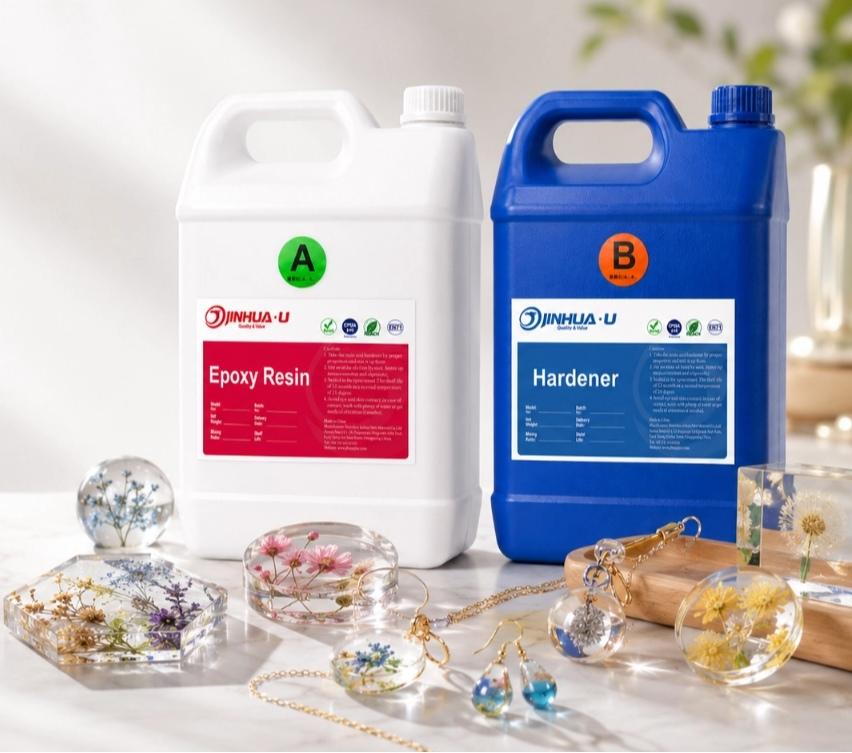
For brands sourcing from a China Art Resin Manufacturer, formulation, packaging, accessories and instructions must be qualified as a single product.
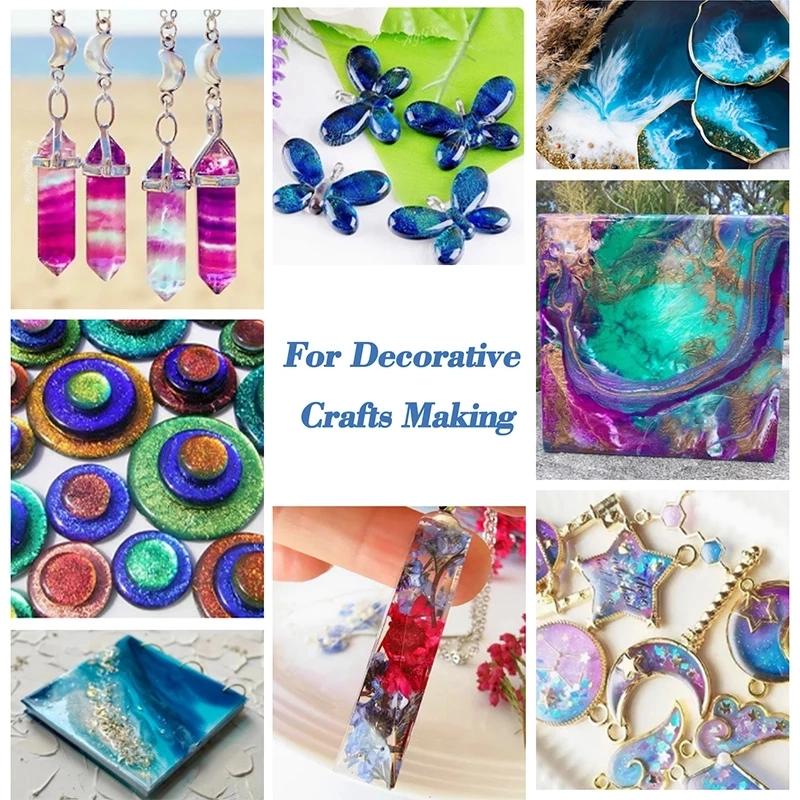
At JINHUA, we support private label and OEM resin projects by offering formulation selection and customization, as well as branded packaging. The focus is on the craft application (not the retail kit) to identify the most appropriate resin formulation.
1. Which Resin Formulation Fits Your Craft Kit?
JINHUA offers 1:1, 2:1 and 3:1 epoxy systems, and single component UV epoxy systems. While Epoxy systems (and other resin systems) may vary in quality, the ratios reflect the resin components and hardener (if any) that must be mixed to obtain a complete system.
| Resin option | Suitable applications | Engineering priority | Limitation to verify |
| 1:1 epoxy | General DIY artwork, decorative coatings | Mixing accuracy, leveling, clarity | Ratio measurement method and coating thickness |
| 2:1 epoxy | Jewelry, keychains, detailed molds | Cavity filling, bubble release, working time | Viscosity and cure under actual mold conditions |
| 3:1 epoxy | Small castings, faster production | Demolding schedule, heat generation | Pot life and maximum safe casting mass |
| UV resin | Thin decorations, jewelry coatings | Light penetration, exposure consistency | Uncured areas behind opaque pigments |
A higher resin-to-hardener ratio does not inherently produce faster curing. Reaction speed depends on hardener chemistry, formulation, temperature, and catalyst selection.
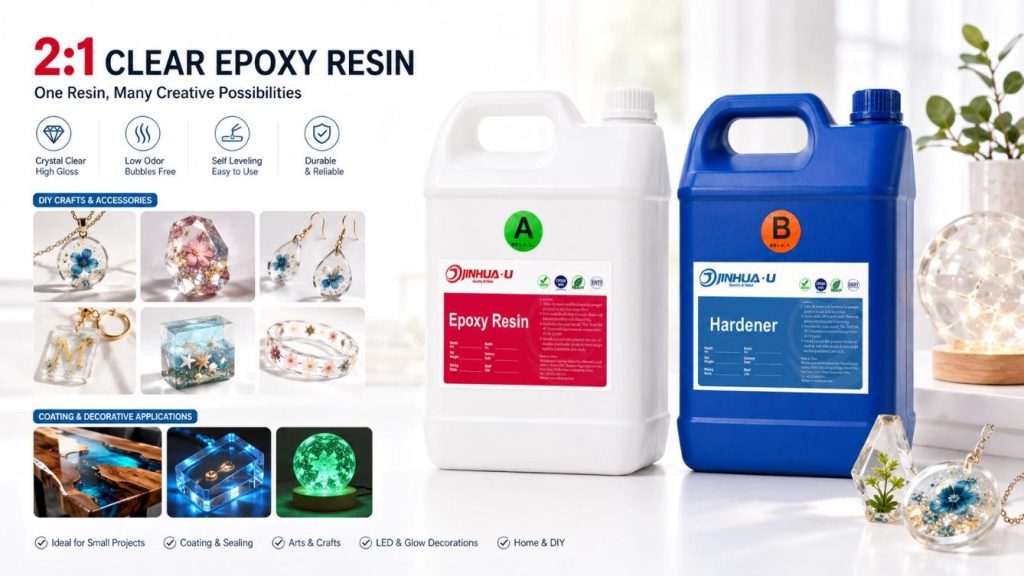
For example, JINHUA's 2120AB-M3 clear epoxy specifies a 2:1 ratio by weight, approximately 40 minutes of usable time at 25°C for a 100 g mixture, and a stated 12–24-hour curing schedule at 25°C.
Those figures are useful for initial screening, but they do not establish acceptable performance in every mold size or ambient condition.
2. What Causes a Retail Resin Kit to Fail During Use?
Exotherm and Cure Variation
Epoxy curing releases heat. A large quantity left in a mixing cup can develop a higher internal temperature than the same formulation spread into a thin layer.
Curing happens quicker at higher temperatures, which may lead to a reduction in working time, heat buildup, discoloration, shrinkage and/or cracking.
When looking at private label kits, look at the following:
•Mass of mixed batch: Was the amount prepared by the customer within the specified limits?
•Pour geometry: Are there coatings of the correct depth for the intended mold?
•Temperature sensitivity: Is the mixture too thick or too thin? Has it gelled? Was it demolded at the correct time?
•Cure completion: Has the gel truly cured?
A short demolding time doesn't guarantee that the gel has cured.
Air Bubbles, Cloudiness and Yellowing
Air bubbles can be lessened by lowering the viscosity of the mixture. However, air bubbles can also be due to vigorous stirring or materials used in the decoration.
Cloudiness in the resin can be due to moisture, incompatible additives, microbubbles, or a number of other factors. These require different remedial actions.
Yellowing can occur for a number of different reasons. It can be caused by impurities, inadequate formulation, photochemical reactions, improper curing and many other things. Yellowing may also occur for a number of reasons including oxidation and exposure to ultraviolet (or other forms of) light. If such reactions occur, discoloration may not be restricted to the resin, but can also occur in other parts of the kit. Transparency at the time of demolding does not guarantee color stability.
3. How Should Resin Chemistry Determine Kit Packaging?
JINHUA provides various packaging options including containers, labels, logos, and color boxes, tailored to our customers' requirements. Packaging specifications need to be determined after the formulation has been chosen.
Mixing Ratio and Fill Accuracy
In the case of two component epoxies, the bottles must be packaged in the proper ratio of resin to hardener.
If a formulation requires mixing by weight, the label should include the direction and a reference scale to avoid systematic errors.
The specification must define the net quantity of each component, the allowable filling variation, and the method of measurement.
Storage and Container Compatibility
Resins and hardeners may react with the liners of container closures and seals in different ways.
Componentviscosity after storage and shipping should be evaluated.
Packaging should protect the component against "incidental contact" with product, label adhesion and legibility should be evaluated.
Storage tests should be performed with finished kits. Stability of bulk component does not always guarantee shelf life of the kit.
4. Are Pigments and Craft Accessories compatible with Resin?
JINHUA provides pigment powders and craft accessories. Compatibility testing will be done on a case to case basis.
Using too much pigment can reduce the clarity and full cure of a resin.
Using colorants can increase the viscosity of a resin and reduce transparency. Metallic and pearlescent pigments can settle before gel time.
Moisture-contaminated additives can lead to haze and surface defects.
Heavily-pigmented layers in UV resin can absorb or scatter light and thus leave other regions uncured.
It is suggested to perform the complete accessories combination test using the instructions to check:
•Colorants: Appearance, cure, and sedimentation at the dosage level.
•Silicone molds: Defects, appearance, reproduction, and release
•Tools: Confirming customers can mix to the required ratio
A pigment that performs well in one epoxy system should not be automatically be allowed for another epoxy system.
5. What Should Buyers Verify Before Mass Production?
Private label qualification must include an approved formulation, a finished kit sample, and mutually agreed acceptance criteria.
At JINHUA, for OEM/ODM services, we can develop samples according to the required formulation and packaging. Buyers can arrange their quality inspection before mass production.
| Verification Stage | Recommended Checks | Failure Being Controlled |
| Incoming Components | Identity, Appearance, Viscosity, Batch Traceability | Incorrect/Inconsistent Raw Materials |
| Resin Performance | Mixing Ratio, Working Time, Cure, Hardness | Soft Cured and Variable Processing Results |
| Optical Performance | Clarity, Bubble Content, Color Stability | Haze, Visible Defects, Yellowing |
| Finished Packaging | Fill Accuracy, Leakage, Label Accuracy | Customer Dosing Errors and Transport Damage |
| Retail Kit Inspection | Accessory Count, Completeness, Instructions, Carton Condition | Missing/Wrong Components, Incorrect Use of Product |
Acceptance Limits will be specified prior to testing. Results from testing conducted under various conditions e.g., temperature, sample mass, curing schedule, are not comparable.
Tech Data Sheets and SD Sheets must be concurrent to the supplied formulation. Market requirements for the classification, labeling, and packaging of the product also need to be reviewed prior to shipping.
How Can JINHUA Support Private Label Resin Development?
Working with a China Art Resin Manufacturer, the lowest price per kilogram may not mean the lowest delivered kit cost. A/B quantities may not be correct, ingredients may not be fully compatible and might lead to leaking bottles, or inconsistent curing may occur, resulting in higher returns and replacements.
For existing formulation private label resins, JINHUA can assist with resin development. Resin properties can be adapted for different containers, labels, and branded cartons.
Let us know about your application, the size and contents of your desired kit and we can discuss sample evaluation and private label resin development.
FAQs
Q1. Does JINHUA manufacture private label craft resin kits?
Yes. JINHUA provides OEM/ODM services for private label craft resin products, including formulation selection, customized packaging, branding, and sample development.
Q2. What mixing ratios does JINHUA offer for craft epoxy resin?
JINHUA offers 1:1, 2:1, and 3:1 epoxy resin systems. Selection depends on the application, required working time, viscosity, casting thickness, and curing behavior.
Q3. Can JINHUA customize epoxy resin formulations?
Yes. We support formulation adjustments involving viscosity, curing time, hardness, transparency, and other application-specific properties, subject to technical evaluation.
Q4. Does JINHUA supply UV resin for private label craft kits?
Yes. JINHUA supplies single-component UV resin for jewelry, small decorative castings, and surface coatings. Suitable curing conditions and pigment compatibility should be verified.
Q5. Can JINHUA customize resin bottles, labels, and packaging?
Yes. We support customized containers, branded labels, logos, and retail cartons. Packaging specifications are determined by the formulation and customer requirements.