





Epoxy resin is a polymer material that has a wide range of applications, such as bonding, coating, sealing, casting, and protecting surfaces. However, the best epoxy resin for wood is not necessarily the best epoxy resin for metal or concrete. Each substrate is different in terms of its surface characteristics, porosity, water-holding capacity and bonding needs.
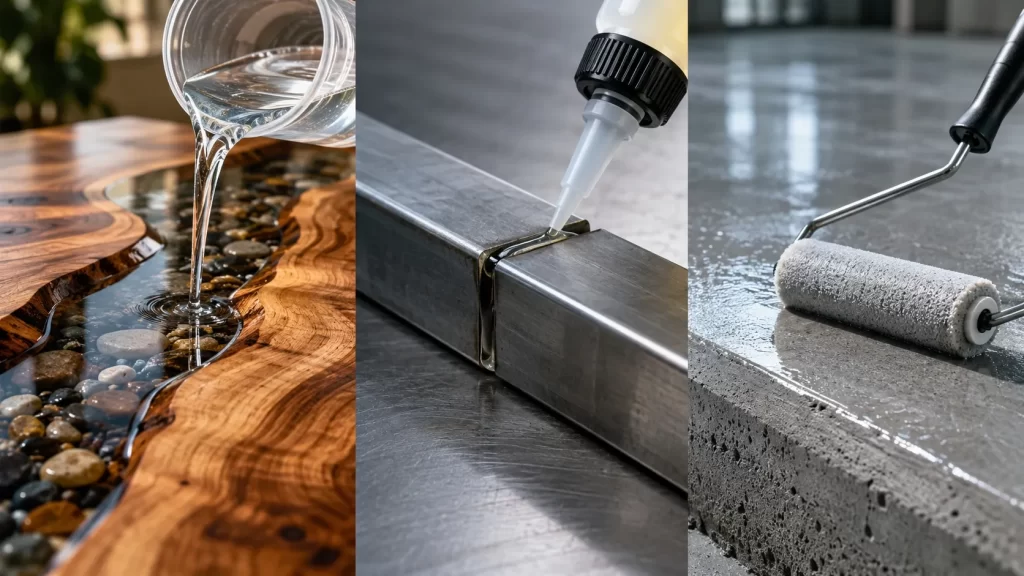
So, what is the most suitable epoxy resin for wood, metal and concrete? This depends on the application, but for wood a clear casting or coating epoxy generally is good, while for metal a high strength structural epoxy is better, and for concrete a durable, chemical resistant epoxy coating may be best.
This guide offers information on which epoxy resin to use with which material and factors to consider prior to purchasing.
What Makes Epoxy Resin Suitable for Different Materials?
Epoxy resin is a two component material made up of resin and hardener. When the components are combined in the right proportion, they undergo a chemical reaction, resulting in a hard, durable polymer.
The performance of an epoxy system will depend upon several factors:
- Adhesion strength
- Hardness and flexibility
- Chemical resistance
- Water and moisture resistance
- Temperature resistance
- UV stability
- Curing speed
- Viscosity
- Surface penetration
- Impact and abrasion resistance
Wood, metal and concrete are very different materials, so it is important to know the specifics of the material to which you are applying the epoxy resin.
Best Epoxy Resin for Wood
Clear epoxy resin or deep-pour epoxy resin is typically a good option for woodworking, furniture, countertops, river tables, decorative panels, and wood repair.
The wood is porous and will absorb the liquid resin. A low viscosity epoxy may be able to enter through the surface and form good mechanical bond. In decorative uses a clear and not highly yellowing epoxy is particularly useful as it does not affect the natural look of the wood.
Recommended features for wood epoxy:
- High clarity
- Low viscosity
- Good wood penetration
- Excellent adhesion
- Low shrinkage
- Bubble-resistant formulation
- UV and yellowing resistance
- Suitable working time
- Good scratch resistance
Generally, deep-pour epoxy resin is more suitable for a river table or a thicker casting than a standard coating epoxy resin. It is designed for use in thicker applications and to help manage heat generation during curing.
A tabletop or coating epoxy can create a smooth, shiny surface on thin protective layers of furniture and countertops.
Tip for wood surfaces
Wood should be clean, dry, and properly prepared before applying epoxy. A thin seal coat is good to apply first to minimize air bubbles from porous wood.
Best Epoxy Resin for Metal
The case of metal is different. Metal does not have the porous, rough surface characteristics of wood and concrete. So, structural epoxy adhesive, which has a high strength, is generally the most suitable adhesive to use for bonding metal parts.
Epoxy systems for metal bonding can be used in industrial applications to achieve excellent adhesion, dimensional stability and resistance to vibration, chemicals and temperature.
Recommended features for metal epoxy:
- High tensile and shear strength
- Strong adhesion to metal
- Excellent chemical resistance
- Good temperature resistance
- Low shrinkage
- Vibration resistance
- Corrosion protection capability
- Long-term dimensional stability
It is commonly used in metal joining, repair, manufacturing of parts for machinery, automobiles, industrial machinery, electrical systems, and metal-to-metal bonding.
Surface preparation is especially critical, especially if the structure is being converted to a new use. Oil, grease, rust, oxidation and dirt can all have a detrimental effect on adhesion. Sanding or abrasive blasting may be necessary or an appropriate cleaning may be necessary depending on the application.
If the metal surface is likely to be outdoors, an epoxy that has high corrosion and environmental resistance will offer extra protection.
Best Epoxy Resin for Concrete
Concrete is porous, alkaline and may be subjected to heavy loads, moisture, chemicals and abrasion. In these applications, there is generally a preference for an industrial grade epoxy floor coating or concrete epoxy coating.
A hard, seamless surface with epoxy coatings can help to enhance the resistance of the concrete to abrasion, chemicals, stains and moisture.
Recommended features for concrete epoxy:
- Excellent adhesion to concrete
- High abrasion resistance
- Chemical resistance
- Moisture resistance
- High hardness
- Strong impact resistance
- Low permeability
- Easy-to-clean surface
- Good durability under heavy traffic
Many production areas, labs, commercial buildings, workshops, garages, factories and warehouses utilize epoxy flooring.
But concrete moisture should be taken into account. Too much moisture or vapor transfer can result in blistering, peeling or coating failure. Therefore, it is important to prepare the substrates and carry out the moisture testing correctly prior to installation.
Wood vs. Metal vs. Concrete: Which Epoxy Should You Choose?
| Material | Recommended Epoxy | Key Performance |
|---|---|---|
| Wood | Clear, coating, or deep-pour epoxy | Clarity, penetration, low yellowing |
| Metal | Structural epoxy adhesive | High bonding strength, chemical resistance |
| Concrete | Industrial epoxy coating | Abrasion, chemical, and moisture resistance |
So the "best" epoxy resin is as such dependent on the application.
For instance, a manufacturer of wood products might focus on clarity and appearance, whereas an autoworker could be interested in maximum bonding strength and temperature resistance. Alternatively, a warehouse might want to focus on abrasion resistance and chemical durability.
Important Factors When Choosing Epoxy Resin
1. Viscosity
Low-viscosity epoxy is useful when penetration is important, particularly for porous wood. Higher-viscosity formulations can be suitable for coating and filling applications.
2. Curing Time
Fast-curing epoxy can increase production efficiency, but slower-curing systems may provide more working time and better control for complex applications.
3. Temperature Resistance
For industrial applications involving heat, choose an epoxy system specifically formulated for elevated-temperature environments.
4. Chemical Resistance
Factories, laboratories, garages, and industrial facilities may require epoxy with resistance to oils, solvents, acids, alkalis, and other chemicals.
5. UV Resistance
For decorative wood products or outdoor applications, UV stability is important because prolonged UV exposure can cause conventional epoxy to yellow or degrade.
6. Mixing Ratio
Always follow the manufacturer's recommended resin-to-hardener ratio. Incorrect mixing can result in soft surfaces, incomplete curing, poor adhesion, or reduced durability.
Can One Epoxy Resin Be Used for Wood, Metal, and Concrete?
It is true that some multi-purpose epoxy resin systems are able to bond or coat more than one substrate. A universal epoxy is not necessarily the best choice for each application, however.
A special formulation can be optimized for the following requirements and give better performance:
- Wood penetration
- Metal adhesion
- Concrete bonding
- Thick casting
- Industrial flooring
- Electrical insulation
- Chemical resistance
If the project is a demanding commercial or industrial application, choosing an epoxy specific to the substrate may help to increase reliability and service life.
How to Improve Epoxy Adhesion
Surface preparation is one of the most crucial elements that determines the performance of epoxy, regardless of the type of substrate used.
Remove dust, oil, moisture, and loose fibres from wood.
To remove grease, rust, oxidation and contamination from metal and to develop a suitable surface profile.
Remove dust, laitance, grease, weak material and contaminants from concrete. There should also be appropriate moisture levels on the surface prior to coating.
The epoxy will have greater mechanical and chemical bond if it is properly prepared.
Why Choose a Professional Epoxy Resin Manufacturer?
Selecting the right manufacturer is critical as well as selecting the right formulation for an industrial buyer.
A professional epoxy resin manufacturer can offer:
- Customized formulations
- OEM and ODM services
- Different curing speeds
- Adjustable viscosity
- Color and transparency options
- Technical documentation
- Application guidance
- Batch consistency
- Quality control
- Packaging customization
Epoxy resin can be tailored to meet specific performance requirements, and can also be used to enhance production efficiency, in large-volume applications.
Conclusion
So, what epoxy resin is best for wood, metal and concrete?
Clear coatings epoxy or deep pour epoxy is suitable for wood as it is good for penetration, clarity and decorativeness.
High strength structural epoxy is preferred for metal since it is essential to achieve strong adhesion, chemical resistance and durability.
Industrial epoxy coating is a favorite choice of the concrete for abrasion, chemical and moisture resistance.
The primary rule is that you should select the epoxy resin based on the substrate, application environment and performance—not just on price or any general purpose labelling.
From wooden furniture manufacturers to metal bonding and concrete floor protection, the right epoxy formulation can drastically enhance durability, beauty, and performance in the long run.