





Epoxy resin can be used to make countertops, bar tops, river tables, flooring, crafts, coatings, and as industrial materials. It is often chosen for various home improvement and craft projects due to its attractive appearance, good adherence, resistance to water, and durability.
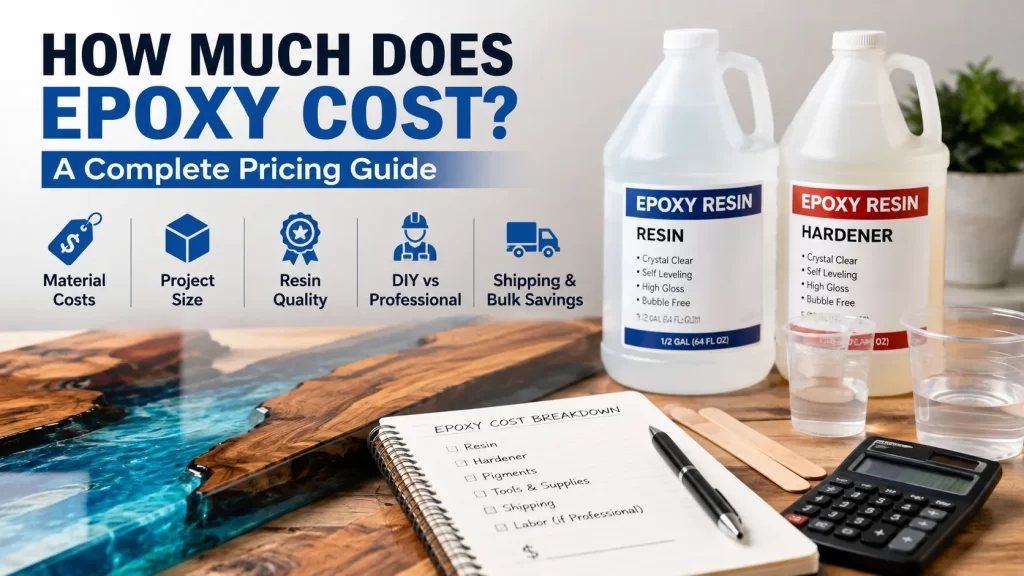
However, how much epoxy resin is it worth? It really depends on the quality of the epoxy, project size, coverage needs, shipping and whether the project is done by hand or by a professional.
Material cost can be widely different depending on the type of material and its use for a typical premium epoxy resin. Some consumer guides estimate the cost of a professionally installed epoxy floor at $2-$12 per square foot and the cost of a professionally installed epoxy countertops at $50-$150 per square foot.
By gaining an understanding of what influences epoxy prices, you can make an informed decision on purchasing the right epoxy product without sacrificing additional unnecessary expenses.
How Much Does Epoxy Resin Cost?
The price for epoxy resin as a product depends on the brand, formulation, quantity, and application, but acceptable values are about $100–$150 per gallon when buying it as a product.
But, the cost of the gallon is not all.
Epoxy products can be priced the same, but offer very different performance. This can include higher clarity, UV stability, chemical resistance, self-leveling capabilities, bubble release and curing consistency.
Therefore, the cost per completed project is a more useful approach to assessing epoxy than is cost per gallon.
What Factors Affect Epoxy Resin Cost?
Several factors can influence the final price of epoxy resin.
1. Type of Epoxy Resin
Different applications require different epoxy formulations.
Tabletop epoxy is designed for relatively thin coatings and is commonly used for countertops, bar tops, tables, and decorative surfaces.
Deep pour epoxy is formulated for thicker castings, such as river tables, live-edge furniture, molds, and artistic projects. Because deep pours require specialized formulations, they can cost more than standard coating epoxy.
Art and craft epoxy is typically designed for smaller projects such as jewelry, coasters, artwork, and decorative pieces.
Specialty and industrial epoxies can also possess enhanced properties such as increased chemical resistance, thermal resistance, electrical insulation or special mechanical properties.
Selection of the right formulation is thus one of the most critical aspects of regulating your overall epoxy expense.
2. Resin Quality
The lower the purchase price, the lower the overall project price may not be.
An inexpensive epoxy might not mix as well as a high-quality epoxy, provide good curing, be less clear, contain too many bubbles, offer less adhesion, or be less durable. When a coating fails, the project will probably require sanding, removal, repair and recoating.
This can make an apparently cheap resin a lot more costly.
By choosing premium epoxy, you can ensure more consistent curing and finishing results, minimizing material waste and project failure risks. Another key aspect of the original source is the importance of considering the long-term costs of the product, in addition to the initial purchase price.
3. Project Size
The bigger the project, the more epoxy will be required.
A small resin coaster might need just a few ounces, for instance, a dining table, countertop or large casting might need several gallons.
Prior to ordering, determine the quantity of resin needed as follows:
- Surface area
- Coating thickness
- Number of coats
- Voids or embedded materials
- Waste allowance
- Project design
Accurate calculation helps prevent both over-ordering and expensive last-minute purchases.
4. Application Thickness
The thickness of the epoxy application is critical to epoxy coverage.
It will take a lot less resin for a thin flood coat than it will for a deep casting. For deep-pour projects, it may be necessary to pour in several phases to manage heat generation and curing.
Comparing epoxy products on a per gallon basis may be misleading. It may be able to cover more or need less coats of a slightly higher selling price, which could reduce the overall project cost.
DIY Epoxy vs. Professional Installation
Another major factor is labor.
The main cost items when buying epoxy and doing the work yourself are the resin, pigments, tools, surface preparation materials, protective equipment and other supplies.
Professional installation includes labor, preparation, equipment, transportation and possibly repair costs.
However, present-day cost data for epoxy sheet flooring indicates that the professional installation typically costs $2 to $12 per square foot, which includes materials and labor. The initial cost of the floor can vary greatly depending on the preparation necessary for the surface and the condition of the existing floor.
Epoxy countertops are significantly more expensive to install, at around $50–$150 per square foot and can vary depending on the design and installation process.
So, while it's possible to save on labor by doing it yourself, professional installation might be worth the cost for larger, more complex, or higher dollar projects, where surface preparation and the quality of application is important.
Does Buying Epoxy in Bulk Save Money?
Often, yes.
A number of suppliers also may discount the price per unit if the customer buys in bulk. Customers who purchase several gallons at once can save on the average cost per gallon especially for people like contractors, manufacturers, furniture makers and others who have several projects.
But the bulk purchase is only cost effective if the resin can be used within its recommended storage time.
Before purchasing large quantities, check:
- Shelf life
- Storage temperature
- Packaging size
- Resin-to-hardener ratio
- Shipping costs
- Manufacturer recommendations
For businesses with recurring epoxy requirements, establishing a reliable bulk purchasing plan can help control material costs.
Don't Forget Shipping Costs
Shipping is another frequently overlooked part of the epoxy budget.
A product may appear inexpensive until shipping and handling charges are added at checkout. Because epoxy is relatively heavy, transportation costs can have a noticeable effect on the final price.
When comparing suppliers, calculate the landed cost:
Landed Cost = Product Price + Shipping + Applicable Fees
For B2B buyers, comparing landed cost rather than product price alone provides a more accurate picture of supplier competitiveness.
How to Save Money When Buying Epoxy Resin
You do not necessarily need to choose the cheapest epoxy to reduce costs. Instead, focus on improving the overall economics of your project.
Buy the Right Resin
Using tabletop epoxy for a deep-pour application, or choosing a specialty formulation when a standard product would work, can increase waste and failure risk.
Always match the resin to the application.
Calculate Before Ordering
Measure your project carefully and determine the required volume before purchasing.
Ordering too little can lead to delays and inconsistent batches. Ordering too much can leave you with unused material.
Compare Price Per Unit
Do not compare only package prices. Compare the price per gallon, kilogram, or usable volume.
Also consider whether the product requires multiple coats.
Consider Long-Term Performance
A cheaper epoxy may become expensive if it yellows quickly, cracks, cures incorrectly, or requires premature replacement.
Durability, clarity, adhesion, chemical resistance, and curing consistency should all be part of your purchasing decision.
Compare Complete Supplier Costs
When evaluating suppliers, consider product price, shipping, minimum order quantity, technical support, lead time, and warranty or replacement policies.
For manufacturers and professional users, supplier reliability can be just as important as the initial resin price.
Is Expensive Epoxy Resin Worth It?
Not always—but quality should match the application.
For a small decorative project, a basic resin may be sufficient. For a high-value countertop, commercial floor, river table, or industrial component, performance becomes much more important.
The right question is not simply:
“What is the cheapest epoxy resin?”
Instead, ask:
“Which epoxy provides the best value for my specific application?”
A slightly higher-quality resin can be more economical if it reduces waste, simplifies application, improves appearance, and extends the service life of the finished project.
Frequently Asked Questions About Epoxy Resin Cost
How much is a gallon of epoxy resin?
The cost for premium epoxy resin is approximately $100-$150 per gallon, but prices can vary significantly depending on the formulation, brand, quantity and usage.
Is epoxy resin expensive?
Epoxy may cost more than some traditional coatings, but because it is durable, looks great, sticks well and is versatile it can be cost-effective for many uses.
How much does an epoxy floor cost?
The average price of professional epoxy flooring is approximately $12-$2 per sq. ft. installed, but there are many factors that can impact the cost of the project, such as surface preparation, epoxy system, floor conditions, location, and project complexity.
How much do epoxy countertops cost?
An epoxy countertop installation is generally between $50-150 per square foot, depending on the size, design, substrate, labor, and finish.
Is cheap epoxy worth buying?
The cheapest epoxy does not necessarily turn out to be the most cost-effective choice. Inadequate curing, poor durability, disfigurements or too short a life may lead to a higher overall project cost.
Final Thoughts
So, what is the price of epoxy resin? No single price for all projects. The price for standalone epoxy ranges from $100 to $150 per gallon for high-quality products and the complete installed project is $100 to $150 per square foot for some flooring installations to a significant amount for professionally installed decorative countertops.
To manage epoxy costs, the best approach is to select the appropriate formulation of epoxy, make accurate calculations of the amount needed, evaluate landed cost of epoxy, and opt for consistency of quality rather than the lowest price.
If you are making an epoxy table, coating a countertop, building a river table, creating decorative artwork or specifying epoxy for an industrial application, it is important to know these cost factors, so you can make a well-informed purchase.