





Epoxy resin is a high performance thermosetting polymer polymer used in industrial coatings, adhesives, composites, electrical encapsulation, construction material, flooring and decorative applications. There are various parameters, such as varying curing times, varying viscosity, varying mechanical properties, chemical resistance, and thermal properties that can be imparted to epoxy systems, making the selection of the epoxy resin manufacturer or supplier a critical choice for product quality and production efficiency.
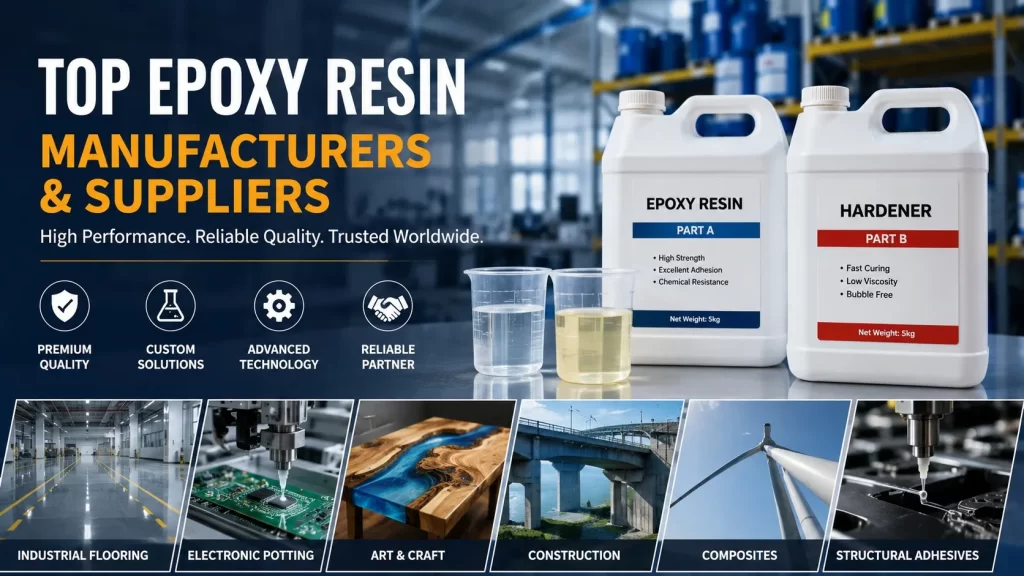
There are over 1250 epoxy resin suppliers in the U.S. market comprising manufacturers, distributors, formulators, and specialty suppliers, according to a 2026 Thomas industry overview. This large supplier base provides buyers with many options, but also makes supplier evaluation even more crucial.
What Is Epoxy Resin?
Epoxy resin is a reactive polymer compound that usually requires a hardener or curing agent to cure the material. The liquid resin system during cure, creates a cross-linked structure that offers strength, durability, adhesion and resistance to many environmental conditions.
The properties of the epoxy can vary according to the formula. Purchase orders may require:
- High mechanical strength
- Excellent adhesion
- Chemical and corrosion resistance
- Low viscosity
- High-temperature resistance
- Electrical insulation
- Optical clarity
- Fast or slow curing
- Low shrinkage
- Bubble-resistant performance
- UV or yellowing resistance
For this reason, there is no single epoxy resin that is ideal for every application.
Major Applications of Epoxy Resin
Epoxy resin can be used in various fields, since its properties can be tailored for various performance requirements.
1. Industrial Coatings
Coatings on concrete, steel, machinery, tanks, pipelines and industrial floors are typically shipped as epoxy. They adhere very well and are resistant to chemicals and abrasions, making them ideal for tough conditions.
One example is industrial flooring. The epoxy floor system will form a single non-tickable, durable, and easy-to-clean surface that is stronger than many traditional floor coverings.
2. Adhesives
Epoxy adhesives are strong for bonding materials like metals, plastics, ceramics, wood, composites and concrete. Structural epoxy adhesives are especially suited for use when a strong bond is needed in mechanical or environmental loads.
3. Composite Materials
Epoxy resin is used as a matrix for fiber-reinforced composites. It can be used with carbon fiber, fiberglass and other reinforcement materials to produce high strength-to-weight ratio lightweight parts.
They are used in the aerospace industry, automotive industry, sporting goods, wind-energy industry, marine industry and industrial equipment manufacturing.
4. Electrical and Electronic Encapsulation
Epoxy resin is also employed a lot in potting and encapsulating electronic components. If formulated correctly, epoxy can be used to insulate and shield sensitive parts from moisture, dust, vibration, chemicals and mechanical damage.
This makes epoxy potting compounds useful for various types of sensors, transformers, circuit boards, power electronics and LED components, and more.
5. Construction and Infrastructure
These are used in construction in a variety of applications such as concrete repair, crack injection, anchoring, bonding, protective coatings and polymer-modified materials. The use of an epoxy system in special construction and polymer-concrete applications is also illustrated by government-qualified material lists.
What Types of Epoxy Resin Suppliers Are Available?
During an epoxy resin supplier search, it's helpful to realize that not all suppliers do the same.
Epoxy Resin Manufacturers
Resin systems are manufactured and may be formulated by the manufacturer, with their own manufacturing, quality-control and technical-support capabilities. These suppliers may be good options for those who need a reliable bulk supplier or specialized formulations.
Custom Epoxy Formulators
Epoxy is formulated to meet specific requisites by custom formulators. They can modify viscosity, curing profile, hardness, flexibility, thermal performance, chemical resistance and others.
This is especially useful for OEM customers and manufacturers that require a product that is flexible enough to meet the needs of their application.
Distributors
Distributors procure epoxy product from various manufacturers and deliver it to customers in various areas. These can be useful for smaller orders, quicker local delivery and a range of brands.
When considering customization options, technical support and production control, however, buyers must differentiate between a distributor and real manufacturer.
How to Choose an Epoxy Resin Manufacturer
It's easy to make problems with only using price to pick a supplier. Evaluation of the supplier based on technical, commercial and quality requirements is better.
1. Match the Resin to the Application
The first step is to state the application. Epoxy resin for a river table, for instance, will have different applications than epoxy resin for electronic potting or structural composites.
Some of the significant specifications might include:
- Mixing ratio
- Viscosity
- Pot life
- Cure time
- Working temperature
- Maximum casting thickness
- Shore hardness
- Tensile and flexural strength
- Glass transition temperature
- Chemical resistance
- Electrical properties
- Optical clarity
A professional supplier should be able to explain which formulation best fits these requirements.
2. Evaluate Customization Capabilities
Customization can be an added benefit for OEM and private label projects. An able manufacturer can supply the custom-made resin and hardener mix, packaging, colors, cure rates and other performance attributes.
Manufacturers can optimize the process instead of having to change their process to fit a standard product by custom formulation.
3. Check Quality Control
Industrial epoxy resin requires consistency to be paramount. Any change in the viscosity, mixing ratio, or curing characteristic would have an impact on production results.
When talking to prospective suppliers, inquire about:
- Raw-material control
- Batch testing
- Quality-control procedures
- Certificate of Analysis availability
- Production traceability
- Packaging standards
- Sample testing
Reliable quality control helps reduce production variation and customer complaints.
4. Consider Technical Support
A decent epoxy resin supplier ought to offer you more than just a product specification sheet. Technical support is particularly valuable in product development, scale-up and troubleshooting.
Application knowledge is a valuable asset that can be passed on from the supplier to the customer to solve problems related to poor adhesion, bubbles, incomplete curing, excessive exotherm, surface defects or improper mixing.
5. Review Production Capacity
Capacity is important to B2B buyers. A supplier could have great samples but not be able to deliver them at a consistent volume.
When ordering in bulk, think about:
- Monthly production capacity
- Minimum order quantity
- Lead time
- Packaging options
- Export experience
- Inventory availability
- Scalability for future orders
A supplier should be capable of supporting both initial testing and long-term commercial production.
Why OEM and ODM Epoxy Resin Services Matter
Whether it is epoxy resin formula construction or the market positioning, the OEM/ODM service can be completed as per the customer's requirement.
For instance, the OEM customer might require a resin system that has a particular curing rate and package size under the OEM brand name. An ODM customer might wish the manufacturer to assist in formulating a total product for a particular use.
This model can be particularly beneficial for businesses that sell:
- Art and craft resin
- Table and deep-pour resin
- Industrial floor coatings
- Electronic potting compounds
- Structural adhesives
- Composite resin systems
- Clear casting resin
Customization can improve product differentiation while helping businesses develop products suited to their target market.
Epoxy Resin Supplier Evaluation Checklist
Before selecting a manufacturer, buyers should compare suppliers using several criteria rather than focusing only on unit price.
A practical evaluation should include:
Product performance: Does the resin meet the required technical specifications?
Consistency: Can the supplier maintain stable performance from batch to batch?
Customization: Can the formulation, curing profile, packaging, or color be customized?
Quality assurance: Does the manufacturer have documented quality-control procedures?
Technical support: Can the supplier assist with formulation and application problems?
Production capacity: Can the supplier support both sample orders and larger production volumes?
Delivery: Are lead times and shipping capabilities suitable for your business?
Documentation: Can the supplier provide technical data sheets, safety documentation, and relevant quality records?
Final Thoughts
Not all epoxy resin companies will be the best manufacturer of the epoxy resin. A quality partner needs to offer you consistent product quality, formulation knowledge, production capacity, customization options, technical assistance, and consistent delivery.
Its use in industrial flooring, corrosion protection, composites and electronic encapsulation are among the growing number of applications for epoxy resin. Industry sourcing data reveals that buyers have many suppliers to consider and need to have their technical needs clearly defined and be able to compare suppliers.
Bulk epoxy resin buyers, companies looking to formulate their own private label products, and those needing a material with specialized performance can benefit from a better control over formulation, quality, package and long-term supply by working directly with a more experienced manufacturer.
To sum up, in picking an epoxy resin supplier, pay attention to the other factors apart from price; application fit, quality consistency, customization, technical support and production reliability.