





The two materials that are compared when selecting a resin for manufacturing, coating, casting, bonding and decorative applications are: epoxy resin and acrylic resin. Both are flexible synthetic resins, but they differ with regard to strength, resistance, looks, curing, flexibility, and application needs, among other factors.
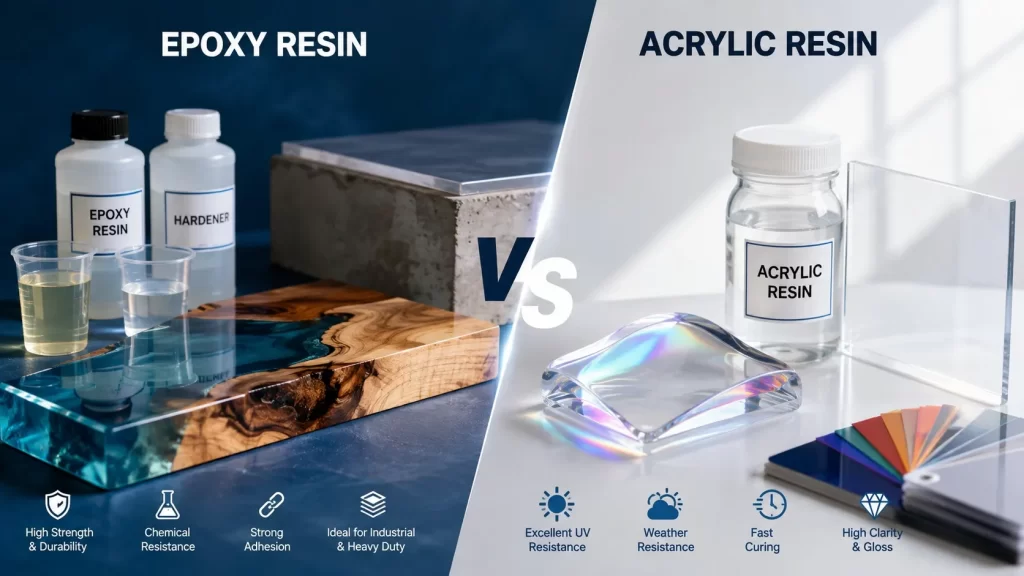
But what is the difference between epoxy resin and acrylic resin? Overall, the epoxy resin has outstanding adhesive, mechanical and chemical resistance properties and durability, while acrylic resin is known for its optical clarity, UV resistance, quick curing and weatherability. It will depend on the application and performance needs.
What Is Epoxy Resin?
Epoxy Resin is a thermosetting polymer, commonly made by mixing together epoxy compounds and a curing agent. The resin and hardener react to each other when they are put together, forming a cross-linked structure that yields a hard, durable material.
Epoxy resin has a broad range of applications such as:
- Industrial coatings
- Electronic potting and encapsulation
- Adhesives
- Composite materials
- Flooring systems
- Table and wood projects
- Casting applications
- Protective coatings
The major benefit of epoxy resin is that it has a high bond strength with many materials like metals, concrete, wood, ceramics and many composite materials. A well-designed epoxy can also offer superb protection against moisture and chemicals, abrasion and mechanical stresses.
What Is Acrylic Resin?
Acrylic resin is a polymer made up of acrylic or methacrylic compounds. Acrylic resin may be thermoplastic or thermosetting in its form, and can come in many different shapes.
Acrylic resins are typically found in:
- Automotive coatings
- Architectural coatings
- Paints and finishes
- Signage and displays
- Transparent products
- Adhesives
- Decorative applications
- Outdoor coatings
Acrylic resin is especially inviting for clarity, color, UV and weatherability. Some of the acrylic formulations provide even fast cure or dry time, which is appropriate for applications where short dry time is desired.
Epoxy Resin vs Acrylic Resin: Key Differences
The major differences between epoxy and acrylic resin are related to their chemistry and resulting properties.
1. Strength and Durability
Epoxy resin tends to have greater mechanical strength, and it is also more resistant to heavy loads. Epoxy is a strong cross-linked network after curing and is able to withstand a large mechanical stress.
The epoxy's use is especially suitable for industrial flooring, structural bonding, composite materials and electronic encapsulation.
Acrylic resin may also be highly durable but with wide variations in mechanical properties depending on the formulation. In some acrylic systems, maximum strength is not the priority; flexibility, impact resistance and weatherability might be more important.
In a more severe structural or industrial use the epoxy is sometimes tougher.
2. Adhesion
It is well known that epoxy resin has excellent adhesion to a wide range of substrates. When the surface is suitably prepared it will bond with metal, concrete, wood, ceramics and composite materials.
Strong bonding can also be achieved with acrylic adhesives for certain plastics and light materials. But, in cases where high bond strength and a long-lasting durability is desired, epoxy is typically preferred.
3. Chemical Resistance
Another significant difference is the chemical resistance.
Most types of cured epoxy resin are generally resistant to many oils, solvents, chemicals, moisture and corrosive environments. Epoxy coatings are helpful in factories, warehouses, laboratories, garages and industrial facilities.
Acrylic resin can be chemically resistant, especially since the kind of chemically resistant acrylic resin is determined by its specific formulation.
Epoxy sometimes is the advantage in harsh chemicals or challenging industrial application.
4. UV and Weather Resistance
Acrylic resin is typically very good for outdoor applications. Numerous formulations of acrylic have very good resistance to ultraviolet light and can keep their color and appearance even in the sun.
Conventional epoxy resin may be more susceptible to uv degradation. Some epoxy systems will yellow, chalk and/or change appearance with extended exposure to sunlight.
Nowadays, however, modern epoxy formulations can be adapted to meet the demands of outdoor use through the use of UV stabilizers, additives, pigments or protective topcoatings.
So acrylic resin is generally selected for long term outdoor use, whereas epoxy is used for high performance use indoors or under protection.
5. Appearance and Optical Clarity
Epoxy and acrylic resin are capable of yielding beautiful finishes, albeit with distinct visual properties.
Transparent casting resin is used for decorative casting, river tables, art work and clear coatings as well as encapsulating. Can offer a heavy rich surface and loads of depth.
Acrylic resin can also be formulated to be very clear and can also be used in applications where optical clarity and UV resistance are of long-term significance.
Epoxy can be very effective for use in decorating projects that need a thick, glossy casting layer. If you need a product or application that is transparent in the outdoors and needs to have a good UV stability, then acrylic may be a better choice.
6. Curing and Processing
Typically, epoxy resin needs to be mixed with a hardener. Mixing ratio needs to be precisely controlled to meet the desired level of curing performance.
The curing time for epoxy varies from a few hours to several days, depending on the type of formulation.
Acrylics can be cured in a variety of ways. Some formulations dry or cure quickly that can enhance the production efficiency.
In cases where high volume manufacturing and rapid processing is essential, a suitable acrylic formulation could be the advantage. For shorter production cycles, however, there are also some special fast-curing epoxy systems.
Epoxy Resin vs Acrylic Resin: Comparison Table
| Property | Epoxy Resin | Acrylic Resin |
|---|---|---|
| Mechanical strength | Excellent | Good to excellent |
| Adhesion | Excellent | Good to excellent |
| Chemical resistance | Excellent | Good to excellent |
| UV resistance | Moderate to good, formulation dependent | Generally excellent |
| Weather resistance | Moderate to good | Excellent |
| Optical clarity | Excellent | Excellent |
| Curing speed | Moderate, formulation dependent | Often fast |
| Hardness | High | Formulation dependent |
| Outdoor applications | Possible with protection | Very suitable |
| Industrial flooring | Excellent | Less common |
| Electronic potting | Excellent | Application dependent |
| Decorative casting | Excellent | Good |
| Composite materials | Excellent | Limited/application dependent |
Which Resin Is Better for Industrial Applications?
When the strength, adhesion, chemical resistance and durability are the main needs for industrial applications, epoxy resin is frequently the best choice.
In fact, epoxy is one of the most popular materials used for industrial flooring, as it can be used to create a hard, seamless and chemically resistant surface. It is also applicable to electronic potting because it is able to shield sensitive parts from moisture, dust, chemicals and mechanical damage.
The acrylic resin might be more appealing for industrial use to which it will be exposed to the outdoors, where it can cure rapidly, requires no color change, and is UV resistant.
It should then be noted that the correct choice should be made based on actual operating conditions and not just the highest general performance resin.
Which Resin Is Better for Outdoor Use?
When the primary concerns are UV and weather resistance, acrylic resin usually outperforms.
Exterior surfaces are often chosen for acrylic coatings which will retain color and appearance under the influence of sunlight and through various weather conditions.
Epoxy is still available for outdoor use, especially if covered with an ultraviolet (UV) resistant overcoat. However, with standard epoxy as the final exposed surface, it may not be the best choice for long term direct sunlight.
One way to do this is to get the best of both technologies, such as epoxy for long-lasting protection and a UV resistant finish for the final layer.
Which Resin Should You Choose?
The choice between epoxy resin and acrylic resin depends on the application's priorities.
Choose epoxy resin when you need:
- High mechanical strength
- Excellent adhesion
- Strong chemical resistance
- Durable industrial coatings
- Electronic potting and encapsulation
- Composite reinforcement
- High-performance adhesives
- Thick decorative casting
Choose acrylic resin when you need:
- Excellent UV resistance
- Strong outdoor weatherability
- Long-term color stability
- Fast curing or drying
- High optical clarity
- Exterior coatings and finishes
- Decorative or transparent applications
To achieve specific properties like viscosity, curing rate, hardness, flexibility, transparency, chemical resistance and UV stability, manufacturers can also customize their resin formulations for specialized projects.
Final Thoughts
So, what is the difference between epoxy resin and acrylic resin? There is no decided advantage for either material. Epoxy resin is generally strong, highly adhesive, chemically resistant and durable in industry, whereas acrylic resin shows excellent UV resistance, weatherability, appearance and processing speed.
The proper resin to be used in the correct environment, substrate, curing, mechanical, chemical, and expected service life for the product.
For manufacturers and B2B buyers, it can be easier to choose or tailor a formulation for a given application when dealing with an experienced resin supplier. Matching the resin chemistry with the actual performance requirements enables businesses to have greater product reliability, manufacturing efficiency and long-term value.