





In fact, composite materials have become indispensable for various industries including aerospace, automotive, marine, construction, wind power, and sporting goods. Epoxy resin is the key ingredient in all high performance composites. The choice of epoxy resin for composite products manufacturer can have a profound effect on the strength, durability, processing characteristics, and success of the product.
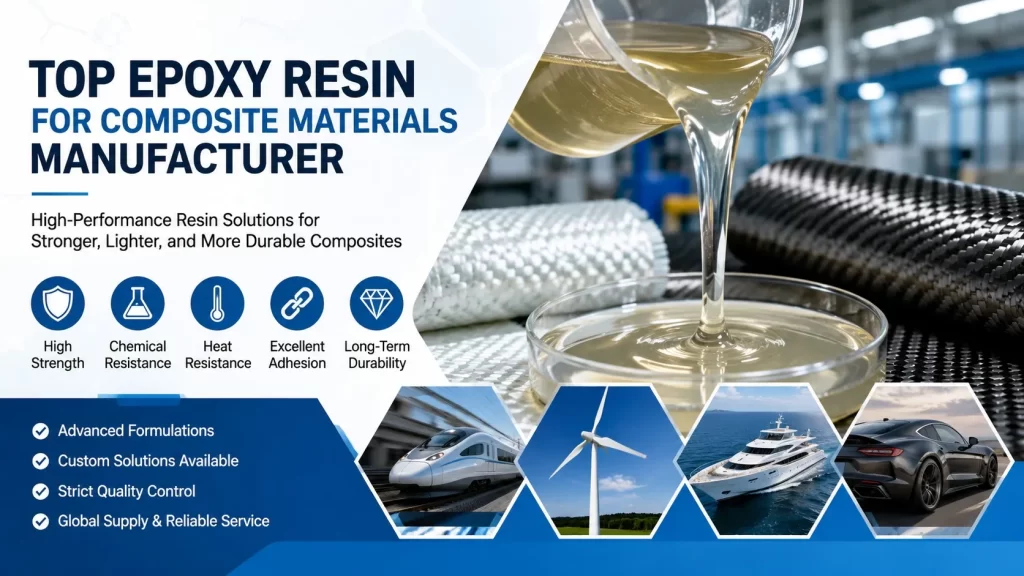
This guide will discuss the key factors in determining who is a leading epoxy resin manufacturer, the advantages of using epoxy composites, and what should be taken into consideration when selecting a supplier, as well as trends in the industry.This guide will cover the top points on who is a leading epoxy resin manufacturer, the benefits of epoxy composites and what should be considered when choosing the right supplier, and the current trends in the industry.
What Is Epoxy Resin for Composite Materials?
Epoxy resin is a thermosetting polymer which is a common matrix material in fiber reinforced composites. Epoxy and reinforcing fibers like carbon fiber, fiberglass, aramid fiber, or basalt fiber form extremely strong, lightweight composites.
Epoxy has a higher ratio of strength to weight than polyester and vinyl ester resins:
- Mechanical strength
- Adhesion to reinforcement fibers
- Chemical resistance
- Fatigue resistance
- Low shrinkage during curing
- Long-term durability
These benefits have made epoxy resin the industry's choice for challenging industrial applications.
Why Composite Manufacturers Prefer Epoxy Resin
Exceptional Mechanical Performance
Epoxy Resin is known for its high tensile strength, flexural strength and impact resistance. These properties, combined with their lighter weight, help to make composite parts stronger at less weight than is required.
Outstanding Adhesion
Epoxy bonds exceptionally well with:
- Carbon fiber
- Glass fiber
- Kevlar
- Wood
- Metal
- Foam cores
Fiber bonding delivers stronger bond and long service life of composite parts.
Superior Chemical Resistance
Industrial composites often operate in harsh environments exposed to:
- Saltwater
- Acids
- Alkalis
- Fuels
- Solvents
Epoxy resin maintains its performance even after prolonged exposure to aggressive chemicals.
Excellent Heat Resistance
High-quality epoxy systems can withstand elevated temperatures, making them suitable for automotive engine components, aerospace structures, and industrial equipment.
Low Shrinkage
Unlike many alternative resins, epoxy cures with minimal shrinkage, producing more accurate dimensions and reducing internal stress.
Industries That Use Composite Epoxy Resin
Modern composite manufacturing relies on epoxy resin in numerous industries.
Aerospace
Aircraft manufacturers use epoxy composites for:
- Aircraft fuselage panels
- Wings
- Interior structures
- UAV components
The lightweight properties improve fuel efficiency while maintaining structural integrity.
Automotive
Automotive manufacturers utilize epoxy composites for:
- Body panels
- Structural reinforcement
- Racing components
- Electric vehicle battery housings
Weight reduction contributes directly to better energy efficiency.
Marine
Boat builders choose epoxy resin because it offers:
- Waterproof protection
- High fatigue resistance
- Excellent bonding with fiberglass
- Long service life
Applications include yachts, fishing boats, surfboards, and marine repair.
Wind Energy
Wind turbine blades require epoxy systems capable of maintaining strength under continuous cyclic loading.
Large-scale blades depend on high-performance epoxy formulations for decades of reliable operation.
Construction
Composite reinforcement is increasingly used in:
- Bridge strengthening
- Structural repair
- Carbon fiber reinforcement
- Infrastructure rehabilitation
Characteristics of a Top Epoxy Resin for Composite Materials Manufacturer
Choosing the right supplier involves much more than comparing prices.
Consistent Product Quality
Reliable manufacturers maintain strict quality control from raw materials through production.
Consistent viscosity, curing behavior, and mechanical properties ensure stable manufacturing processes.
Advanced R&D Capability
Leading manufacturers continuously develop:
- Faster curing systems
- Low-viscosity formulations
- High-temperature epoxies
- UV-resistant systems
- Flame-retardant resins
- Bio-based epoxy solutions
Innovation enables customers to remain competitive.
Comprehensive Product Portfolio
A professional manufacturer typically offers:
- Laminating epoxy resin
- Infusion resin
- Vacuum bagging resin
- Pultrusion resin
- Filament winding resin
- Hand lay-up systems
- RTM resin
- Prepreg resin
Different manufacturing processes require specialized resin systems.
Custom Formulation Services
OEM customers often require unique properties, including:
- Specific curing times
- Customized viscosity
- Improved flexibility
- Enhanced impact resistance
- Higher glass transition temperature (Tg)
Experienced manufacturers can formulate products according to customer requirements.
International Certifications
Reputable suppliers commonly comply with:
- ISO 9001 Quality Management
- REACH
- RoHS
- Environmental regulations
- Industry-specific quality standards
Certification reflects manufacturing consistency and regulatory compliance.
How to Choose the Best Epoxy Resin Manufacturer
Before selecting a supplier, evaluate several important factors.
Manufacturing Experience
Manufacturers with many years of experience generally possess mature production technology and better quality control.
Production Capacity
A reliable supplier should meet both small-batch development and large-scale commercial production needs.
Stable supply chains reduce delivery risks.
Technical Support
Excellent suppliers provide:
- Resin selection guidance
- Processing recommendations
- Technical troubleshooting
- Material testing assistance
- Application development
Strong engineering support can significantly shorten product development cycles.
Global Logistics
International buyers should consider:
- Export experience
- Packaging quality
- Shipping reliability
- Delivery lead times
- Customs documentation
Efficient logistics improve project scheduling.
Competitive Pricing
The lowest price does not always represent the best value.
Long-term quality consistency often reduces manufacturing costs through fewer defects and improved productivity.
Current Trends in Composite Epoxy Resin Manufacturing
The composite industry continues evolving rapidly.
Sustainable Materials
Manufacturers increasingly develop environmentally friendly epoxy systems using renewable raw materials while maintaining mechanical performance.
Faster Production
Fast-curing epoxy systems help manufacturers reduce production cycles and increase output.
Automation-friendly formulations are becoming more popular.
Lightweight Engineering
Demand for lightweight materials continues to grow in:
- Electric vehicles
- Aerospace
- Robotics
- Renewable energy
Advanced epoxy systems play a central role in lightweight composite innovation.
High-Temperature Performance
In industrial applications, the epoxy systems need to be able to perform under increasingly demanding thermal conditions.
Manufacturers are still working on improvements of the glass transition temperature and thermal stability.
Benefits of Working with a Professional Manufacturer
Partnering with an experienced epoxy resin manufacturer provides numerous advantages:
- Consistent product quality
- Reliable technical support
- Flexible customization
- Stable supply chain
- Global shipping capability
- Competitive production costs
- Faster product development
- Long-term business partnership
Companies no longer have to buy resin; they can now get full material solutions that are suited for their production process.
Conclusion
Selecting the proper epoxy resin for composite materials manufacturer is a strategic decision that can have a significant impact on product quality, production efficiency, and company success.
The top manufacturers are known for their cutting-edge research, quality control, customization options, and global supply. From the fabrication of aerospace parts and marine structures, to automotive components, wind turbine blades, and industrial composites, a reliable epoxy resin supplier is the key to maintaining high-quality results and sustainable success.
Manufacturers who invest in innovation, eco-friendly materials, and customer-centric technical assistance will continue to be the top choice for companies around the world, as composite technologies evolve.