



Updated 1 month ago
Thermoplastic Polyurethane (TPU): Properties, Benefits & Applications

hqt

Thermoplastic polyurethane (TPU): A thermoplastic elastomer that possesses the properties of both rubber and thermoplastics. Due to its high abrasion, elasticity, chemical resistance and durability, TPU is used in challenging applications like cable assemblies, electrical connectors, automotive systems, robotics, industrial equipment, medical devices and outdoor products.
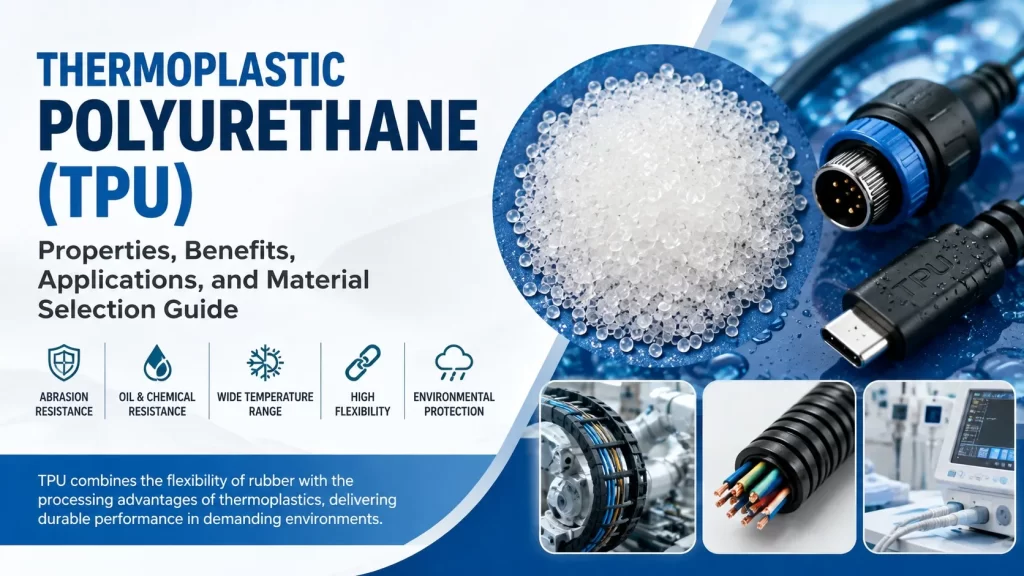
It is important to understand TPU properties, benefits, limitations, and uses when engineers are choosing materials for cable jacketing and/or connector overmolding. The proper material can result in greater product reliability, longer service life, and a barrier to electrical components in harsh environmental conditions.
What Is Thermoplastic Polyurethane?
TPU, also known as thermoplastic polyurethane, is a thermoplastic elastomer (TPE). TPU can be processed by thermoplastic manufacturing methods, and has a high level of elasticity, unlike conventional rubber.
This combination provides TPU with some significant benefits. It is capable of repeated flexing, mechanical resistance and protection, and is appropriate for processes like injection molding and overmolding.
The unique property of TPU is used in products that need to endure harsh operating environments. TPU can possess resistance to abrasion, oils, grease, chemicals, moisture, UV radiation, ozone and other environmental factors based on the formulation.
TPU is widely used in the cable jacket and connector overmoulding for electrical and electronic applications. It may form a protective layer around wires, cables, and connectors, which can help to prevent damage to the internal components caused by mechanical or environmental factors.
Key Properties of Thermoplastic Polyurethane
TPU is formulated into different grades, depending on which one it is, its performance varies. Engineers need to compare the material to the actual temperature, chemical, mechanical and electrical characteristics of the application.
1. Excellent Flexibility
Flexibility is one of the most crucial properties of TPU.
For applications that involve cables or components that move repeatedly, use TPU which can endure repeated bending and flexing. Especially advantageous for robotics, drag-chain cables, industrial machinery and mobile equipment.
Some TPU formulations have the ability to remain useful flexible at low temperatures and yet retain good performance at high temperatures. According to the original iCONN Systems article, the temperature range for the TPU is about -40°C to +125°C, depending on the type of TPU grade and cable construction.
2. High Abrasion Resistance
TPU is highly wear and abrasion resistant.
It is important for cable assemblies that regularly come into contact with machinery, pass through cable tracks or work in a space where mechanical wear is a problem. TPU is able to offer a extended service life in facing repeated friction compared with many traditional flexible materials.
3. Resistance to Oil and Chemicals
TPU can offer excellent resistance to a wide range of oils, greases and chemicals.
It makes sense for applications in the automotive, industrial, manufacturing and mechanical sectors where cable assemblies might be subject to lubricants, fuels, cleaning agents or other substances.
But, the chemical resistance depends on the TPU formulation. Compatibility needs to be considered at all times with the chemical, concentration, exposure time and temperature.
4. Resistance to Environmental Conditions
TPU is resistant to a variety of harsh environmental conditions, including humidity, ozone, UV exposure and mechanical wear.
This is where TPU comes into its own, as it can be used for outdoor equipment and industrial products that remain functional after being exposed to the environment.
However, for long-term outdoor use, UV stabilisation and the specific TPU formulation should be taken into account when selecting the material.
5. Elasticity and Mechanical Strength
TPU is elastic and has good mechanical properties.
This balance is especially helpful in an over molded connector. The material can offer flexibility between a rigid connection, and also offer some protection against mechanical stresses on the connection.
The final product is a material, which can be used as a protective layer and as a structural part of the cable assembly.
Why Is TPU Used for Cable Jacketing?
Cable assemblies may be subjected to bending, vibration, exposure to moisture, chemicals, temperature variations and mechanical impact. If not properly jacked, these conditions may reduce cable life and may lead to electrical or mechanical failure.
TPU cable jacketing can offer solutions to these challenges by delivering:
- Flexible mechanical protection
- Abrasion resistance
- Resistance to oil and grease
- Environmental protection
- Good low-temperature flexibility
- Protection against repeated bending
- Suitable performance for harsh industrial environments
The best cable jacket material depends on the application. TPU is only one option among materials such as PVC, PP, TPR, PBT, PE, and other specialized polymers.
TPU for Connector Overmolding
One more significant and widely used application of thermoplastic polyurethane is connector overmolding.
Overmolding is a technique of molding a protective material over an existing cable, connector or electrical component. The intent is to provide for greater integration of the assembly and greater protection, strain relief, sealing and mechanical durability.
TPU's elasticity, its resistance to oils, grease and solvents, along with its resistance to abrasion, make it an attractive choice for overmolding. In addition, the material comparison by iCONN also suggests TPU as a high-performance overmolding material, but with a higher price tag than some other materials.
TPU overmolding can reduce environmental contamination and moisture intrusion to the electrical interface for water-proof connectors or harsh environment connectors.
Common Applications of TPU
TPU is used across many industries because its performance characteristics address a wide range of mechanical and environmental challenges.
Automotive
Automotive systems frequently use flexible cable assemblies that must withstand vibration, temperature changes, oils, and mechanical movement.
TPU is therefore widely used for automotive cables and related interconnect applications.
Robotics and Automation
Robotic systems require cables that can tolerate continuous movement and repeated bending.
TPU's flexibility and flexural fatigue performance make it suitable for:
- Robotic arms
- Drag-chain systems
- Automated production equipment
- Motion-control systems
- Industrial sensors
Industrial Machinery
Industrial equipment often exposes cables and connectors to oil, grease, vibration, dust, moisture, and mechanical stress.
TPU cable jackets and overmolded connectors can provide additional protection in these environments.
Mining and Heavy Equipment
Mining environments can be especially demanding because equipment may encounter abrasion, moisture, dust, chemicals, vibration, and mechanical impact.
Durable TPU cable assemblies can be considered where flexible and rugged interconnect solutions are required.
Medical Equipment
Medical and laboratory equipment can require flexible, durable cable assemblies with resistance to repeated handling and cleaning processes.
Material selection should take into account sterilization methods, chemical exposure, regulatory requirements, and the specific operating environment.
Outdoor and Harsh-Environment Electronics
Outdoor electronics and connected equipment may face rain, humidity, UV exposure, temperature fluctuations, and physical impact.
TPU can be used as part of a customized cable or connector design to improve environmental durability.
TPU vs. Other Overmolding Materials
TPU is not automatically the best material for every application.
For example, PVC may be attractive when cost, flame resistance, or general-purpose durability is important. PP offers versatility and relatively low cost, while TPR can provide rubber-like flexibility and shock absorption. PBT is useful when dimensional stability and temperature resistance are priorities.
TPU stands out when the application requires a combination of:
- High flexibility
- Abrasion resistance
- Mechanical durability
- Oil and grease resistance
- Low-temperature performance
- Rugged environmental protection
The final decision should be based on the complete application rather than one material property. Material compatibility between the cable jacket, connector housing, and overmolding compound is also critical for achieving a reliable assembly.
How to Choose the Right TPU Material
Selecting TPU for a cable or connector requires more than simply choosing a material labeled "TPU."
Engineers should evaluate several factors:
Operating Temperature
Determine the minimum and maximum temperatures the assembly will experience. Temperature can affect flexibility, mechanical strength, electrical performance, and service life.
Chemical Exposure
Identify oils, fuels, solvents, cleaning agents, acids, bases, and other chemicals that may contact the cable or connector.
Mechanical Stress
Consider bending radius, flex cycles, abrasion, vibration, tensile loads, impact, and repeated mating or movement.
Environmental Conditions
Evaluate exposure to water, humidity, UV radiation, ozone, dust, saltwater, and other environmental factors.
Electrical Requirements
For electrical cable assemblies, dielectric properties, voltage requirements, insulation resistance, and applicable industry standards must be evaluated alongside mechanical performance.
Manufacturing Process
The material must also be compatible with the intended manufacturing process, including injection molding, overmolding, insert molding, or other production methods.
Is TPU the Right Choice for Your Application?
TPU is an excellent material when a product needs flexibility, durability, abrasion resistance, and environmental protection in one material.
It is especially valuable for cable assemblies and connectors operating in automotive, robotics, industrial automation, mining, medical, and other demanding environments.
However, TPU may not be necessary for simple, low-stress applications. Because TPU can cost more than some general-purpose materials, engineers should balance performance requirements against total product cost.
The most effective approach is to evaluate the entire cable assembly rather than selecting the jacket or overmolding material in isolation. Connector design, cable construction, sealing requirements, operating temperature, chemical exposure, and mechanical loads all influence final performance.
Frequently Asked Questions About Thermoplastic Polyurethane
What does TPU stand for?
TPU stands for Thermoplastic Polyurethane. It is a thermoplastic elastomer that combines rubber-like flexibility with thermoplastic processing characteristics.
Is TPU a type of rubber?
TPU behaves similarly to rubber in terms of elasticity and flexibility, but technically it is a thermoplastic elastomer rather than traditional vulcanized rubber.
Is TPU suitable for cable assemblies?
Yes. TPU is widely used for overmolding connectors and jacketing cables due to its many desirable properties, including flexibility, abrasion resistance, resistance to oils, grease and environmental conditions.
Is TPU waterproof?
TPU has excellent moisture resistance qualities when used on its own, but when used in a complete cable assembly, it is not necessarily waterproof. The properties of waterproof performance are related to the design of the connector, the sealing method, the construction of the cable, interfaces and the application requirements.
Is TPU resistant to chemicals?
Chemical resistance is also variable with formulation; TPU can resist a variety of oils, greases and solvents. Always check for chemical compatibility in particular.
What industries use TPU cable assemblies?
Typical markets are automotive, robotics, industrial automation, mechanical engineering, medical equipment, outdoor electronics, and flexible and rugged cable assemblies.
Conclusion
A thermoplastic polyurethane (TPU) is a high-performance material that can offer an optimum combination of flexibility, durability, abrasion resistance and environmental protection. These features make it a desirable material for cable jackets, connector overmolding, sensors, industrial equipment and automotive systems, and more.
Important to consider is the full operating environment when selecting the TPU material. The different grades of TPU are determined by various factors, including temperature, chemicals, mechanical movement, moisture, UV exposure, electrical requirements and manufacturing processes, and these should all be taken into account when selecting a particular grade of TPU.
When making custom cable assemblies and connectors, an experienced interconnect engineer can help to decide on the type of material (TPU or another material like PVC, TPR, PP or PBT) that is most suitable for the application.