





Polyester and polyurethane are two popular synthetic polymers that are used in a variety of industries including textiles, apparel, outdoor, automotive, furniture and industrial. They may be called by similar names but they are different materials in terms of structure, properties and functions.
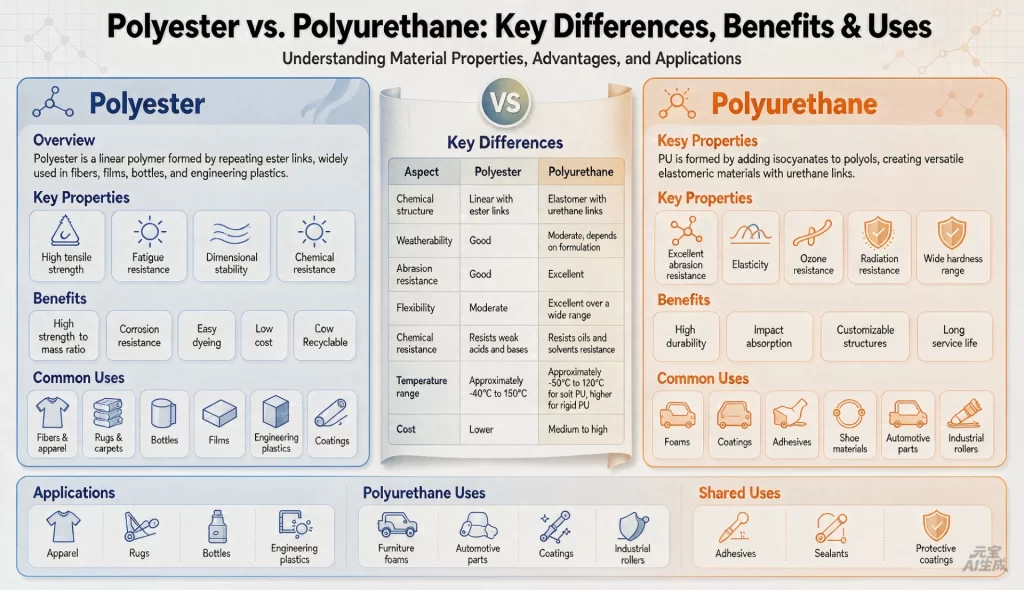
Understanding polyester vs. polyurethane is essential for fabric manufacturers, apparel brands, designers, and product developers when choosing the appropriate fabric to ensure durability, stretch, comfort, water resistance, and performance.
The important thing to remember is that polyester and polyurethane are not necessarily direct substitutes. They are actually being used jointly in many textile applications. Polyester can be used to form the basic fabric structure and polyurethane can be used to create stretch, flexibility, water protection or protection.
What Is Polyester?
Polyester is a synthetic polymer material, which is widely used as a raw material for textile fiber. Polyester is used in apparel and fabrics for its strength, dimensional stability, quick drying, wrinkle resistance and versatility.
Polyester can be made in a variety of forms such as filament, staple fiber, tow and fiberfill. The polyester staple fibres can also be blended with other fibres like spandex to enhance the comfort and stretch of the fibre.
The performance and affordability aspect of polyester is a major benefit. Its water absorbing capacity is comparatively low, it is resistant to abrasion and it does not shrink and wrinkle easily. The properties can be exploited in sportswear and in the manufacture of uniforms, home textiles, outdoor products and a multitude of applications in industrial fabrics.
Main Benefits of Polyester Fabric
- High tensile strength
- Good abrasion resistance
- Quick drying
- Excellent shape retention
- Good color retention
- Resistance to wrinkles and shrinking
- Easy-care properties
- Cost-effective for large-scale production
- Easy to blend with other fibers
Polyester is therefore often used as the structural foundation of a performance fabric.
What Is Polyurethane?
Polyurethane or simply PU is an versatile polymer material which can be synthesized in many variants such as Elastomers, Coating, Flexible Foam and Crosslinked Foam.
Polyurethane may be used as a fiber in the textile industry or to apply it as a coating or laminate. Common examples include the spandex, or elastane, that includes a lot of polyurethane and offers outstanding stretch and recovery.
PU coatings can also be used to coat textile substrates to make them more waterproof, windproof, flexible, durable and in better appearance. The protective outdoor clothing, protective clothing, bags, camping goods, and technical textiles such as protective clothing are examples of items that are usually made from PU-coated fabrics.
Main Benefits of Polyurethane
- Excellent elasticity
- High stretch and recovery
- Flexible and lightweight
- Good abrasion resistance
- Water-resistant or waterproof potential
- Wind-resistant performance
- Soft or leather-like surface options
- Suitable for technical and performance fabrics
Because polyurethane can be engineered in many different ways, its final performance depends heavily on its formulation and how it is incorporated into the fabric.
Polyester vs. Polyurethane: What Is the Difference?
The simplest way to understand the difference is to consider their roles.
Polyester is commonly used as a structural textile fiber, while polyurethane is often used to add functional properties such as stretch, elasticity, or water resistance.
| Property | Polyester | Polyurethane |
|---|---|---|
| Primary textile role | Base fiber | Stretch fiber, coating, or laminate |
| Strength | High | High, depending on formulation |
| Stretch | Limited by itself | Excellent |
| Elastic recovery | Low to moderate | Excellent |
| Water resistance | Water-repellent but not inherently waterproof | Can provide strong water resistance |
| Wrinkle resistance | Excellent | Depends on construction |
| Flexibility | Moderate | Excellent |
| Abrasion resistance | Good to excellent | Good to excellent |
| Drying speed | Fast | Depends on construction |
| Typical use | Apparel, uniforms, home and industrial textiles | Activewear, stretch fabrics, coatings, protective textiles |
This comparison also explains why the question “Is polyester better than polyurethane?” does not have one universal answer. The better material depends on the product's requirements.
Polyester vs. Polyurethane for Stretch
If stretch is the primary requirement, polyurethane has a clear advantage.
Polyurethane-based elastane or spandex can stretch substantially and recover its original shape. This makes it especially valuable for leggings, sports bras, swimwear, compression garments, yoga apparel, and other close-fitting products.
Polyester alone generally does not provide the same level of elasticity. However, polyester can be blended with polyurethane-based elastane to combine durability with stretch.
For example, a polyester-spandex fabric can provide:
- Durable fabric construction
- Comfortable stretch
- Better body movement
- Shape recovery
- Improved fit
- Easy-care performance
This combination is one reason polyester and polyurethane are frequently complementary rather than competing materials.
Polyester vs. Polyurethane for Water Resistance
Polyester naturally has low water absorption, but standard polyester fabric should not automatically be considered waterproof.
Polyurethane can significantly improve water resistance when used as a coating or membrane. A PU coating creates a barrier that helps prevent liquid water from passing through the fabric.
This makes polyester with polyurethane coating a popular construction for rainwear, outdoor equipment, protective fabrics, and technical textiles.
However, water resistance and breathability need to be considered together. A dense PU coating can provide strong water protection but may reduce air and moisture-vapor transmission. Specialized PU membranes can be engineered to provide a better balance between water resistance and breathability.
Which Is More Durable: Polyester or Polyurethane?
Durability depends on the application and the specific fabric construction.
Polyester is well known for its tensile strength, abrasion resistance, dimensional stability, and resistance to deformation. It is therefore an excellent choice when a fabric needs to maintain its shape and withstand everyday wear.
Polyurethane offers advantages in applications involving repeated movement, flexibility, impact, and elasticity. However, PU coatings can eventually crack, peel, or lose performance when exposed to prolonged flexing, excessive heat, or unsuitable chemicals.
For many demanding applications, a polyester base combined with polyurethane can provide a useful balance of strength, flexibility, and protection.
Common Applications of Polyester and Polyurethane
Activewear
Polyester and polyurethane are widely used together in performance apparel. Polyester contributes durability and quick drying, while polyurethane-based elastane provides stretch and recovery.
Swimwear
Stretch, shape retention, and resistance to repeated movement are essential for swimwear. Polyester blends containing elastane can provide the required combination of durability and flexibility.
Outdoor Apparel
PU-coated polyester is frequently used for jackets, rainwear, camping equipment, and other outdoor products because the PU layer can improve resistance to water and wind.
Fashion and Accessories
Polyurethane can also be used to create leather-like finishes for fashion products, bags, footwear, and accessories. It provides manufacturers with a flexible way to achieve particular textures and appearances.
Industrial Textiles
Polyester is widely used in industrial fabrics because of its strength and dimensional stability, while polyurethane can provide specialized performance such as flexibility, coating protection, or abrasion resistance.
Which Material Should You Choose?
The right choice depends on your product requirements.
Choose polyester when you prioritize:
- Strength
- Dimensional stability
- Quick drying
- Wrinkle resistance
- Easy maintenance
- Cost efficiency
Choose polyurethane when you prioritize:
- Stretch
- Elastic recovery
- Flexibility
- Water resistance
- Protective coatings
- Soft or leather-like finishes
For many performance applications, the best solution is not polyester versus polyurethane, but rather polyester and polyurethane together.
Frequently Asked Questions
Is polyurethane the same as polyester?
No. Polyester and polyurethane are different polymer families with different chemical structures and performance characteristics.
Is polyester or polyurethane better for clothing?
There is no one right or wrong approach. Polyester is ideal for long-lasting, dry-rot resistant fabrics, whereas polyurethane is well suited for stretch fabric, elasticity and special finishes. The benefits of both can be achieved with a polyester-polyurethane mixture.
Is polyester with PU coating waterproof?
By using an appropriate coating formulation, thickness, construction and testing requirements, polyester can be rendered highly water-resistant or waterproof.
Is polyurethane fabric stretchy?
It can be. Elastane made of polyurethane is extremely elastic and is often used for providing stretch and recovery in fabrics. However, PU coatings are different and don't necessarily make a fabric stretch.
Final Thoughts
Comparing polyester to polyurethane isn't a straightforward process—you have to understand more about the material than their names imply, and how they work in the finished fabric.
Durable, versatile, easy care, quick drying, polyester is a strong, inexpensive and stable textile fibre. Polyurethane is highly flexible, elastic and can be function coated. Today, the two materials are frequently combined in performance fibers to make for both durability and comfort.
When it comes to selecting the ideal fabric, material buyers and manufacturers have a range of factors to consider, such as the application, stretch, water resistance, durability, hand feel, breathability, and budget. Choosing the correct fiber content and construction of the fabric can help guarantee the finished product will meet the expectations of the consumer.