



Updated 5 hours ago
Silicone Rubber for Molds: Types, Uses, Mixing & Curing Guide
sidrahafeez754

What is Silicone Rubber Used for in Mold Making?
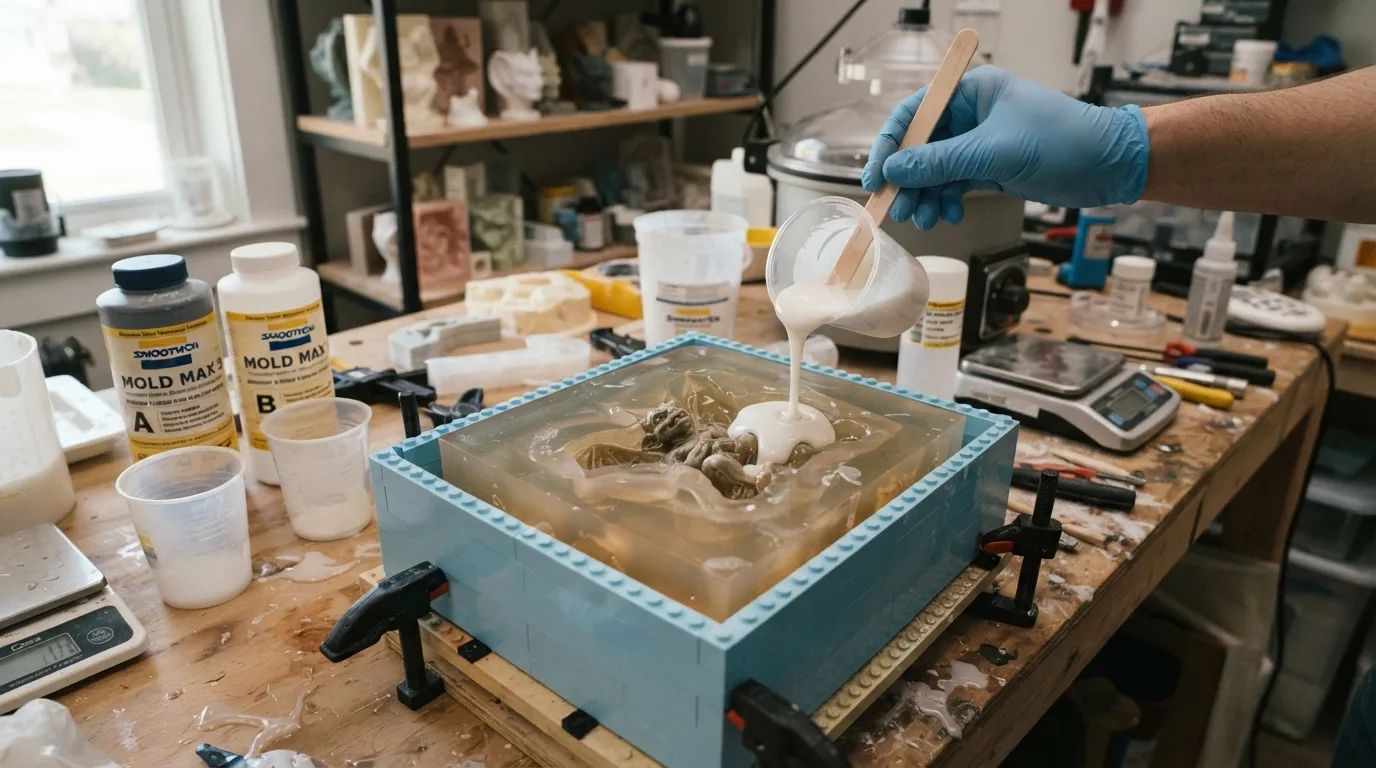
Mold-making silicone is a soft polymer compound that is employed to make a negative impression of a master model. Silicone is liquefied and poured around the model and left to dry. After the silicone mold curing process is complete, the original model can be removed. This forms a reusable mold to cast materials like resin, wax, gypsum, and other appropriate materials.
- It can be referred to as silicone mold rubber, silicone molding rubber, silicone molding material, or silicone elastomer. Another common term is RTV silicone rubber. RTV is an abbreviation of room temperature vulcanizing, a system that does not need industrial heat to cure.
- JINHUAs 717AB-F is a two-part platinum system that is used to create detailed molds. It is also easy to see the material when preparing and pouring because of its translucent nature.
Why Viscosity is Important in Mold Making
The viscosity determines the ease of movement of liquid silicone. A material with less viscosity tends to flow more easily around small lines, corners, and shallow textures. This is particularly handy in creating molds with detailed surface features.
- JINHUA reports a dynamic viscosity of 1500 + 500 mPa s for the two components of 717AB-F. The product is made to be highly flowable and release natural bubbles, and this ensures that the material gets to the small surface patterns before it is cured.
- Silicone flow is significant due to the possibility of pinholes or missing details caused by trapped air. These issues can be mitigated by slow mixing, controlled silicone mold pouring, and appropriate resting time. In cases where it is possible to use it, vacuum degassing can also be employed.
- Soft silicone rubber for molds is especially helpful in cases where there are undercuts in the model. The mold is able to bend out of the completed casting rather than pushing the part out violently.
- But soft is not necessarily good. Big molds might require extra support since too much flexibility can impinge on dimensional precision. Optimal hardness is determined by the size of the mold, geometry, and casting material, and demolding technique.
Platinum Cure Silicone Vs Tin Cure Silicone
Mold-making materials have various curing chemistries. Platinum cure silicone or addition cure silicone involves the use of a platinum catalyst to form the cured rubber network. Another reaction system is used in tin-cure silicone, also known as condensation-cure silicone.
- The two types are both used, but their processing behavior and compatibility may vary. In choosing a two-part silicone rubber, it is always important to consult the technical data of the manufacturer and test it on the actual master model and casting compound.
- The 717AB-F of JINHUA is a platinum-cured silicone rubber RTV-2. RTV-2 implies that the material is provided in two parts which are mixed and then cured. The mixing ratio is 1:1.
Significant Technical Properties to Check
The decision to use mold-making rubber may be based on the appearance, which may not give consistent results. It is more effective to make comparisons of measurable properties. Look at:
- Silicone viscosity, influencing flow and detail penetration.
- Elongation at break, which demonstrates the degree of stretch of the material.
- Curing time, which affects production schedules.
- Working time and pot life, the time the mixed material is usable.
- Silicone shrinkage that may compromise dimensional accuracy.
- Resistance to temperature, particularly warm casting materials.
- Chemical resistance, which must be equal to the casting compound.
- Silicone compression resistance that is important when loading molds repeatedly.
- Release properties, which affect the ease of separation of finished parts.
In the case of 717AB-F, JINHUA states that it operates in about 0.5 hours at 25 o C and cures at room temperature in about four hours.
How to Improve Mold Flexibility and Service Life
Flexibility of silicone rubber for molds is not just dependent on Shore A hardness. Performance is influenced by mold thickness, geometry, tear strength, and casting conditions.
To increase the life of reusable silicone molds, do not overstretch or cut them when demolding. Wipe off finished molds and store them in an area free of unwarranted heat, dust, and mechanical stress.
It is also important that the casting material. The mold can be subjected to various demands by resin, wax, plaster, and other compounds. According to JINHUA, mold life may be dependent on the strength of the tear, the material used in casting, the method of demolding, storage, and repeated exposure to deep undercuts or sharp edges. An appropriate silicone mold release agent can also come in handy in certain applications, though compatibility must always be verified.
Selection of a Trustworthy Mold-Making Material
The optimal silicone molding material is not necessarily the softest or the quickest-curing one. It requires a balanced technical profile of the actual mold.
- Look at the master model, the hardness of Shore A, the viscosity, the working time, the curing conditions, the number of castings to be expected, and the casting material, and then decide.
- To do detailed craft work, a soft formulation with good elongation and tear resistance can be used to simplify demolding. In the case of larger molds, more significant shape support can be considered.
- The silicone product line of JINHUA is aimed at flowability, detail reproduction, flexible demolding, and reusable mold performance. The 717AB-F specification is a blend of soft 0-30 Shore A hardness with a 1:1 mix ratio and natural release of bubbles.
Conclusion
The correct material is the first step to a good mold, but the formulation is equally important. Viscosity affects flow. Hardness affects flexibility. Demolding is influenced by tear strength. Curing behavior affects production time. The combination of these properties creates an easier-to-use and more reliable mold in repeated casting cycles.
In projects that require flexibility, reproduction of details, and dependable remolding, the silicone rubber of molds provided by JINHUA can provide an effective starting point. Get product samples, technical advice,e or OEM/ODM solutions to fit your mold-making process at JINHUA.