



Updated 5 hours ago
Silicone Mold Making Material for Detailed and Flexible Molds
sidrahafeez754
Silicone Mold Making Material: A Technical Guide for Flexible Molds
A good mold is not merely a copy of a shape. It captures fine lines, releases easily, is flexible, and can withstand repeated casting. This is why it is so important to select the appropriate silicone mold-making material.
- Silicone is a handy compromise of flexibility, durability, and detail reproduction for craft makers, resin casters, and small manufacturers. Contemporary mold-making silicone has the capability of reproducing shallow textures and fine patterns and also enables the created mold to bend around delicate forms.
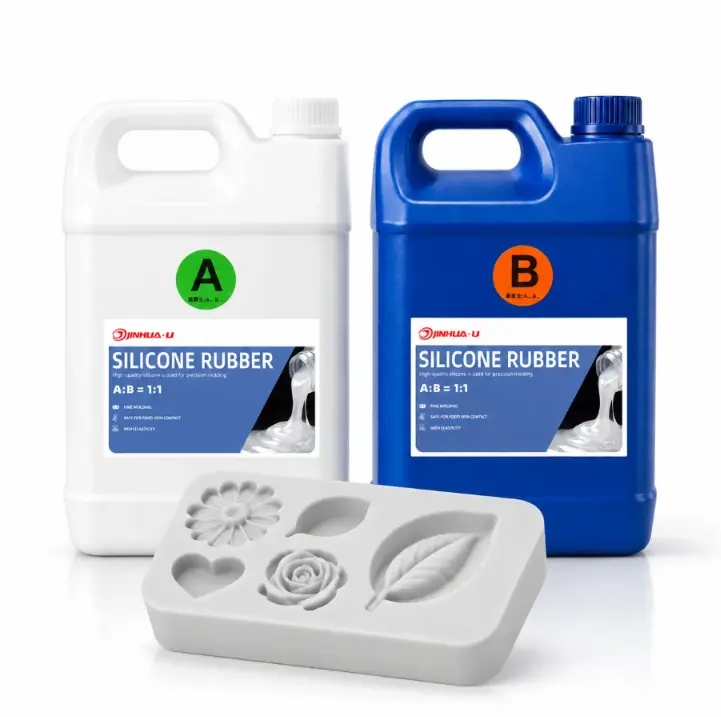
- The 717AB-F of JINHUA is a 0-30 Shore A platinum silicone mold. It is intended to be used in soft, flexible molds and detailed craft. The product has a 1:1 mixing ratio, is translucent, and cures at room temperature in approximately four hours.
What is Silicone Mold Making Material?
Silicone mold material is a flexible polymer system that can be used to make reusable negative molds based on a master pattern. The original model is surrounded by liquid silicone rubber, which is left to dry. After crosslinking, the flexible mold may be detached from the master.
- The term encompasses a number of formulations such as RTV silicone, RTV silicone rubber, silicone elastomer, and silicone molding compound. RTV refers to room temperature vulcanization, which means that the material can cure at room temperature instead of having to be heated in an industrial furnace.
- A typical two-part silicone contains Component A and Component B. These are mixed in a given mixing ratio. The silicone catalyst or curing agent then starts the chemical reaction that creates the cured rubber network.
Importance of Silicone Viscosity in Mold Making
- Silicone viscosity influences the ease with which the material can flow around a master model. Silicone with low viscosity is able to penetrate small crevices and on small surface details. Silicone with high viscosity can offer a more viscous flow profile and can act differently when being poured.
- Good silicone flow is particularly helpful in creating molds with small grooves, shallow textures, lettering, and miniature details. The release of natural bubbles may also be used to minimize the presence of trapped air in the mold cavity. JINHUA particularly explains this material as possessing natural release of bubbles and high detail reproduction.
Platinum Cure Silicone Vs Other Silicone Systems
All silicone molding materials do not have the same curing chemistry. There are two popular types: platinum cure silicone and tin cure silicone.
- Addition cure silicone is also known as platinum cure silicone. Tin-cure silicone is generally associated with condensation-cure silicone. They may be both useful; however, their processing characteristics, compatibility, and curing behavior may vary.
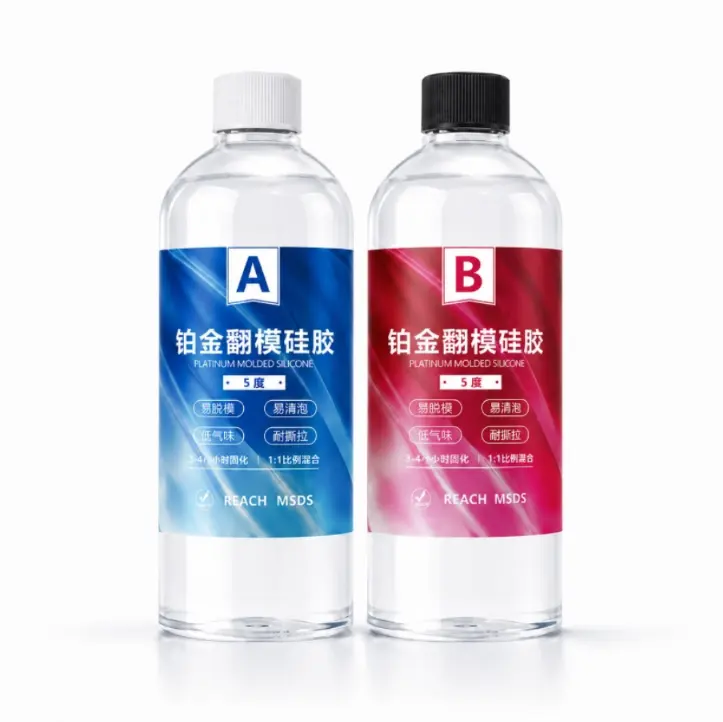
- A two-component platinum system is applicable in cases of controlled mixing and predictable room-temperature curing. The 717AB-F of JINHUA is a platinum mold silicone and has a mixing ratio of 1:1. The product recommends room-temperature curing of about four hours.
Technical Properties
In the case of silicone rubber as a mold material, one can make the wrong decision by just considering the hardness. It is preferable to consider the overall technical profile. Important properties include:
• Tear strength, which is important in demolding and in repeated use.
• Elongation at break, which demonstrates the distance that silicone can be stretched before breaking.
• Curing time, which influences the speed of production.
• Pot life and working time that define the duration of the mixed silicone in service.
• Silicone contraction that may influence dimensional accuracy.
• Dimensional stability, particularly with detailed master models.
• Mold flexibility, useful in complicated shapes and undercuts.
• Mold durability, influencing repeated casting performance.
• Release properties, which affect the ease of separation of the completed part.
JINHUA gives an operating time of 0.5 hours at 25 °C for 717AB-F, then room-temperature curing of about four hours.
Achieving Better Results in Silicone Mold Making
The stage of preparation influences the final mold quite surprisingly. Begin with a clean master model and a stable mold box. Weigh silicone components and mix them in the recommended proportion.
- In the case of a 1:1 system, Components A and B are to be measured in equal quantities. Blend gently to reduce unnecessary air introduction. Where vacuum degassing equipment is available, it can be used in case the application needs very clean surfaces.
- But the 717AB-F of JINHUA is designed to release natural bubbles. To minimize trapped air, the company advises that it should be mixed slowly and poured carefully.
- A low-height pour can also assist in spreading the silicone around small features. Give ample time to cure and then demold. Squeezing a soft mold too hard will ruin fragile edges.
Selecting the Right Silicone to Use in Your Project
The optimal silicone elastomer is dependent on what you are producing. A soft formulation may be very good to use on complex shapes, flexible areas, and simple demolding. When the mold requires more structural support, a more difficult formulation can be used. To ease the removal of a silicone mold-making material, a tear-resistant and highly elongating material can be used in fine craft work. In the case of repeated production, the durability of molds and dimensional stability are of greater importance.
Conclusion
Casting should be made easier by a mold; not every project should be a struggle. The correct silicone viscosity assists material to fine details. The right Shore A hardness enhances flexibility. Good tear resistance facilitates cleaner demolding, and appropriate curing conditions ensure consistency.
Select JINHUA to rely on reliable mold-making materials, technical requirements, and customized solutions. Get in touch with JINHUA to talk about samples and identify a silicone formulation that fits your casting process.