



Updated 28 minutes ago
Eco Resin Manufacturer for Sustainable & Bio-Based Resin Solutions
sidrahafeez754
Eco Resin Manufacturer: Sustainable Resin Materials and Production
The resin business is evolving. Customers no longer consider only the clarity, hardness, curing speed, and price. They also desire to know the origin of materials, their manufacturing process, and the environmental concerns that are incorporated in the process.
- That change has generated increasing demand for an eco resin producer that can integrate trusted resin chemistry with more responsible material decisions. Nevertheless, the term eco must not be used as a blanket statement. A resin can be based on renewable feedstock, have recycled material, generate fewer VOC emissions, or have a water-based system. These are various features, and they are to be considered individually.
- In the case of businesses that purchase resin in large quantities, the objective is straightforward: to identify a formulation that can be used consistently and that can be used to promote viable sustainability goals.
What is More Sustainable About a Resin?
The process of sustainability begins with formulation. The environmental profile of a resin may be affected by the raw materials, the manufacturing process, the energy consumption, the packaging, the durability, and the end-of-life.
A resin manufacturer can be sustainable by using renewable feedstock or coming up with a formulation that minimizes wastage and enhances the efficiency of the material. Other products can be bio-based, whereas others can be low-emission or have an extended service life. Common approaches include:
• Using renewable or partially renewable raw materials
• Recycling more where appropriate.
• Cutting down on manufacturing waste.
• Improving production efficiency
• Formulation of low-VOC or low-odor formulations.
• Maximizing packaging and material use.
• Increasing the life span of products to minimize the frequency of replacement.
This is the reason why an environmentally friendly resin manufacturer ought to present quantifiable technical data instead of making general green statements.
Bio-Based Resin, Recycled Resin, and Renewable Resin
These two terms are usually confused, yet they characterize various material routes.
- A bio-based resin has some bio or renewable material. A plant-based resin is a kind of bio-based resin in which feedstocks can be plant-based. A manufacturer of renewable resin can also rely on renewable feedstocks to minimize reliance on fossil-based feeds.
- Recycled resin, on the other hand, is a material that has been reused in a past product or manufacturing waste. Recycled-content resin has the potential to facilitate material circularity, but its applicability relies on the performance and purity needed.
A resin may thus be bio-based, but not biodegradable. Similarly, recycled resin does not necessarily make good compost. These differences are important in the choice of materials to use in commercial products.
Green Epoxy Resin and its Performance
Sustainability must not be at the cost of fundamental performance. A green epoxy resin must be able to fulfill the needs of the target application.
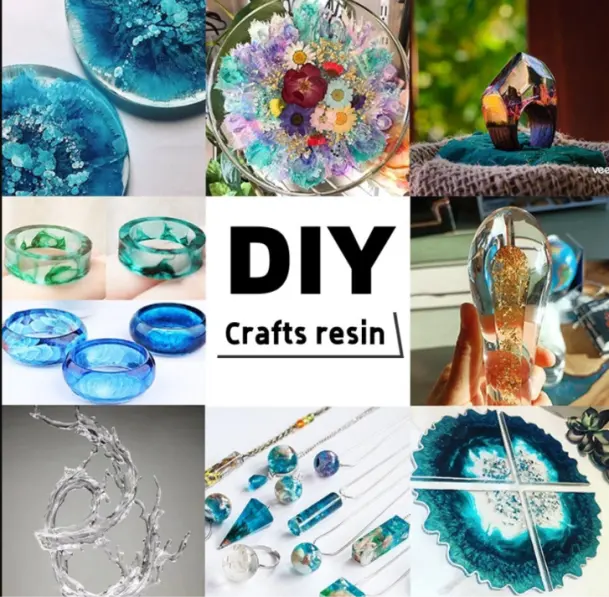
As an example, a sustainable epoxy resin to be cast might require good clarity, controlled viscosity, reliable curing, and adequate hardness. A bio-based epoxy resin can be interesting due to its renewable nature, yet its mechanical and thermal characteristics must be suitable to match the project. It is also said to be transparent, yellowing-resistant, and can be used in small ornaments, jewelry, keychains, and miniature encapsulation projects. The final result
The Final Result is Controlled by Resin Chemistry
A well-balanced chemical system is behind all resins. The formulation of resin dictates the flow, reaction, curing, and post-hardening performance of the material. A manufacturer operates with the resin chemistry and polymer formulation to regulate the following properties:
• Viscosity and flow
• Mixing ratio
• Pot life
• Curing time
• Hardness
• Tensile strength
• Flexural strength
• Thermal resistance
• Chemical resistance
• Transparency
• Yellowing resistance
• Dimensional stability
These are particularly significant when coming up with a sustainable polymer to be used in business. Reformulation can change multiple other properties when a single raw material is changed, and therefore sustainable reformulation needs to be properly tested and not merely an ingredient substitution.
Applications of Eco-Friendly Resin
Many applications can be made of sustainable resin solutions. The specific formulation must always be aligned with the performance required. Potential applications include:
- Decorative objects, small molds, jewelry, ornaments, and craft pieces can be cast using eco-friendly resin. The 1011AB of JINHUA is specifically designed to work with small casts and can be used on miniature ornaments, jewelry, keychains, and encapsulation work.
- Sustainable casting resin may also be used in larger applications where controlled curing and heat management are considerations. JINHUA, an eco resin manufacturer, has a variety of casting formulations such as those that are used to make deeper pours and larger mold fillings.
- Other possible applications are in adhesives, coatings, electronic encapsulation, flooring, furniture, composites, and decorative uses. JINHUA explains its wider range of resins in crafts, electronic potting, LED lighting, flooring, architectural decoration, and furniture production.
Importance of Technical Data in Selecting a Supplier
A resin supplier that is sustainable must be capable of offering more than just appealing product descriptions. To make a comparison of formulations, buyers require quantifiable data. Search technical documents that include:
• Mixing ratio
• Viscosity
• Pot life
• Curing time
• Hardness
• Density
• Thermal performance
• Chemical resistance
• Mechanical properties
• Storage conditions
• Shelf life
• Safety information
JINHUA offers technical data sheets of various types of epoxy, UV resin, silicone, PU, gypsum, and other related materials via its technical download center.
Selecting an Eco Resin Supplier to Supply in the Long-Term
An effective supplier of eco resin must be aware of environmental objectives and manufacturing realities. The consistency of products is as important as the sustainability story.
- Compare the formulation with your actual process before making a large order. Check viscosity, mixing ratio, curing behavior, hardness, appearance, and compatibility with molds or substrates. The small-scale trials can expose problems that cannot be detected by looking at a specification sheet.
- Supplier capability also becomes a factor in case you require custom packaging, private labeling, or formulation modifications. We offer OEM/ODM services including formulation, packaging, and own-label services.
Create Better Resin Solutions at JINHUA
- Sustainability is a concept that makes sense when it is practical. The correct resin must be reliable, minimize unnecessary waste, and fit the production process without causing new issues.
- JINHUA, an eco resin manufacturer, produces epoxy resin, casting resin, UV resin, silicone, adhesives, and specialty materials used in craft, industrial, electronic, flooring, furniture, and other applications. It has a product line consisting of fast-curing 1011AB cast resin with a weight mixing ratio of 3:1, 45-minute pot life, 4 to 5-hour curing time, and Shore D 87 hardness.
Conclusion
A label is not a definition of a greener resin. It is characterized by what is contained in the formulation, its performance, its efficiency in production, and what it has to say about its environmental assertions. Today, contact JINHUA and talk about your resin project and identify a viable material solution that is designed around your technical and production requirements.