



Updated 1 month ago
Metallic Epoxy Floor Coatings: Benefits, Uses & Installation Guide

hqt

Many homeowners, designers, contractors and commercial property owners are opting for metallic epoxy floor coatings as they offer a durable yet decorative look. Instead of solid colour epoxy floors, metallic epoxy produces flowing patterns, depth and reflections that can resemble natural marble, polished stone, molten metal, clouds, water flowing etc.
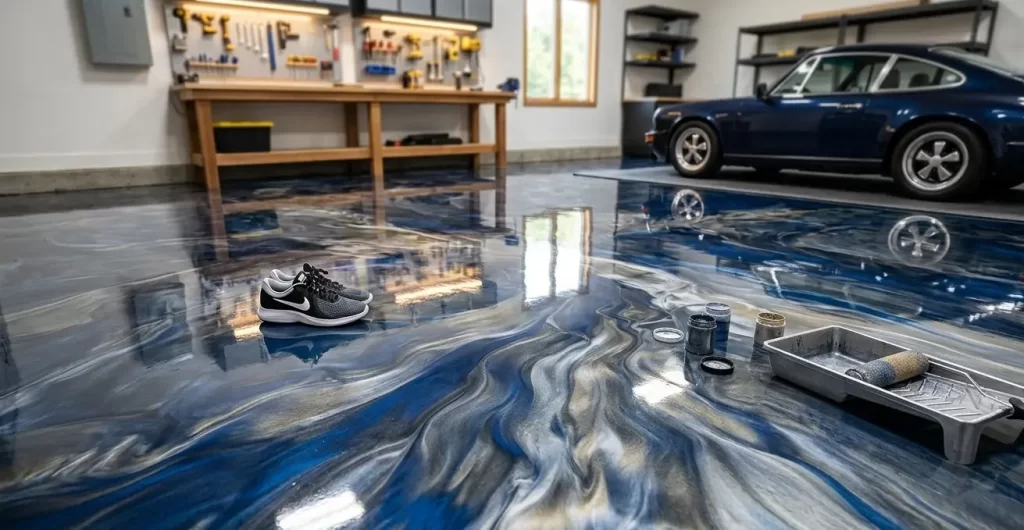
Each application will be different, and a metallic epoxy floor can give a completely personalized effect. Meanwhile, the smooth surface of the epoxy has some practical advantages, such as stain resistance, resistance to water, chemicals and relative ease of upkeep.
This guide will provide you with an understanding of the meaning of metallic epoxy flooring, how it operates, the primary benefits it offers, its application and considerations before installation.
What Is Metallic Epoxy Flooring?
A decorative floor coating system comprising of specially formulated metallic pigments and epoxy resin. The pigmented epoxy is brushed on a well-prepared concrete base and formed in place while it is still damp.
The metallic particles are redistributed while the coating is curing. The coating may exhibit pronounced swirls, waves, veins, ripples and three-dimensional effects depending upon the pigment combination, application technique, airflow and tools employed by the applicator.
This is the difference between metallic epoxy and normal epoxy floor. A standard epoxy floor will most likely come with a solid color finish or flake design, while metallic epoxy is formulated to create movement and visual depth.
Silver, gold, copper, bronze, black, white, blue, green, red, and charcoal are popular metallic hues. Many different pigments can also be used together to create unique flooring designs.
How Does Metallic Epoxy Flooring Work?
There are several layers of materials that make up a professional metallic epoxy floor.
Preparation of the concrete substrate is the first thing to consider. Other contaminants such as dirt, grease and coatings, and weak concrete must be removed to enable the new coating to bond properly.
Depending on the type of floor system and whether the concrete is in good condition or not, a primer or base coat can be applied. Then the metallic epoxy is added.
The metallic pigments are incorporated into the epoxy and controlled to achieve the desired appearance. The movement of the pigments can be affected or directed by the use of rollers, brushes, special tools, airflow, or other methods that the installer wishes to employ.
Finally, a clear protective topcoat is frequently put on the decorative layer. The urethane or polyaspartic topcoat can be used in the right application to enhance abrasion, chemical and UV resistance and preserve the underlying metallic design.
The movement of the pigment is in part unpredictable and therefore no metallic epoxy floor will look exactly the same. This natural change is one of the primary reasons why metallic epoxy is appealing for custom interior design.
Key Benefits of Metallic Epoxy Floor Coatings
1. Unique, High-End Appearance
Metallic epoxy flooring has the greatest benefit in terms of its look. A floor using metallic pigments and epoxy can result in a beautiful floor that has depth and movement.
The final look of the surface may be reminiscent of:
- Natural marble
- Polished stone
- Molten metal
- Flowing water
- Clouds
- Abstract artwork
- Industrial metal
This makes metallic epoxy especially attractive for spaces where the floor is part of the overall interior design.
2. Seamless Surface
Unlike other tile flooring, there are not any conventional grout strains in metallic epoxy flooring. When properly installed, a coating forms a continuous and seamless surface.
There are no joints to allow dirt, dust or spills to accumulate, making the floor easier to clean.
3. Durable and Wear Resistant
Epoxy flooring is meant to endure day-to-day wear and tear and harsh surroundings. Metallic epoxy systems offer good abrasion resistance, stain resistance, moisture resistance and resistance to many common chemicals with an appropriate protective topcoat.
But actual performance will depend on the complete flooring system, substrate preparation, quality of installation and choice of topcoat.
4. Easy to Clean
A properly sealed metallic epoxy floor has a non-porous surface which is relatively easy to maintain.
Typical maintenance involves cleaning the surface with a pH neutral cleaner, and dust and debris removal. Spills may also be cleaned prior to growing into a bigger problem.
More special consideration should be given to the cleanliness of high gloss metallic floors as dust and fine grit can stand out on reflective surfaces.
5. Extensive Design Options
Metallic epoxy offers a variety of design options. Many pigments can be mixed to create delicate, sophisticated designs or to create dramatic and decorative design.
Silver and charcoal tones, for instance, can give a sophisticated industrial look, while Blue and white can evoke a water or cloudy look.
Businesses can also choose colours that will match the branding or interior design.
6. Moisture and Chemical Resistance
When installed properly, the epoxy coating forms a solid barrier that protects the concrete surface. In the hands of a qualified topcoat, the system can withstand moisture and most common chemicals.
Metallic epoxy is good for use in areas where spills and regular cleaning are anticipated.
Where Can Metallic Epoxy Flooring Be Used?
Metallic epoxy is suitable for many residential, commercial, and specialty environments.
Residential Spaces
Homeowners commonly choose metallic epoxy for:
- Garages
- Basements
- Kitchens
- Living rooms
- Home offices
- Entertainment areas
- Custom interiors
It can transform an ordinary concrete floor into a visually distinctive feature.
Automotive Showrooms and Garages
The reflective appearance of metallic epoxy works particularly well in automotive dealerships, motorcycle showrooms, luxury garages, and display areas.
The seamless surface also makes routine cleaning easier.
Retail Stores
Retail businesses can use decorative epoxy flooring to create a modern and premium shopping environment. Custom colors can be selected to complement the store's interior or brand identity.
Restaurants and Hospitality
Restaurants, bars, hotels, entertainment venues, and hospitality spaces can benefit from metallic epoxy because it combines decorative appeal with a seamless surface that is relatively easy to clean.
Offices and Commercial Interiors
Metallic epoxy can also be used in offices, lobbies, reception areas, studios, and other commercial interiors where appearance is important.
Entertainment and Event Venues
Nightclubs, theaters, casinos, and event spaces can use metallic effects to create dramatic flooring that becomes part of the overall visual experience.
Metallic Epoxy Flooring Installation Process
Professional installation generally starts with concrete preparation.
Step 1: Inspect and Prepare the Concrete
The installer evaluates the concrete for cracks, contamination, moisture problems, weak areas, and previous coatings.
Mechanical grinding or other preparation methods may be used to create a suitable surface profile.
Step 2: Repair the Substrate
Cracks, holes, spalls, and other imperfections should be addressed before coating installation.
Proper preparation is critical because even an attractive metallic finish cannot compensate for serious substrate problems.
Step 3: Apply the Base or Primer Coat
Depending on the selected system, a primer or base coat is applied to improve adhesion and establish a suitable foundation for the decorative layer.
Step 4: Apply Metallic Epoxy
The metallic epoxy is mixed according to the manufacturer's requirements and applied to the prepared floor.
During the coating's working time, the installer manipulates the material to create the desired pattern and depth.
Step 5: Apply a Protective Topcoat
After the metallic layer has cured sufficiently, a clear protective topcoat can be installed.
For many applications, a UV-stable urethane or polyaspartic topcoat is preferred because it can provide additional protection against wear and sunlight.
Are Metallic Epoxy Floors Slippery?
A smooth, high-gloss epoxy surface can become slippery when wet. This is an important consideration for garages, entrances, restaurants, and other areas where water or liquids may be present.
Slip resistance can be improved by incorporating an appropriate anti-slip additive into the protective topcoat. The goal is to increase traction while maintaining the desired decorative appearance.
How to Maintain a Metallic Epoxy Floor
Metallic epoxy flooring is relatively easy to maintain when the protective topcoat is in good condition.
A basic maintenance routine includes:
- Sweep or dust mop regularly.
- Remove sand and abrasive debris promptly.
- Clean spills as soon as practical.
- Use a mild, pH-neutral floor cleaner.
- Avoid aggressive abrasive cleaning products.
- Use appropriate mats in high-traffic areas.
- Follow the coating manufacturer's maintenance recommendations.
The protective topcoat is particularly important because it protects the decorative metallic layer from everyday wear.
Metallic Epoxy Flooring: Is It Right for You?
Metallic epoxy flooring is a strong option when you want both decorative impact and functional performance.
It is particularly suitable for homeowners and businesses looking for a customized, seamless floor with a premium appearance. It works especially well in showrooms, garages, retail spaces, hospitality venues, entertainment areas, and modern residential interiors.
However, metallic epoxy is not simply a decorative paint. Successful results depend heavily on concrete preparation, material selection, application technique, environmental conditions, and topcoat selection. Because the metallic effect is created while the coating is curing, installer experience can have a significant impact on the final appearance.
Frequently Asked Questions
How long does metallic epoxy flooring last?
The service life depends on traffic, substrate conditions, coating quality, installation, and maintenance. A professionally installed system with a suitable protective topcoat can provide long-term performance.
Is metallic epoxy better than regular epoxy?
Neither is universally better. Standard epoxy is generally more suitable when you want a consistent color or decorative flake appearance. Metallic epoxy is preferable when the goal is a customized, three-dimensional decorative finish.
Can metallic epoxy be customized?
Yes. Metallic pigments are available in many colors and can be combined to create different patterns, contrasts, and visual effects.
Can metallic epoxy be used outdoors?
Epoxy is mostly known as a metallic epoxy. The complete coating system, along with UV exposure, temperature changes, moisture and outdoor environments, are all factors that must be considered. A more suitable system could be a UV resistant system for the specific environment.
Is metallic epoxy easy to clean?
Yes. A well sealed out Metallic Epoxy floor will be smooth and seamless and is usually easily sweepable and mopped. Abrasive dirt can be removed regularly, which helps to protect the finish.
Final Thoughts
Metallic epoxy floor coatings are a completely unique hybrid of art and flooring. They're three-dimensional, have a reflective shine, are seamlessly constructed, and have customizable colors, making them an appealing option to traditional flooring materials.
Metallic epoxy can make a concrete floor look unique and special in an array of settings, such as luxury garages and automotive showrooms, restaurants, retail, basements, and modern living rooms.
When selecting a metallic pigment, be sure to concentrate on more than the pigment itself. The key factors in a beautiful and long-lasting metallic epoxy floor are: preparing the concrete correctly, using a compatible epoxy system, professional application methods, and a tough protective topcoat.