





The cured epoxy resin is used for its outstanding strength, durability, chemical resistance and good adhesion. The combination of these properties renders epoxy as a great adhesive, coating, electronic potting compound, flooring material, woodworking compound, and industrial compound. But the very characteristics that make epoxy so dependable make it very hard to take off once it has hardened.
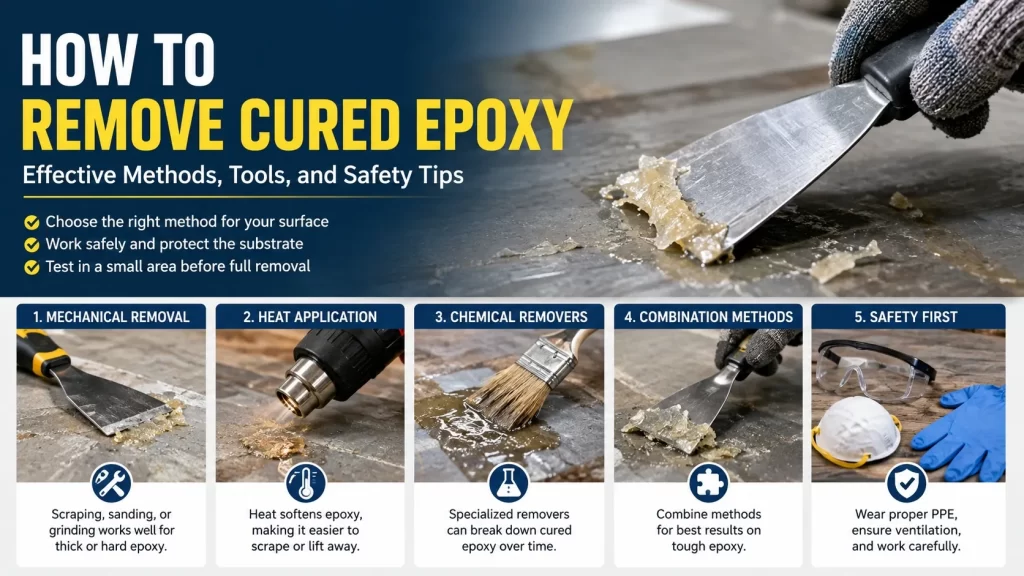
When removing hardened epoxy from metal, wood, concrete, plastic, glass or electronic components, it is important to select the proper method. Each of these methods – mechanical removal, heat treatment and chemical removers – is effective under certain conditions, with varying benefits and risks.
This guide discusses the process of the safe removal of cured epoxy, the best techniques for removing it, and some precautions to take to protect the underlying material.
Why Is Cured Epoxy So Difficult to Remove?
Typically, epoxy is a system of two parts – a resin and a hardener. During the curing process, these components react and create a very cross-linked polymer structure. After curing, the epoxy is a thermoset material and is not "meltable," unlike a polymer that can be remolded by heating it to a molten state and cooling it.
These qualities of adhesive, waterproof and chemical resistant are exactly those that are used in demanding applications. But these attributes are not helpful for removal either. The cured epoxy can be very well bonded to the substrate and can require more than one technique to remove, says MG Chemicals.
The first is thus to find three factors:
- How thick is the cured epoxy?
- What material is underneath it?
- How strongly is the epoxy bonded?
What might work well for a steel part could be totally unsuitable for plastic or a fragile printed circuit board.
1. Mechanical Removal: Sanding, Scraping, and Chipping
For many applications, mechanical epoxy removal is the most controlled approach.
Mechanical removal involves physically breaking, cutting, scraping or abrading the cured epoxy. Common tools include:
- Plastic or metal scrapers
- Putty knives
- Chisels
- Sandpaper
- Rotary tools
- Orbital sanders
- Grinding equipment
If thick epoxy deposits, it's best to remove the majority of the epoxy using a scraper or chisel. After most of the epoxy has been stripped off, you can use sanding to remove the rest of the thin epoxy film.
Mechanical removal works best on metal and concrete, as these surfaces can withstand more abrasion than delicate plastics or finished surfaces. Mechanical removal is also easier to use on concrete and metal substrates. However, too much force may be able to scratch, gouge or damage the substrate.
Best Practice for Mechanical Removal
Go with the least aggressive tool that will remove the epoxy. If a plastic scraper is effective, don't have to use a grinder immediately.
If you have thick deposits, slowly tap off the epoxy, don't try to remove all of it in one. This will make it easier for you to have a handle on the material as you come to it.
Use appropriate eye protection and respiratory protection and control dust when sanding or grinding cured epoxy (where possible).
2. Using Heat to Soften Cured Epoxy
Some cured epoxy systems will become easier to remove with heat. At temperatures exceeding its glass transition temperature (Tg), the epoxy can soften and become less rigid. This can decrease its adhesion to a point where it's possible to be scraped off or separated.
For localized applications a heat gun is typically used. As the epoxy softens, it can be removed by means of a scraper or other appropriate tool.
This method is especially suitable for epoxy adhesive joints and localized deposits. According to MG Chemicals, exposing the epoxy to temperatures above its Tg (glass transition temperature) increases the ability to remove the epoxy and make it more pliable.
Care must be taken with the use of heat, however.
Excessive temperature can:
- Damage plastic components
- Discolor wood
- Burn coatings
- Deform substrates
- Damage electronic components
- Create unpleasant or hazardous fumes
- Increase fire risk
Maximum allowable temperature is variable and will depend on the epoxy and the substrate. So, exercise control over the heat and don't focus heat in any one spot for too long.
3. Chemical Removal of Cured Epoxy
When mechanical means are not practical, chemical removal is also possible. It's necessary to comprehend however, that common house solvents are not always effective against fully cured epoxy.
The cured epoxy is much more resistant to chemicals than the uncured epoxy. After a period of time, the special epoxy removers can soften the material, enabling it to be scraped off.
Specialty product 8309 and 8310A are offered by MG Chemicals, intended for use in cured coatings and materials related to epoxy. Additional note by the company: The soaking time varies depending on the resinand hardener, fillers and formulation.
One of the primary factors is substrate compatibility. The chemicals that soften epoxy can also be harmful to other plastics, coatings, adhesives or finishes.
Before using any chemical remover:
- Read the product's technical documentation.
- Confirm compatibility with the substrate.
- Test it on a small, inconspicuous area.
- Follow the manufacturer's recommended exposure time.
- Provide appropriate ventilation.
- Wear the PPE specified on the product label or safety data sheet.
Chemical removal can require hours rather than minutes, especially when dealing with highly cross-linked, low-filler epoxy systems.
4. How to Remove Epoxy from Different Surfaces
The best epoxy removal technique depends heavily on the substrate.
Metal
Typically, one of the more forgiving surfaces for removal of the cured epoxy is metal. Depending on the component, all the following methods are acceptable: Mechanical scraping, sanding, grinding and controlled heat.
Don't use hard grinding when it may alter the size or surface treatment of precision metal parts.
Wood
Care needs to be taken with wood because sanding and scraping too hard can cause the removal of wood fibers with the epoxy.
If the epoxy is thin, it can be controlled sanded. Gentle and regular checks of the surface. In some cases, heat may be appropriate, but will burn the wood or harm the surface finish.
Concrete
Concrete is very durable and it can usually resist mechanical grinding or abrasion. If the coating is for a large area, the use of a special floor grinding machine can be considered.
Removal of epoxy can produce a lot of dust so it is important to have adequate dust collection and personal protective equipment (PPE).
Plastic
Plastic is much more heat and chemically sensitive. A solvent that will melt cured epoxy can melt or harm the plastic that is under the cured epoxy.
In the case of plastic parts, start with the most benign mechanical method available. Only use chemical removers after testing for compatibility.
Electronics and PCBs
The removal of cured epoxy from electronics is a very challenging application. Epoxy potting compounds are formulated to protect components and can be used to securely enclose electronic assemblies.
Components, solder joints, traces, connectors and circuit boards can be damaged by mechanical force, heat, or chemicals. The complete removal from potted PCBs has a low probability of success, without harming the underlying components, MG Chemicals says.
If the value of the electronics is high, consider whether it is technically and economically feasible to remove electronics before starting.
5. Can Acetone Remove Cured Epoxy?
One popular enquiry is: Can cured epoxy be dissolved with acetone?
This is dependent on the formulation and cure state of the epoxy. Fully cured epoxy is more resistant to acetone and other solvents, which can be used for cleaning or removal of uncured epoxy.
Thus it might be useless to apply the acetone to a thick layer of fully cured epoxy. Chemical softening may be more appropriate, where specialized epoxy removers are available.
Test the compatibility of the solvent before use on plastic, painted surfaces or wood finishes or other sensitive surfaces.
6. Choosing the Best Epoxy Removal Method
There is no universal method for removing cured epoxy. The best approach depends on the application.
| Removal Method | Main Advantage | Best Application |
|---|---|---|
| Scraping | Precise and inexpensive | Small epoxy deposits |
| Sanding | Controlled material removal | Wood, metal, coatings |
| Grinding | Fast for thick layers | Concrete and durable metal |
| Heat | Can soften adhesive bonds | Selected bonded joints |
| Chemical remover | Useful for difficult residues | Suitable compatible substrates |
| Combination method | Flexible and effective | Complex removal jobs |
In many cases the most effective solutions are achieved by a mixture of techniques. For instance, if the bond is made with heat, it can be softened by heat, if the bond is made mechanically, the bulk material can be removed, and if it is mechanically removed with a special tool, the remaining residue can be handled.
7. Safety Precautions When Removing Cured Epoxy
Always remove with safety.
Avoid dust when sanding or grinding epoxy. Use heat, monitor temperatures and keep ventilation good. Follow the manufacturer's safety guidelines and protective equipment when using chemical removers.
A chemical remover that is effective is not necessarily safe! Not only is chemical compatibility with the substrate important, but chemical compatibility with softening epoxy is important.
When using epoxy to cover an electronic component, structural part, precision assembly or expensive finished surface, it is better to seek expert rework than to try to remove the epoxy in an aggressive manner.
Frequently Asked Questions
What is the easiest way to remove cured epoxy?
A first step for many surfaces is controlled mechanical removal. You can remove the hardened material using scraping, sanding or grinding over time and monitor the substrate.
Can cured epoxy be melted?
Note that cured epoxy is a thermoset polymer, which is not like the thermoplastic polymer that can be melted and remolded. In some cured epoxy systems overheating will cause softening, and this may occur when a cured epoxy system is heated above its Tg, heat can cause damage to the substrate.
Will alcohol remove cured epoxy?
Fully cured epoxy is not the best material to be cleaned with mild solvents like isopropyl alcohol, and is usually more useful for cleaning uncured materials. Mechanical removal, heat, or special chemical treatment is typically necessary to remove fully cured epoxy.
Is chemical removal better than sanding?
Not necessarily. Sanding can provide more localized treatment, and may be more manageable on compatible substrates. Chemical removal may prove helpful in situations where mechanical access is difficult; however, this can have an impact on other materials and may require longer exposure.
Final Thoughts
Taking off cured epoxy is a process that takes patience, proper equipment and knowledge of the material that is beneath the work. Mechanical removal is most localized and if appropriate, heat may be used to soften suitable epoxy systems, and if compatibility and safety conditions are met, specialized chemical removal systems can be used.
The key point is to not treat as strongly as needed. Always run the test using the material first, protect the surrounding material and always follow the technical and safety instructions for the epoxy and removal products used.
From repairing industrial parts to wood refinishing, epoxy removal product, to epoxy removal from epoxy coated parts, to epoxy removal from electronic assemblies, there are a variety of epoxy removal methods available that can help you avoid any unnecessary damage to the substrate.