





When it comes to garage, basement, workshop, warehouse or commercial epoxy flooring, one of the first questions you're likely to ask is: What is the cost of epoxy flooring?
This will be determined by the size of the floor, the type of epoxy system, the condition of the concrete, the surface preparation work and the type of decor you want to use, as well as the choice between professional or DIY installation.
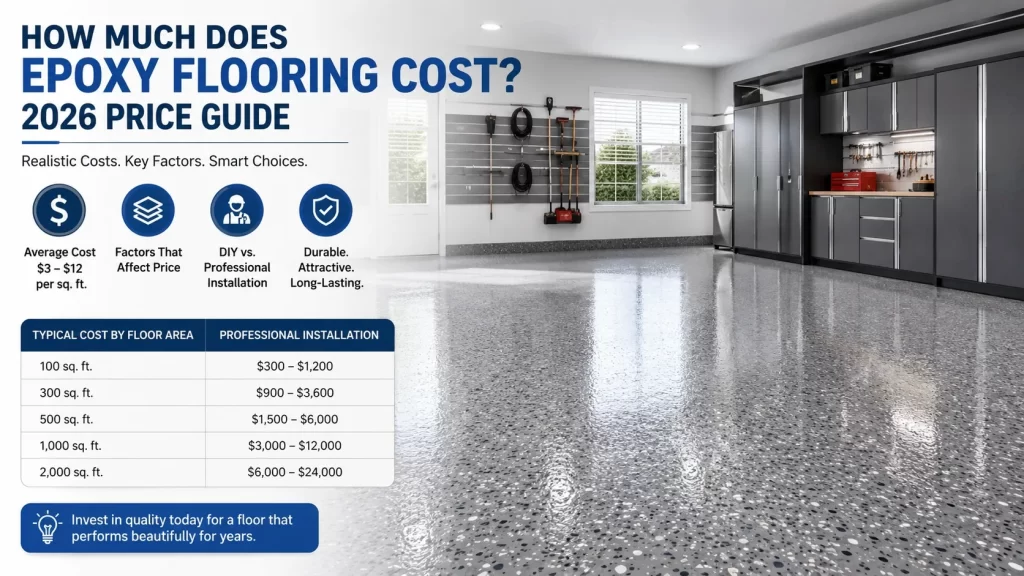
Professionally installed epoxy floors range from about $3 to $12 per sq.ft. as a general estimate; higher quality decorative systems are more expensive. The original source of this guide states a cost of approximately $7.50 per square foot for a professional installation; however, the price of a project varies widely depending on the project and location.
Average Epoxy Flooring Cost Per Square Foot
The simplest method of determining your budget is to find the square footage of the home you're looking for, and multiply that number by the cost you think per square foot.
| Floor Area | Estimated Professional Cost |
|---|---|
| 100 sq. ft. | $300–$1,200 |
| 200 sq. ft. | $600–$2,400 |
| 300 sq. ft. | $900–$3,600 |
| 400 sq. ft. | $1,200–$4,800 |
| 500 sq. ft. | $1,500–$6,000 |
| 1,000 sq. ft. | $3,000–$12,000 |
These are for preliminary budgeting purposes, and are not guaranteed quotes. The per-square-foot cost of large commercial projects might be less than smaller ones due to the possibility of more efficient use of materials and labor.
A standard sized 2 car garage may range from approximately $1,200 to $4,800, depending on the coating system and preparation necessary.
What Determines the Cost of Epoxy Flooring?
1. Type of Epoxy
Not all epoxy flooring systems have the same price or performance.
Water-based epoxy is generally one of the more economical options. It can be suitable for light-duty residential applications, but it typically provides less durability and chemical resistance than higher-solids systems.
100% solids epoxy contains little or no solvent and creates a thicker, more durable coating. It is often selected for garages, workshops, warehouses, and commercial environments where the floor must withstand heavier traffic.
Flake epoxy flooring combines a base epoxy coating with decorative vinyl flakes. Besides improving appearance, flakes can add texture and help conceal minor imperfections in the concrete. This system is especially popular for residential garages.
Metallic epoxy is a premium decorative option. Metallic pigments create a distinctive three-dimensional appearance that can resemble marble, flowing water, stone, or other patterns. Because application requires additional materials and skill, metallic epoxy generally costs more than a standard solid-color system.
2. Concrete Preparation
One of the most important—and often overlooked—parts of an epoxy flooring project is surface preparation.
Epoxy does not perform well when applied over a dirty, oily, weak, or poorly prepared concrete surface. Depending on the condition of the floor, preparation may include:
- Removing old coatings or paint
- Grinding the concrete
- Repairing cracks and damaged areas
- Filling holes and surface imperfections
- Removing oil and grease
- Cleaning and vacuuming dust
- Checking for moisture problems
A floor that requires extensive preparation will usually cost more than a clean, structurally sound concrete slab.
In fact, investing in proper preparation can help prevent premature peeling, bubbling, or coating failure. Professional installers commonly use mechanical grinding or other preparation methods to create a suitable surface for epoxy adhesion.
3. Labor and Installation
Labor can represent a significant portion of the total epoxy flooring cost.
Professional installation may include concrete preparation, crack repair, primer application, epoxy installation, decorative materials, and protective topcoats. More complicated designs generally require more time and expertise.
A simple solid-color floor is usually faster to install than a decorative metallic system. Similarly, a heavily damaged concrete floor requires more preparation than a relatively new slab.
Professional installation can also reduce the risk of common application problems such as uneven coverage, bubbles, poor adhesion, incorrect mixing, or insufficient curing time.
4. Decorative Finishes and Add-Ons
Additional features can increase the project price but may also improve the floor's appearance, performance, or lifespan.
Popular upgrades include:
Decorative flakes: Available in numerous color combinations, flakes can create a professional garage-floor appearance while providing additional texture.
Metallic pigments: These produce customized patterns and visual effects for residential and commercial spaces.
Anti-slip additives: Useful in garages, workshops, commercial kitchens, and other areas where floors may become wet or slippery.
UV-resistant topcoats: A protective topcoat can help improve resistance to sunlight and discoloration, especially in areas exposed to strong UV radiation.
High-performance topcoats: Polyurethane or polyaspartic topcoats may be used as part of certain flooring systems when additional abrasion, chemical, or UV resistance is required.
DIY Epoxy Flooring vs. Professional Installation
DIY epoxy flooring can reduce labor expenses, but it does not necessarily mean the project will be inexpensive.
A successful DIY installation may require equipment such as a concrete grinder, pressure washer, rollers, squeegees, mixing tools, protective equipment, and other supplies.
More importantly, the quality of the finished floor depends heavily on preparation and application technique. Incorrect mixing ratios, poor surface preparation, excessive moisture, improper thickness, or insufficient curing can result in bubbles, peeling, uneven color, or premature failure.
For a small and relatively simple floor, an experienced DIY homeowner may be able to complete the project successfully. For large garages, commercial facilities, or floors with significant damage, professional installation may provide better long-term value.
How to Reduce Epoxy Flooring Costs
If your budget is limited, there are several ways to control costs without automatically choosing the cheapest coating.
Choose the Right Flooring System
You do not necessarily need a premium metallic floor for a functional garage or workshop. A standard solid-color or flake system may provide an excellent balance between appearance, durability, and price.
Prepare the Concrete Yourself
If appropriate for your project, completing basic cleaning or moving equipment and belongings before the installer arrives may reduce preparation time. However, specialized grinding and concrete repair should be performed correctly rather than simply skipped.
Compare Multiple Quotes
Request detailed estimates from several qualified flooring contractors. Instead of comparing only the final price, ask what each quote includes—especially surface preparation, number of coating layers, crack repair, decorative materials, and topcoat.
Consider Long-Term Value
The cheapest epoxy flooring system is not always the least expensive option over its entire service life. A low-cost coating that requires frequent repairs or recoating can ultimately cost more than a higher-quality system installed correctly.
Is Epoxy Flooring Worth the Cost?
Epoxy flooring is often the perfect balance of durability, aesthetics, and low maintenance for many uses.
If installed correctly, an epoxy floor can be a smooth, simple floor that is easier to clean than a rough concrete floor. There are also many colors, textures and decorative finishes that are offered for epoxy systems.
Epoxy can protect garages from everyday usage, traffic from vehicles, dirt, and many automotive contaminants. In commercial and industrial applications, special epoxy systems can be developed to meet the challenging needs.
But epoxy is not suitable for all floors. Depending on the moisture or unstable concrete, outdoor exposure, or chemical and temperature specifications, another flooring system or a special epoxy formulation may be necessary.
Final Thoughts: How Much Should You Budget for Epoxy Flooring?
Well, how much is epoxy flooring?
Professionally installed epoxy flooring typically costs between $3 and $12 per square foot for initial budgeting purposes, depending on a variety of factors including the type of coating system applied, the condition of the concrete floor, project size, labor costs, decorative elements and protective topcoats.
The basic garage floor will be relatively inexpensive, and the heavily prepared commercial floor or the customized metallic will be quite expensive.
The first step is to look at the floor in terms of what it will cost you in the long run, rather than the minimum price it comes at. With the proper concrete preparation and quality epoxy system, and the proper application, a beautiful floor that is easy to care for and will last for years.
Before deciding, calculate the area of the floor; determine the type and amount of traffic and chemical exposure it will see; select a suitable epoxy system; and get comprehensive quotes that specify exactly what is being quoted.
This will ensure that you are able to make informed comparisons and select an epoxy flooring solution that meets your performance needs and budget.