





High traffic areas like warehouses, manufacturing facilities, hospitals, laboratories, commercial kitchens, automotive facilities, and other areas of commerce are also common commercial epoxy flooring applications. It offers a non-slip and hygienic surface that is smooth, resistant to wear and tear, and cleaner to use on a daily basis.
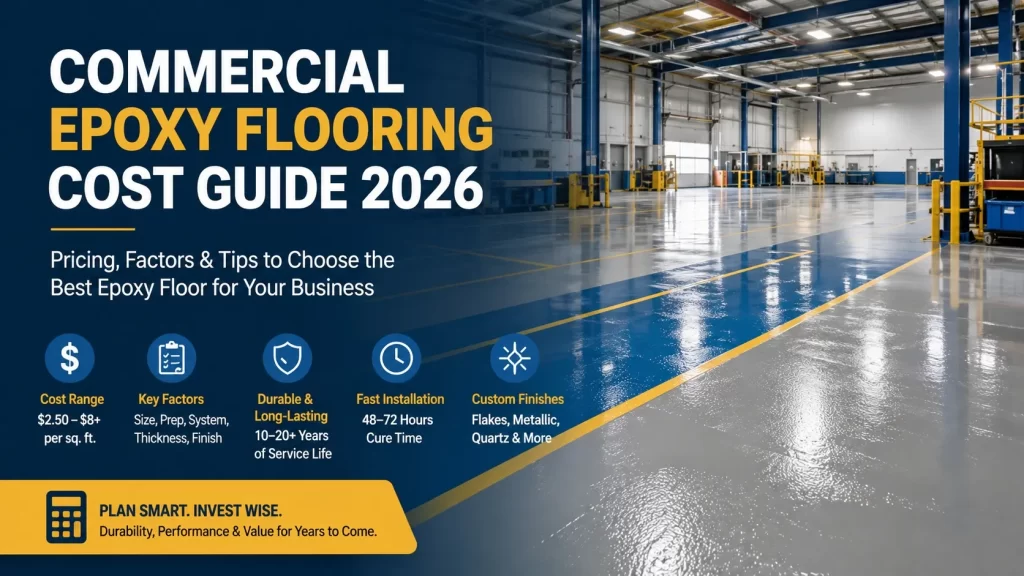
But how much does commercial epoxy flooring cost?
Generally, when applied over concrete, commercial epoxy flooring ranges from about $2.50 to $8 per square foot; costs vary depending on size of the project, condition of the floors, surface preparation, type of epoxy system, desired performance, and decorative finishes. Generally, the bigger the project the lower the costs per square foot due to larger spread of installation and material costs.
But the cost per square foot is only a single component of the cost of the investment. When choosing a flooring system, the environment, traffic, chemical exposure, maintenance and anticipated service life should all be taken into consideration.
What Is Commercial Epoxy Flooring?
Commercial epoxy flooring is a flooring system that is made up of a resin that is poured onto a prepared concrete base. The epoxy resin and hardener chemically react when mixed together and create a solid, continuous surface.
Unlike other flooring materials that have joints and seams, the epoxy can create a seamless floor and be applied in various commercial and industrial applications.
Common benefits include:
- High resistance to heavy traffic
- Excellent adhesion to prepared concrete
- Resistance to many chemicals and stains
- Easy cleaning and maintenance
- Customizable colors and finishes
- Seamless appearance
- Options for slip resistance
- Long service life when properly installed
Due to these attributes, epoxy flooring has become popular in such diverse locations as warehouses, manufacturing units, laboratories, schools, hospitals, commercial kitchens, automotive units, retail stores, and more.
How Much Does Epoxy Flooring Cost Per Square Foot?
A commercial epoxy floor will cost a lot more depending on the extent and size of the job.
A typical pricing model for projects by size is:
| Project Size | Approximate Epoxy Cost |
|---|---|
| Up to 1,500 sq. ft. | $5.25–$8 per sq. ft. |
| 1,500–5,000 sq. ft. | $3.05–$7 per sq. ft. |
| More than 5,000 sq. ft. | $2.50–$6 per sq. ft. |
These are typical commercial installation ranges and does not necessarily include specialty additives, advanced chemical resistance, moisture mitigation or decoration finishes.
Even if the same basic epoxy system is used, a 10,000 square foot warehouse installation might cost less per square foot than a 1,000 square foot commercial space installation.
What Factors Affect Commercial Epoxy Flooring Cost?
1. Floor Size
One of the most significant factors that can impact epoxy flooring cost is the size of the facility.
Typically economies of scale are favorable over larger projects. The materials can be bought in larger quantities, and the preparation, equipment and transport, labour costs can be spread over more square footage.
For smaller projects, fixed project costs can be a greater percentage of the total project cost, increasing the cost per square foot.
2. Concrete Surface Preparation
The surface preparation is a critical factor to the performance of a good epoxy floor.
The concrete could require mechanical grinding, cleaning, repair, leveling or other preparation prior to applying the epoxy. The time and expense involved in preparing for the coating may be extended by existing coatings, oil contamination, cracks, holes, moisture, and uneven surfaces.
In a typical concrete floor project, the surface may need to be ground, patched or leveled prior to the application of the coating.
If not properly prepared, poor adhesion, peeling, bubbling, cracking and failure of coatings early in service can occur.
Hence, with all epoxy installations, there is no case for taking the cheapest because it may not have done the surface preparation properly.
3. Epoxy System and Thickness
All epoxy floors are not created equal.
A simple coat may suffice in moderate traffic environments while a multi-layered resinous system is recommended for heavy industrial coating.
Higher-performance systems may provide improved:
- Impact resistance
- Abrasion resistance
- Chemical resistance
- Slip resistance
- Moisture protection
- Antimicrobial performance
The more complex the environment, the more critical it is to choose a flooring system that performs well and not to just the lowest initial price.
4. Chemical Exposure
The design and/or cost of an epoxy floor can be greatly affected by chemical exposure.
Oils, solvents, acids, cleaning chemicals or other harmful substances could be found in manufacturing plants, laboratories, food-processing facilities, or maintenance areas.
In these types of environments, regular epoxy can be inadequate. Additional protective coatings or specialty formulations may be needed.
The proper system can help to minimize surface deterioration and maintenance costs over time.
5. Decorative Finishes
The epoxy flooring isn't necessarily gray or solid colored.
For commercial facilities, they can opt for one of the following:
- Decorative vinyl flakes
- Quartz aggregate
- Metallic effects
- Custom colors
- Patterns
- Logos and branding
- High-gloss finishes
Decorative epoxy can enhance the look of retail stores, showrooms, lobbies, offices and customer facing areas.
But more materials and installation will typically add up to the project cost as a whole.
Popular Types of Commercial Epoxy Flooring
Different epoxy systems are designed for different performance requirements.
Epoxy Mortar Flooring
Epoxy mortar systems combine epoxy resin with graded aggregates to create an extremely durable floor.
They are suitable for demanding industrial environments where high mechanical strength and chemical resistance are priorities.
Quartz-Filled Epoxy
Quartz aggregate can be incorporated into epoxy to increase durability while creating a textured and decorative appearance.
Quartz systems can be particularly useful in areas where both aesthetics and performance are important.
Metallic Epoxy
Metallic epoxy uses specially formulated pigments to create three-dimensional swirls and decorative effects.
It is commonly selected for showrooms, entrances, retail environments, and other areas where visual appearance matters.
Antimicrobial Epoxy
Epoxy flooring is naturally seamless and non-porous when properly installed, making it easy to clean.
Special antimicrobial formulations can provide additional protection for environments where hygiene is particularly important, including healthcare and food-related facilities.
Anti-Static Epoxy
Facilities handling sensitive electronic equipment or environments where static electricity is a concern may require an anti-static or conductive flooring system.
These systems are designed to help control static buildup and safely dissipate electrical charges.
Epoxy vs. Urethane vs. MMA Flooring Cost
Epoxy is not the only resinous flooring option. Urethane and methyl methacrylate (MMA) are also used in commercial and industrial environments.
| Flooring Type | Approximate Cost | Main Advantage |
| Epoxy | $2.50–$8+ per sq. ft. | Cost-effective durability |
| Urethane | $6–$19 per sq. ft. | Flexibility and wear resistance |
| MMA | $5–$12 per sq. ft. | Extremely fast curing |
The actual price depends on project size, formulation, substrate condition, and installation requirements.
Epoxy Flooring
Epoxy is often selected because it provides a strong combination of durability, chemical resistance, customization, and relatively low cost.
One limitation is curing time. Commercial epoxy systems may require approximately 48–72 hours before full use, depending on the formulation and environmental conditions.
Urethane Flooring
Urethane is generally more expensive than epoxy but offers advantages in areas exposed to impact, temperature changes, or heavy wear.
It can also be a better choice for applications where flexibility and abrasion resistance are important.
MMA Flooring
Methyl methacrylate flooring is known for very fast curing. Some systems can be returned to service within the same day.
That makes MMA attractive for businesses where extended downtime is especially expensive. However, its installation requirements and material cost can make it more expensive than standard epoxy.
Is Commercial Epoxy Flooring Worth the Cost?
For many businesses, epoxy flooring can provide excellent long-term value.
The initial installation cost is only one part of the total cost of ownership. A floor that lasts longer, requires less maintenance, and resists damage may be more economical over its service life than a cheaper floor that requires frequent repairs or replacement.
Properly installed and maintained epoxy flooring can last 10 to 20 years or more, depending on the environment and flooring system.
Epoxy is also relatively easy to clean because its seamless surface does not have the joints commonly found in tile flooring.
For facilities with heavy traffic, vehicle movement, chemical exposure, or strict cleaning requirements, these characteristics can make epoxy a practical long-term investment.
How to Reduce Epoxy Flooring Costs
Businesses can control flooring costs without simply choosing the cheapest material.
Choose the Right System
Avoid over-specifying a flooring system for an area that does not require extreme performance. At the same time, do not use a basic coating where chemical, thermal, or mechanical demands require a specialized system.
Prepare the Concrete Correctly
Good surface preparation helps maximize coating adhesion and service life. Investing in preparation can reduce the risk of premature repairs.
Consider Total Cost of Ownership
Instead of comparing only installation prices, consider maintenance, downtime, repairs, cleaning, and replacement costs.
Plan Around Business Operations
Epoxy requires curing time. Scheduling installation during weekends, holidays, planned shutdowns, or other low-production periods can help reduce the financial impact of downtime.
Frequently Asked Questions About Epoxy Flooring Cost
How much does a 1,000-square-foot epoxy floor cost?
Using the above general range for small projects (1,000 square feet or less), a 1,000 square foot commercial epoxy could run approximately $5,250 to $8,000. The actual price may vary depending on surface preparation, thickness of coating, repairs, additives and decorative needs.
How much does a 5,000-square-foot epoxy floor cost?
The rough figures for a 5,000-square-foot installation, before factoring in any special upgrades or odd preparation requirements, are in the ballpark of $3.05 to $7 per square foot, or a total cost of roughly $15,250 to $35,000.
How long does commercial epoxy flooring last?
The service life of an epoxy floor ranges from 10 to 20 years or more depending on the level of traffic, chemicals, impact, maintenance and the type of epoxy floor system used, as proper installation and upkeep of the floor will influence the duration of service life.
How long does epoxy flooring take to install?
Add surface preparation and curing time when preparing for a commercial installation (days may be longer). Typically, normal use of epoxy can take around 48-72 hours, depending on the product and conditions.
Is epoxy cheaper than urethane flooring?
Typically, the price of the epoxy is less than the urethane's. But the most appropriate one is dependent on the environment where it will operate. Urethane can be the more expensive material, but may be warranted for flexibility, impact resistance, temperature resistance or special chemical performance.
Final Thoughts
Epoxy floors are not a commodity product, the cost of commercial epoxy flooring depends on far more than only the resin cost. The actual price is dependent on the size of the project, the condition of the concrete, surface preparation, desired thickness of the coating, any chemical exposure, traffic, decorative needs and installation conditions.
Epoxy is a desirable compromise in many commercial and industrial facilities regarding initial cost, durability, maintenance, appearance and performance.
It is best to consider the floor based on what your facility specifically needs and not just the lowest quote. A professional flooring assessment will determine which thickness of coating, surface preparation techniques, additives and finish to use for your application.
In the end, the proper epoxy flooring system can help save your concrete investment, allow for reduced maintenance needs, help make your workplace more appealing, and offer you a durable solution for many years.