



Updated 2 months ago
Fast-Cure vs Slow-Cure Epoxy Resin: Which One Should You Buy?

hqt

The exceptional bonding properties of epoxy resin combined with its chemical resistance and durability make it a versatile material used in a variety of applications such as crafts, woodwork, electronics, flooring, composites, and industrial production. However, selecting the right epoxy resin is more than just about the formulation or use, it is also about the choice of the right curing speed.
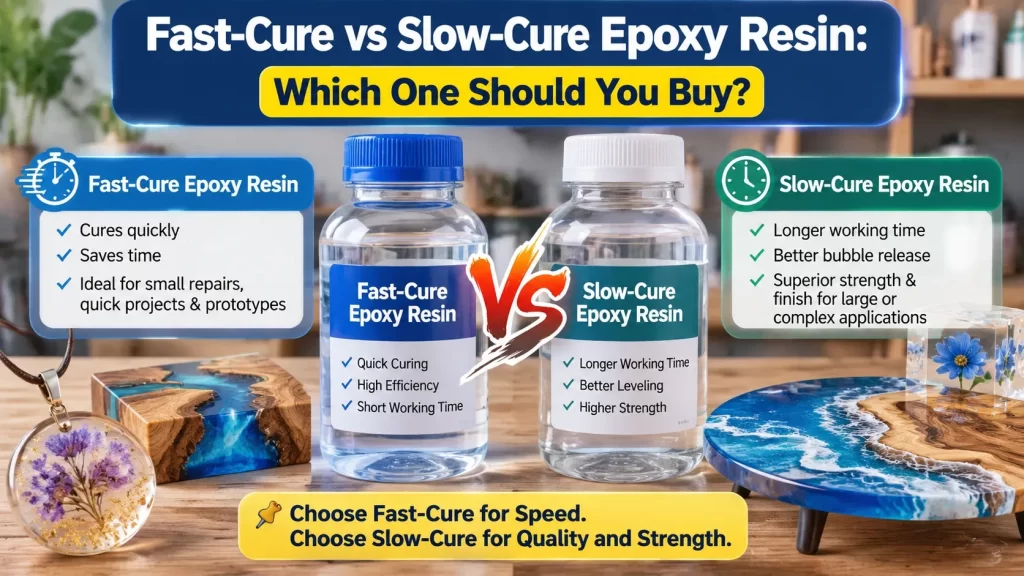
Many people compare fast-cure epoxy resin with slow-cure epoxy resin when purchasing epoxy resin. Each type offers certain benefits and will depend on the project's needs, the environment in which you're working, and the outcome you're looking for.
Fast cure epoxy - suitable for short turnaround times, especially for minor repairs or projects that require a rapid turnaround. Slow cure epoxy resin has a longer working time, better leveling, better penetration and better quality finish for larger more complex applications.
This guide offers a quick explanation of the distinction between fast cure and slow cure epoxy resin, so that manufacturers, professionals and do-it-yourselfers can select the best epoxy for their needs.
What Is Fast-Cure Epoxy Resin?
Fast cure epoxy resin is a special formulation of the epoxy resin that has an accelerated curing time. It has a quicker reacting hardener system that can cure the resin in a shorter time than the standard or slow curing hardener systems.
Fast curing epoxy resin may start to set in minutes and have a handling strength in a couple of hours or less, depending on product formulation.
Key Features of Fast-Cure Epoxy Resin
1. Quick Processing Time
The single best thing about a fast cure epoxy resin is the speed at which it cures. Enables the user to finish projects more quickly, which cuts down on the time needed between applying and finishing.
Common applications include:
- Emergency repairs
- Small-scale bonding
- Quick prototypes
- Jewelry making
- Minor surface repairs
- Maintenance work
2. Short Working Time
Fast cure epoxy mixes rapidly, giving the user only limited time to mix, pour and modify epoxy. It is not as well suited for large projects where detailed adjustments are needed.
3. Faster Production Cycles
In industrial manufacturing, fast-curing epoxy resin can boost manufacturing efficiency by reducing the assembly and processing time.
What Is Slow-Cure Epoxy Resin?
Slow-cure epoxy resin is formulated to have a slower curing time, providing plenty of time for mixing, pouring and adjustment before the resin becomes hard.
Slow cure epoxy resin will take longer to cure, but can yield superior overall performance in more severe applications.
Key Features of Slow-Cure Epoxy Resin
1. Longer Working Time
Slow-cure epoxy gives users more flexibility during application. This is especially important for:
- Large casting projects
- Deep pours
- Composite manufacturing
- Large surface coatings
- Professional woodworking
The extended working time helps reduce mistakes and improves application quality.
2. Better Air Bubble Release
Because the resin remains liquid longer, trapped air bubbles have more time to escape naturally. This creates a smoother and clearer final surface.
3. Improved Mechanical Properties
Slow curing allows epoxy molecules to form stronger cross-linked structures, often resulting in better:
- Adhesion strength
- Impact resistance
- Thermal stability
- Chemical resistance
Fast-Cure vs Slow-Cure Epoxy Resin: Main Differences
| Feature | Fast-Cure Epoxy Resin | Slow-Cure Epoxy Resin |
|---|---|---|
| Curing Speed | Very fast | Slow and controlled |
| Working Time | Short | Long |
| Ease of Use | Requires quick handling | More user-friendly |
| Bubble Release | Limited | Better |
| Large Projects | Less suitable | Highly suitable |
| Surface Finish | Good | Excellent |
| Production Speed | Faster | Slower |
| Strength Development | Good | Usually higher |
Which Epoxy Resin Has Better Strength?
Many people assume fast-cure epoxy resin is weaker because it cures quickly. However, strength depends more on the chemical formulation than curing speed alone.
High-quality fast-cure epoxy systems can provide excellent bonding performance for small applications. However, slow-cure epoxy resin generally has an advantage in structural applications because the slower reaction allows better molecular bonding.
For applications such as:
- Carbon fiber composites
- Industrial bonding
- Electronic encapsulation
- Heavy-duty coatings
slow-cure epoxy resin is often preferred.
Fast-Cure Epoxy Resin Applications
Fast-cure epoxy resin is suitable when speed is the highest priority.
1. Quick Repairs
Fast-curing epoxy adhesives are commonly used for repairing:
- Metal parts
- Plastic components
- Wood products
- Equipment surfaces
The rapid curing time minimizes downtime.
2. Small Craft Projects
Artists and hobby users often choose fast-cure epoxy for:
- Small resin artwork
- Decorative items
- Jewelry
- DIY projects
3. Rapid Prototyping
Manufacturers developing prototypes may use fast-cure epoxy to quickly test designs and shorten development cycles.
Slow-Cure Epoxy Resin Applications
Slow-cure epoxy resin is preferred for projects requiring quality, strength, and precision.
1. Deep Pour Casting
For river tables, molds, and thick castings, slow-cure epoxy is usually the better option because it generates less heat during curing and reduces cracking risks.
2. Composite Materials
Slow-cure epoxy resin is widely used in:
- Aerospace composites
- Automotive parts
- Marine components
- Fiberglass reinforcement
Its excellent penetration and bonding performance improve final product durability.
3. Industrial Coatings
Large industrial surfaces benefit from slow-curing formulas because they provide:
- Better leveling
- More uniform thickness
- Improved appearance
Factors to Consider When Choosing Epoxy Resin
1. Project Size
The size of your project is one of the most important factors.
Choose fast-cure epoxy resin for:
- Small repairs
- Quick projects
- Short production cycles
Choose slow-cure epoxy resin for:
- Large surfaces
- Complex molds
- Professional applications
2. Required Working Time
If you need time to adjust positioning, remove bubbles, or create detailed finishes, slow-cure epoxy is the better choice.
If the application is simple and speed matters more, fast-cure epoxy works well.
3. Environmental Conditions
Temperature and humidity can affect epoxy curing performance.
In colder environments, curing may take longer. Fast-cure epoxy can help compensate for slower reactions, while slow-cure formulas provide more control in warmer conditions.
4. Final Performance Requirements
Consider the final use of the product.
For decorative projects, appearance and clarity may be the priority.
For industrial applications, factors such as:
- Tensile strength
- Heat resistance
- Chemical durability
- Long-term stability
are more important.
Can You Mix Fast-Cure and Slow-Cure Epoxy Resin?
Generally, mixing different epoxy systems is not recommended unless specifically designed by the manufacturer.
Different resin and hardener combinations may cause:
- Improper curing
- Reduced strength
- Surface defects
- Cloudiness
- Sticky surfaces
Always follow the recommended mixing ratio and technical instructions provided by the epoxy resin manufacturer.
Fast-Cure vs Slow-Cure Epoxy Resin: Which One Should You Buy?
The answer depends on your application.
Choose fast-cure epoxy resin if you need:
- Faster curing
- Quick repairs
- Short production time
- Small projects
Choose slow-cure epoxy resin if you need:
- Longer working time
- Better surface quality
- Stronger structural performance
- Large casting or industrial applications
Slow cure epoxy resin is often the best choice for many professional manufacturing and composite or high quality casting applications because of its added control and reliability.
Fast-cure epoxy resin might be convenient and efficient for simple repair work and quick production requirements.
Conclusion
There are significant pros and cons to both fast-cure and slow-cure epoxy resins. The selection will be determined by the size of the project, the time required for working, the curing schedule and performance desired.
Both fast-cure epoxy resin and slow-cure epoxy resin are beneficial in various aspects, with fast-cure resin providing time and productivity savings and slow-cure resin offering better control, stronger bonding, and quality finishes.
There are a number of factors to keep in mind when buying epoxy resin, in addition to its curing speed, you should also take into account that epoxy resin is able to fit your specific application. Deciding on the right curing speed will help to get better results, cut down on waste, and make the overall project a success.