



Updated 2 months ago
DIY Epoxy Resin vs Industrial Epoxy Resin: What's the Difference?

hqt

Epoxy resin has now emerged as one of the most popular materials for crafts, coatings, manufacturing and industrial applications. Whether used in handmade river tables, jewelry, electronic encapsulation, or for heavy-duty, long-lasting flooring, epoxy resin is an excellent choice for its strength, durability and chemical resistance. But not every epoxy resin is the same.
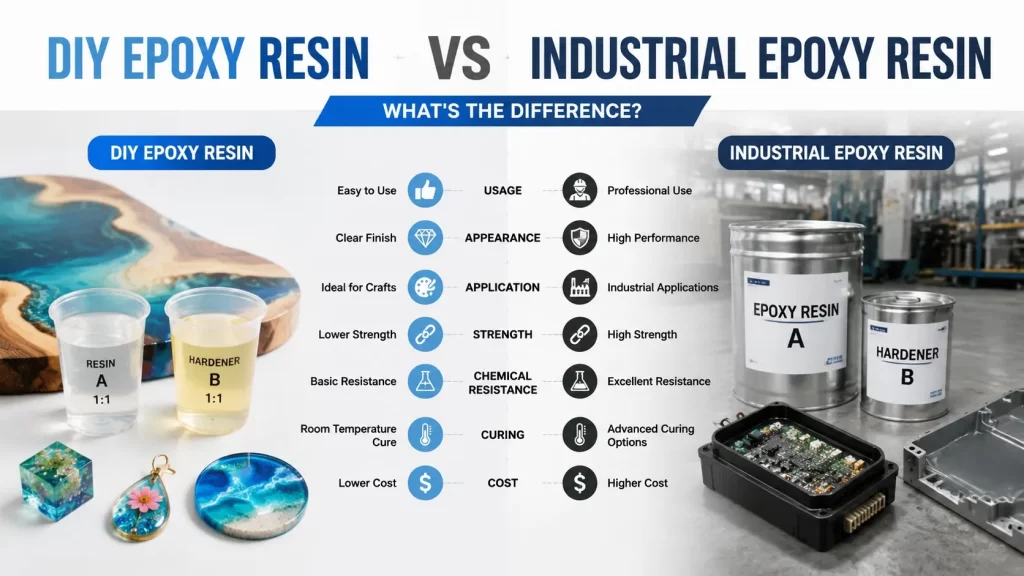
One of the frequently asked questions when considering a purchase is: What is the difference between DIY epoxy resin and industrial epoxy resin? Although both materials share an epoxy chemistry, they have vastly different formulations, characteristics, curing properties, and uses.
The knowledge of these differences is beneficial to the hobbyist, engineer and business personnel in selecting the appropriate epoxy resin for the project at hand.
What Is DIY Epoxy Resin?
Epoxy resin done by yourself is primarily utilized for personal projects, crafts, decoration and small-scale applications. It is not about extreme performance, ease of use, visual effects and convenience.
These are typical do-it-yourself epoxy resin products:
- Art resin for paintings and crafts
- Jewelry resin
- Tabletop coating resin
- Small casting resin kits
- Decorative epoxy applications
Typically, these are created for novices and hobbyists who require an easy combination and pleasing final look.
Key Features of DIY Epoxy Resin
1. Easy Mixing Ratio
The typical DIY epoxy resin formulations are simple 1:1 epoxy resin and hardener. This simplifies measurement and decreases the number of mistakes made by user.
2. Excellent Transparency
When making your own epoxy resin, you may try to make it as clear as possible. With decorative use, many products use stabilizers which help to maintain clarity.
3. Longer Working Time
Users can remove bubbles, add pigments and develop artistic designs with some of the craft epoxies which give sufficient working time.
4. Lower Viscosity
A thinner formula enables resin to flow easily and to define fine detail in molds.
What Is Industrial Epoxy Resin?
Industrial epoxy resin is designed for use in challenging applications where strength, reliability and long-term durability are essential.
It is common in the following:
- Electronics potting and encapsulation
- Composite materials
- Aerospace components
- Automotive parts
- Industrial flooring
- Adhesives
- Protective coatings
- Electrical insulation
Unlike products made by the person, industrial epoxy systems are created meeting specific performance criteria.
Key Features of Industrial Epoxy Resin
1. Higher Mechanical Strength
Industrial epoxy resin provides superior:
- Tensile strength
- Impact resistance
- Wear resistance
- Adhesion performance
This results in its suitability for applications under vibration, pressure and mechanical stress.
For instance, electronic potting compounds like epoxy resin must be able to withstand moisture, vibration, and temperature changes.
2. Better Chemical Resistance
Industrial environments often involve exposure to:
- Oils
- Solvents
- Cleaning chemicals
- Acids
- Industrial fluids
Industrial epoxy formulations are designed to maintain stability under harsh chemical conditions.
DIY epoxy resin, while durable, may not provide the same level of protection.
3. Advanced Temperature Performance
Industrial epoxy resin can be customized for high-temperature applications.
Special formulations may offer:
- Higher heat resistance
- Better thermal stability
- Reduced expansion and contraction
- Improved thermal conductivity
This is important for industries such as electronics, automotive, and energy systems.
DIY Epoxy Resin vs Industrial Epoxy Resin: Main Differences
| Feature | DIY Epoxy Resin | Industrial Epoxy Resin |
|---|---|---|
| Main Purpose | Crafts and decoration | Manufacturing and engineering |
| User Level | Beginners and hobbyists | Professionals and industries |
| Strength | Moderate | High |
| Chemical Resistance | Basic | Advanced |
| Temperature Resistance | Limited | High-performance |
| Customization | Colors and effects | Technical modifications |
| Certification Requirements | Usually none | Often required |
| Cost | Lower | Higher |
| Production Scale | Small projects | Mass production |
Differences in Formulation
The biggest difference between DIY and industrial epoxy resin is the formulation.
Industrial epoxy resin may contain specialized additives such as:
- Flame retardants
- Thermal fillers
- Toughening agents
- UV stabilizers
- Conductive materials
- Low-viscosity modifiers
These additives improve performance for specific industries.
For example:
- Electronic potting epoxy requires excellent insulation and moisture protection.
- Composite epoxy requires high strength and lightweight properties.
- Industrial flooring epoxy requires abrasion resistance.
DIY epoxy resin generally prioritizes appearance and ease of application rather than specialized performance.
Curing Process Differences
The curing process also separates DIY epoxy resin from industrial epoxy resin.
DIY Epoxy Resin Curing
DIY products are usually designed for room-temperature curing.
Typical characteristics:
- Simple mixing
- Longer curing time
- Minimal equipment required
- Suitable for home environments
Users can usually complete projects without professional tools.
Industrial Epoxy Resin Curing
Industrial systems may require:
- Precise temperature control
- Controlled humidity
- Vacuum degassing
- Automated dispensing equipment
- Specific curing schedules
Manufacturers optimize curing conditions to achieve maximum performance.
Applications Comparison
Common DIY Epoxy Resin Applications
DIY epoxy resin is ideal for:
Art and Crafts
Artists use epoxy resin for:
- Resin paintings
- Decorative objects
- Handmade gifts
- Pigment effects
Furniture Projects
Popular applications include:
- River tables
- Countertops
- Wood coatings
- Decorative surfaces
Small Casting Projects
Examples include:
- Molds
- Keychains
- Jewelry
- Accessories
Common Industrial Epoxy Resin Applications
Industrial epoxy resin is used in many professional fields.
Electronics Industry
Epoxy potting compounds protect:
- Circuit boards
- Sensors
- Power modules
- Electronic components
They provide:
- Electrical insulation
- Moisture protection
- Mechanical protection
Composite Manufacturing
Epoxy resin is combined with:
- Carbon fiber
- Fiberglass
- Reinforcement materials
to produce lightweight and strong components.
Industrial Coatings
Epoxy coatings are used for:
- Factory floors
- Warehouses
- Workshops
- Heavy-duty surfaces
because they provide excellent durability.
How to Choose Between DIY and Industrial Epoxy Resin?
Choosing the correct epoxy depends on your project requirements.
Choose DIY Epoxy Resin If You Need:
✔ Decorative finishing
✔ Craft projects
✔ Small casting applications
✔ Easy application
✔ Low equipment requirements
DIY resin is the best choice for hobbyists and creative projects.
Choose Industrial Epoxy Resin If You Need:
✔ High mechanical strength
✔ Long-term durability
✔ Chemical resistance
✔ Electrical protection
✔ Large-scale manufacturing
Industrial epoxy resin is the better solution for professional applications.
Why Businesses Prefer Custom Industrial Epoxy Resin Solutions
Many manufacturers require epoxy resin that matches specific production requirements.
Professional epoxy resin suppliers can provide:
- Custom viscosity
- Customized curing speed
- Specific hardness levels
- Thermal performance improvements
- Flame-resistant formulations
- OEM and ODM services
This enables companies to produce a more reliable product and to obtain more efficient production.
Customized epoxy solutions are typically used for industries that don't adhere to the standard product line, like electronics, automotive, renewable energy and aerospace.
Final Thoughts: DIY Epoxy Resin or Industrial Epoxy Resin?
The technology of DIY epoxy resin is similar to that of industrial epoxy resin, though they have very different applications.
Make your own epoxy resin emphasizes creativity, convenience and looks. Ideal for craft, furniture and ornamental usage.
Industrial epoxy resin is performance, reliability and durability oriented. It is intended for jobs that require the highest level of performance and do not tolerate failure.
When selecting an epoxy resin, take the project need, environment, performance and production requirements into account. Choosing the appropriate epoxy system can help to enhance the quality of the products, save costs, and guarantee long-term results.
When it comes to professional manufacturing applications, having a partner in the form of an experienced epoxy resin manufacturer can offer the best solution.