





Owing to its impressive strength, durability, and chemical resistance, epoxy resin is a prevalent material in woodworking, crafts, industrial coatings, electronics, and DIY projects. One of the most key considerations to the final performance of the hardened material is however the selection of the right epoxy resin mixing ratio.
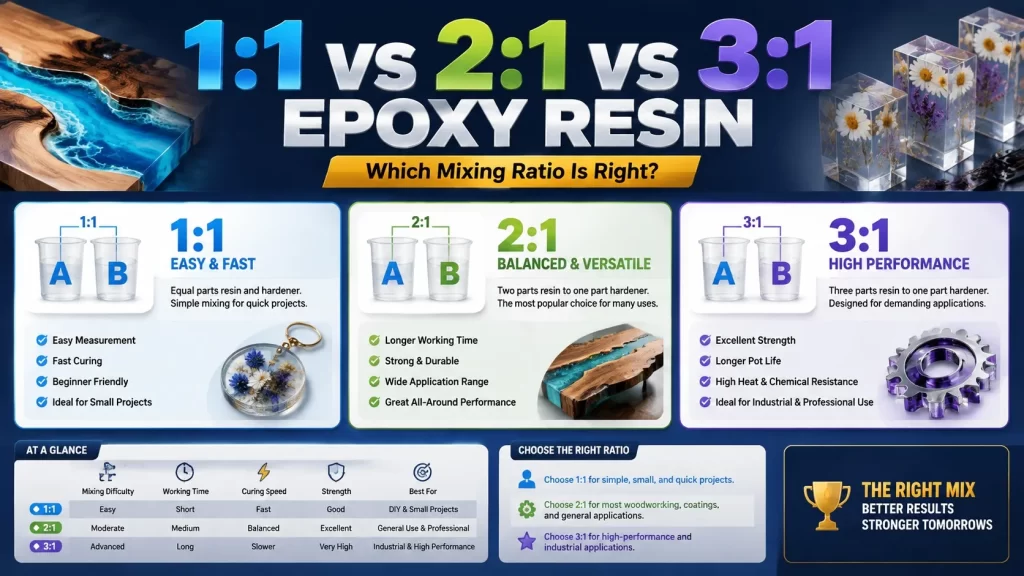
The three most common formulations are 1:1, 2:1, and 3:1 epoxy resin. Both ratios have varying properties such as curing, viscosity, working time, hardness and applied properties.
So, what is the best epoxy resin mixing ratio to use? This all depends on the application and what the results are looking for, along with the processing conditions involved.
Here, we will discuss how different types of epoxy can be used to help manufacturers, professionals, and do-it-yourselfers choose the right epoxy resin.
What Does Epoxy Resin Mixing Ratio Mean?
The mixing ratio is the ratio of epoxy resin (Part A) to hardener (Part B) required to form a well-cured polymer.
For example:
- 1:1 epoxy resin means one part resin + one part hardener.
- 2:1 epoxy resin means two parts resin + one part hardener.
- 3:1 epoxy resin means three parts resin + one part hardener.
The ratio depends on the chemical composition of the epoxy system. In some materials, increasing the amount of hardener will increase the rate of curing; with epoxy resin, the correct proportion must be used to ensure it cures properly.
Improper mixing will produce:
- Soft or sticky surfaces
- Poor mechanical strength
- Incomplete curing
- Reduced chemical resistance
- Yellowing or cracking over time
It is therefore important to choose the correct ratio of epoxy resin in the product, in order to ensure the quality and long-term performance of the product.
1:1 Epoxy Resin: Easy Mixing and Fast Applications
What Is 1:1 Epoxy Resin?
A 1:1 epoxy resin system is composed of an equal mix of resin and hardener. It is one of the easiest formulations of epoxy to use, due to the fact that the ratio of epoxy to hardener is the same.
This type is popular for beginning users, for small hobbies and simple processing applications.
Advantages of 1:1 Epoxy Resin
1. Easy Measurement
The most significant benefit of 1:1 epoxy resin is its ease of use. Users are able to easily combine equal percentages of Part A and B without calculation.
Therefore, it is suitable for:
- DIY crafts
- Jewelry making
- Small repairs
- Decorative projects
2. Faster Processing
There are many 1:1 epoxy systems that can be relatively fast curing, so that the user can finish the project in a period of time.
Typical applications include:
- Small casting projects
- Art coatings
- Quick bonding applications
3. Beginner-Friendly
1:1 epoxy resin minimizes the risk of accidental mixing failure and enhances user experience due to ease of mixing.
Limitations of 1:1 Epoxy Resin
Although convenient, 1:1 epoxy resin may have some limitations:
- Shorter working time
- Lower temperature resistance in some formulations
- Less customization flexibility
- Not always suitable for large industrial applications
For professional manufacturing, other ratios may provide better performance.
2:1 Epoxy Resin: Balanced Performance and Versatility
What Is 2:1 Epoxy Resin?
A 2:1 epoxy resin requires two parts epoxy resin and one part hardener. It is one of the most commonly used professional epoxy systems.
This ratio provides a balance between working time, strength, and curing performance.
Advantages of 2:1 Epoxy Resin
1. Longer Working Time
Compared with many 1:1 systems, 2:1 epoxy resin often provides more processing time before curing begins.
This makes it suitable for:
- Large surface coatings
- River tables
- Composite materials
- Industrial applications
2. Better Mechanical Properties
2:1 epoxy systems are commonly designed for higher performance, offering:
- Improved hardness
- Better adhesion
- Higher durability
- Stronger chemical resistance
3. Wide Application Range
2:1 epoxy resin is widely used in:
- Wood coating
- Carbon fiber composites
- Fiberglass reinforcement
- Industrial bonding
- Protective coatings
For many professional users, 2:1 epoxy resin is considered a reliable all-purpose solution.
Limitations of 2:1 Epoxy Resin
The main disadvantage is that accurate measurement is more important than with 1:1 systems.
Users need:
- Proper measuring tools
- Thorough mixing
- Correct curing conditions
3:1 Epoxy Resin: High Performance and Professional Applications
What Is 3:1 Epoxy Resin?
A 3:1 epoxy resin system uses three parts resin and one part hardener. It typically contains a higher resin content and is often developed for advanced applications.
Advantages of 3:1 Epoxy Resin
1. Excellent Mechanical Strength
Many 3:1 epoxy systems offer outstanding:
- Tensile strength
- Impact resistance
- Thermal stability
- Structural durability
This makes them suitable for demanding environments.
2. Longer Pot Life
Because of its formulation, 3:1 epoxy resin often provides extended working time.
It is beneficial for:
- Large composite structures
- Industrial manufacturing
- Complex molding processes
3. Professional Finish Quality
3:1 epoxy resin can provide excellent clarity, smoothness, and surface performance when properly formulated.
Applications include:
- High-end furniture coatings
- Aerospace composites
- Marine applications
- Engineering components
Limitations of 3:1 Epoxy Resin
The main challenges include:
- More complex measurement
- Higher technical requirements
- Longer curing time in some systems
It may not be the best option for simple DIY projects.
1:1 vs 2:1 vs 3:1 Epoxy Resin Comparison
| Feature | 1:1 Epoxy Resin | 2:1 Epoxy Resin | 3:1 Epoxy Resin |
|---|---|---|---|
| Mixing Difficulty | Very Easy | Moderate | More Technical |
| Working Time | Short | Medium | Long |
| Curing Speed | Faster | Balanced | Slower |
| Strength | Good | Excellent | Very High |
| Professional Use | Limited | High | High |
| DIY Use | Excellent | Good | Moderate |
| Large Projects | Less Suitable | Suitable | Excellent |
How to Choose the Right Epoxy Resin Ratio?
Choosing between 1:1, 2:1, and 3:1 epoxy resin depends on several factors.
1. Consider Your Application
Choose 1:1 epoxy resin for:
- Crafts
- Small repairs
- Hobby projects
- Quick applications
Choose 2:1 epoxy resin for:
- Woodworking
- Coatings
- General manufacturing
- Composite materials
Choose 3:1 epoxy resin for:
- Industrial components
- High-performance composites
- Structural applications
2. Consider Processing Requirements
If you need simple operation, a 1:1 system may be ideal.
If you need more control over curing time and performance, 2:1 or 3:1 systems are better choices.
3. Consider Final Performance
For decorative projects, appearance and convenience may matter most.
For industrial applications, prioritize:
- Strength
- Heat resistance
- Chemical resistance
- Long-term durability
Higher-ratio systems often provide more opportunities for performance optimization.
Common Mistakes When Mixing Epoxy Resin
Regardless of the ratio, proper mixing is essential.
1. Incorrect Ratio Measurement
Always follow the manufacturer's recommended ratio. Adding extra hardener does not improve curing.
2. Poor Mixing
Mix slowly and thoroughly to avoid:
- Unmixed material
- Weak areas
- Sticky surfaces
3. Ignoring Temperature
Temperature affects:
- Viscosity
- Curing speed
- Final hardness
Always use epoxy resin within the recommended processing conditions.
Conclusion: Which Epoxy Resin Ratio Is Best?
There is no single “best” epoxy resin mixing ratio. The right choice depends on your specific needs.
- 1:1 epoxy resin is the easiest option for beginners and small projects.
- 2:1 epoxy resin offers the best balance between usability and performance.
- 3:1 epoxy resin is ideal for professional and high-performance applications.
The 2:1 epoxy resin is a popular option for most commercial and industrial applications as it offers a high strength combined with ease of use and versatility. Manufacturers that need the highest possible durability or specific performance might find the 3:1 epoxy formulation useful, however.
Choosing the right epoxy resin ratio can provide better curing, higher product quality and longer service life.