





It is often durability that is the most critical criterion for a high performance coating, adhesive, casting material or protective layer. Epoxy resin and polyurethane are two of the most popular materials used in various industrial, commercial and DIY products. The two materials have high protection, chemical resistance and mechanical strength, but have different performance in different environments and use.
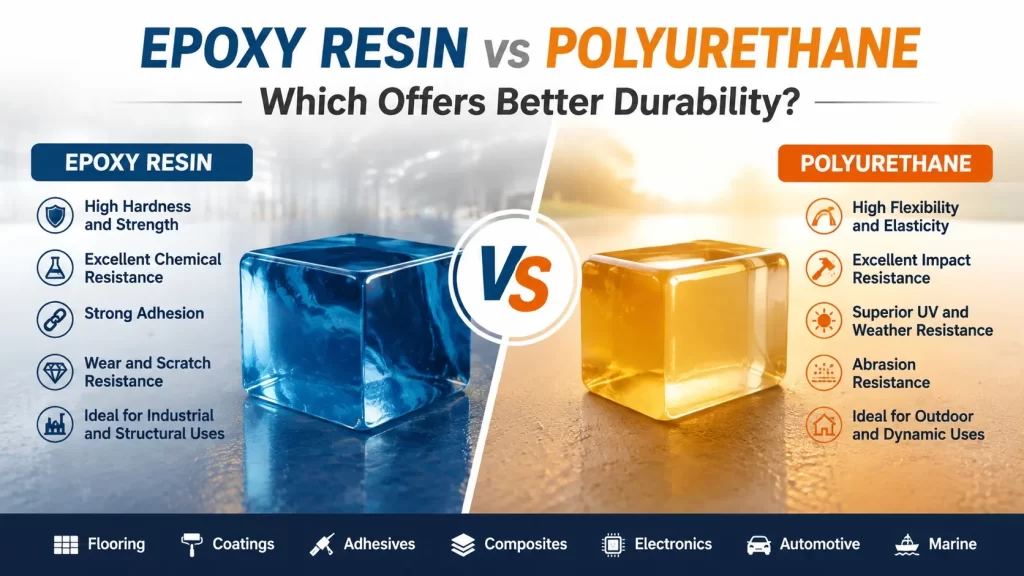
There is no clear winner when it comes to epoxy resin vs polyurethane – which is the more durable? Both epoxy resin and polyurethane offer high hardness, bonding strength, and load resistance, but epoxy resin doesn't offer the same flexibility, impact resistance or weather protection as polyurethane.
Epoxy resin and polyurethane are different materials that can be used in applications ranging from flooring, coatings, composites, electronics, crafts, and industrial uses, so it is important to understand the differences between these materials when selecting a material for a particular application.
What Is Epoxy Resin?
Epoxy resin is a thermosetting polymer that is formed using a combination of epoxy compound and curing agents. Epoxy, after cure forms a strong, rigid and adherent structure with good mechanical properties.
Epoxy resin is widely used, it has a strong strength and chemical resistance:
- Industrial flooring systems
- Electronic potting and encapsulation
- Composite materials
- Marine applications
- Table and art coatings
- Structural adhesives
- Protective coatings
One of the biggest benefits of epoxy resin is that it adheres well to all kinds of surfaces, such as metal, concrete, wood, fiberglass and carbon fiber.
What Is Polyurethane?
Polyurethane or PU is a versatile polymer that is produced by reacting a polyol with isocyanates. Polyurethane, in contrast to epoxy resin, can be made flexible, semi-rigid or rigid.
Polyurethane is used in the following applications:
- Protective coatings
- Automotive parts
- Sealants
- Industrial rollers
- Foam products
- Flooring finishes
- Elastomer applications
Polyurethane is used in many applications because of its flexibility and resistance to abrasion and where surfaces are subject to movement, vibration or outdoor exposure.
Epoxy Resin vs Polyurethane: Durability Comparison
1. Hardness and Strength
Pure Hardness, in general, Epoxy Resin is better than Polyurethane.
Once cured, epoxy forms a hard, dense surface which can resist:
- Heavy machinery
- High-pressure environments
- Mechanical stress
- Frequent traffic
This renders epoxy resin suitable for industrial floors, composite structures and for any application where the utmost strength is required.
Polyurethane, a harder, yet typically softer and flexible material. It is softer, can absorb impact better but may not be as resistant to deep scratches as epoxy.
Winner for hardness and structural strength: Epoxy Resin
2. Impact Resistance
Hardness is not the only measure of durability. Materials need to be impact resistant as well.
Epoxy resin is very strong but can become brittle in extreme impact or sudden temperature changes. If it is unable to absorb energy, there can be cracking if the impact is heavy.
Due to the elastic properties, polyurethane is highly impact resistant. Can bend, compress, and will spring back without cracking.
Polyurethane is typically a more durable choice for applications where there is vibration, movement or physical impact.
Winner for water repellency: Acrylic
3. Chemical Resistance
Many places of work, such as manufacturing plants, laboratories, warehouses, and industrial areas, are exposed to chemicals.
Epoxy resin is very resistant to:
- Oils
- Solvents
- Acids
- Alkalis
- Industrial chemicals
It has a dense molecular structure, which forms a protective barrier and blocks penetration by chemicals.
Polyurethane is also chemically resistant, although the resistance is dependent on the formulation. Some types of polyurethane coatings can be affected more quickly by some chemicals.
Winner for weatherability: Epoxy Resin
4. UV and Weather Resistance
Durability is a consideration when deciding between epoxy and polyurethane, as it is an outdoor product.
The traditional epoxy resin is not so resistant to UV. Exposed to the sun over a long period of time causes:
- Yellowing
- Surface degradation
- Loss of gloss
Polyurethane has better UV stability and weather resistance, making it more suitable for use in outdoor applications.
Usually, polyurethane is used for applications like exterior coatings, vehicle finishes, and even outside surfaces.
Winner for color: Paints that are either waterproof or oil resistant.Winner for outdoors: Polyurethane.
5. Scratch and Wear Resistance
Epoxy and polyurethane both have a good resistance to wear, but act differently.
Epoxy forms a very hard surface, which is scratch and abrasion resistant. It is frequently used in the warehouses, manufacturing plants, garages etc. where there is heavy traffic.
In conditions where surfaces are repeatedly subjected to abrasion, polyurethane offers increased flexibility and abrasion resistance.
Many industrial floorings are in fact a combination of both materials: epoxy is used as the base layer and polyurethane as the protective topcoat.
Winner: Depends on application
- Heavy-duty industrial surfaces: Epoxy
- Flexible wear protection: Polyurethane
Epoxy Resin vs Polyurethane for Different Applications
Industrial Flooring
Epoxy resin is widely used for factory floors because of its:
- High load-bearing capacity
- Chemical resistance
- Strong adhesion
- Smooth finish
However, polyurethane topcoats are often added to improve UV resistance and flexibility.
Best choice: Epoxy base + polyurethane topcoat
Electronic Potting and Encapsulation
Electronic components require materials that protect against:
- Moisture
- Dust
- Chemicals
- Mechanical stress
Epoxy resin is commonly preferred because it provides excellent insulation, adhesion, and protection.
Best choice: Epoxy Resin
Composite Materials
In fiberglass, carbon fiber, and reinforced composites, epoxy resin remains one of the most popular choices because it offers:
- High strength-to-weight ratio
- Strong fiber bonding
- Low shrinkage
- Excellent dimensional stability
Best choice: Epoxy Resin
Outdoor Coatings
For outdoor environments exposed to sunlight, rain, and temperature changes, polyurethane usually performs better.
Applications include:
- Exterior surfaces
- Automotive coatings
- Outdoor equipment
- Marine finishes
Best choice: Polyurethane
Advantages of Epoxy Resin
High Mechanical Strength
Epoxy provides excellent tensile and compressive strength, making it suitable for demanding applications.
Superior Adhesion
It bonds strongly with many substrates, reducing failure risks.
Excellent Chemical Resistance
Epoxy protects surfaces from aggressive chemicals and industrial fluids.
Smooth Decorative Finish
Clear epoxy resin is popular for artistic applications, furniture coatings, and decorative surfaces.
Advantages of Polyurethane
Excellent Flexibility
Polyurethane can withstand movement without cracking.
Superior Weather Resistance
It maintains performance under sunlight and changing weather conditions.
High Impact Resistance
Its elasticity helps absorb shocks and vibrations.
Wide Range of Formulations
Manufacturers can customize polyurethane for different hardness levels and performance requirements.
How to Choose Between Epoxy Resin and Polyurethane?
The best choice depends on the application environment.
Choose epoxy resin when you need:
- Maximum strength
- Strong adhesion
- Chemical resistance
- Structural performance
- Composite bonding
Choose polyurethane when you need:
- Flexibility
- Impact resistance
- Outdoor durability
- UV protection
- Abrasion resistance
The ideal choice is not to use one material or the other, but to use both materials together for many advanced industrial applications. The epoxy layer can be used to enhance the strength and adhesion, and the polyurethane layer to increase flexibility and environmental protection.
Conclusion: Which Offers Better Durability?
Epoxy resin vs polyurethane – which is more durable?
The answer will vary based on the desired level of durability.
Epoxy resin has excellent hardness, bonding strength, and chemical resistance which is suitable for industrial, structural and protective applications. Polyurethane provides greater flexibility, impact resistance and weather protection, which results in it being a more suitable material for outdoor applications and areas with high movement.
Many professionals opt for a blend of the two materials – epoxy resin and polyurethane – to reap the benefits of both in the long run.
The various considerations that can be taken into account when choosing a resin material include environmental exposure, mechanical loading, chemical exposure, temperature, and the service life. A good resin system will provide improved performance, reduced maintenance and long-term benefits.