



Updated 2 months ago
Clear Epoxy Resin vs Polyester Resin: What's the Difference?

hqt

If you're looking for a resin material for crafts, coatings, composites or industrial use, you're likely to be considering two options: epoxy resin and polyester resin. However, there are a few key differences between the two materials, such as their composition, performance, appearance, durability, etc. and they are both thermosetting polymers that are commonly used in the manufacturing of various products and DIY projects.
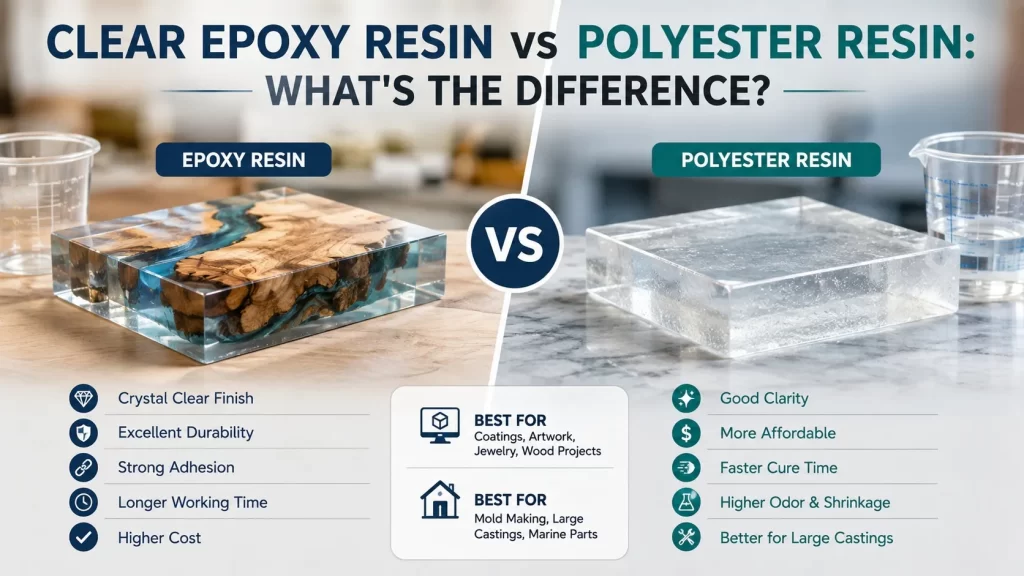
It is important to distinguish between clear epoxy resin and polyester resin in order to choose the appropriate material for the intended application for the manufacturer, designer and hobbyist.
What Is Clear Epoxy Resin?
Clear epoxy resin is a high performing thermosetting polymer that is formed by a combination of epoxy resin and a curing agent. After mixing, the chemical reaction creates a strong, durable and clear material that has high adhesion and resistance.
Clear epoxy resin is popular in use for:
- River tables and wood coating
- Art and craft projects
- Jewelry making
- Floor coatings
- Electronic potting
- Composite materials
- Protective surface coatings
A major benefit of a clear epoxy resin is that it can achieve a smooth and glassy surface with good mechanical properties.
Key Features of Clear Epoxy Resin
1. Excellent Transparency
Clear epoxy resin is of excellent optical quality and is excellent for decorative uses where clearness is important. Can maintain natural beauty of wood, art and embedded items.
2. Strong Adhesion
Epoxy resin bonds extremely well with materials such as:
- Wood
- Metal
- Glass
- Concrete
- Carbon fiber
- Fiberglass
This strong bonding capability makes it popular for industrial and construction applications.
3. Low Shrinkage
Clear epoxy resin will cure with very little shrinkage and less than polyester resin. This keeps the part's dimensions accurate and minimises cracking and deformation.
4. High Chemical and Moisture Resistance
Cured epoxy resin provides excellent protection against:
- Water
- Chemicals
- Oils
- Environmental exposure
This makes it suitable for demanding industrial environments.
What Is Polyester Resin?
Another thermosetting polymer used in combination with fiberglass is polyester resin. It is a chemical product and is prepared by a chemical reaction between polyesters polymers and reactive monomers, typically styrene.
Polyester resin has been used for many years due to its being a relatively inexpensive material in the manufacture of composites on a large scale.
Common applications include:
- Fiberglass boats
- Automotive parts
- Swimming pools
- Storage tanks
- Construction panels
- Industrial composites
Polyester resin is less concerned with appearance and performance quality than epoxy resin, but more with low cost and rapid production.
Clear Epoxy Resin vs Polyester Resin: Main Differences
Although both resins can create strong finished products, their characteristics differ significantly.
1. Appearance and Transparency
For projects requiring a crystal-clear finish, epoxy resin is usually the better choice.
Clear epoxy resin offers:
- Better transparency
- Higher gloss finish
- Less yellowing when UV-resistant formulas are used
- Smoother surface quality
Polyester resin can also appear transparent, but it often has:
- More visible imperfections
- Higher chance of cloudiness
- Stronger odor during application
- Greater yellowing tendency over time
For decorative applications such as river tables, artwork, and luxury coatings, epoxy resin is generally preferred.
2. Strength and Durability
Both materials provide good strength, but their performance differs.
Epoxy Resin Advantages:
- Higher tensile strength
- Better impact resistance
- Stronger bonding ability
- Improved fatigue resistance
- Better long-term durability
Polyester Resin Advantages:
- Good rigidity
- Suitable for fiberglass reinforcement
- Lower material cost
- Faster production cycles
For high-performance applications requiring long service life, epoxy resin typically provides better overall performance.
3. Adhesion Performance
Adhesion is one of the biggest differences between epoxy resin and polyester resin.
Clear epoxy resin creates strong chemical bonds with many surfaces, which is why it is commonly selected for:
- Repair applications
- Composite manufacturing
- Protective coatings
- Structural bonding
Polyester resin has weaker adhesion properties and usually performs best when combined with fiberglass reinforcement.
If bonding strength is a priority, epoxy resin is often the preferred option.
4. Curing Time
The curing process also differs.
Clear Epoxy Resin
Epoxy resin usually cures more slowly, allowing:
- Better leveling
- More working time
- Reduced application mistakes
- Improved surface quality
Depending on the formula, curing may take several hours to several days.
Polyester Resin
Polyester resin cures faster, making it suitable for mass production.
However, faster curing can create challenges such as:
- Short working time
- Higher shrinkage
- More internal stress
Manufacturers often choose polyester resin when production speed is more important than premium finish.
5. Cost Comparison
Cost is another important factor when selecting resin materials.
Polyester resin is generally cheaper because:
- Raw materials cost less
- Production processes are simpler
- It is widely used in large-volume manufacturing
Clear epoxy resin usually costs more because it provides:
- Better performance
- Higher durability
- Superior appearance
- More advanced formulations
For professional products where quality and customer experience are important, epoxy resin often provides better value despite the higher initial cost.
6. Odor and Safety Considerations
Polyester resin contains styrene, which produces a strong chemical smell during application.
Users typically need:
- Good ventilation
- Protective equipment
- Proper handling procedures
Clear epoxy resin generally has a milder odor, making it more suitable for indoor applications such as:
- Crafts
- Furniture coatings
- Decorative projects
However, both materials should always be used according to manufacturer safety guidelines.
Clear Epoxy Resin vs Polyester Resin: Application Comparison
| Application | Recommended Resin |
|---|---|
| River tables | Clear Epoxy Resin |
| Jewelry making | Clear Epoxy Resin |
| Art projects | Clear Epoxy Resin |
| Floor coatings | Epoxy Resin |
| Electronic potting | Epoxy Resin |
| Fiberglass boats | Polyester Resin |
| Automotive fiberglass parts | Polyester Resin |
| Large composite production | Polyester Resin |
| Industrial repair bonding | Epoxy Resin |
Which Resin Should You Choose?
The best choice depends on your project requirements.
Choose clear epoxy resin if you need:
- Crystal-clear appearance
- Strong adhesion
- High durability
- Premium surface finish
- Low shrinkage
- Professional-quality results
Choose polyester resin if you need:
- Lower cost materials
- Fast production
- Large fiberglass applications
- Basic composite manufacturing
Clear epoxy resin is generally the best choice for decorative, high value, precision applications.
Polyester resin is still suitable for high-volume production where economics are important for fiberglass production.
Why Choose a Professional Clear Epoxy Resin Manufacturer?
Partnering with an experienced clear epoxy resin manufacturer guarantees a consistent manufacturing process, reliable performance, and tailored solutions.
A professional supplier can supply:
- High-transparency epoxy formulations
- Low-yellowing technology
- Different curing speeds
- Custom packaging options
- OEM and ODM services
- Technical support
In the case of furniture makers, electronics companies, crafts manufacturers, construction, and composite producers, the resin supplier could have a major impact on product performance and customer satisfaction.
Final Thoughts
The main difference between clear epoxy resin and polyester resin is the performance, look, price, and application needs.
For high-quality projects and advanced industrial applications, clear epoxy resin provides superior transparency, stronger bonding and greater durability and finish.
Despite the high cost, polyester resin can still be an economical option for large scale fiberglass and composite production when cost and production speed are important consideration.
Knowing the pros and cons of each resin can help businesses and creators choose the best resin solution and maximize their possibilities for success.