





Many users often find themselves with a dilemma when choosing the right resin for their project: Casting resin or coating resin? Both materials are excellent in terms of durability, transparency and protection, but are used in completely different applications, since they are based on a different epoxy resin technology.
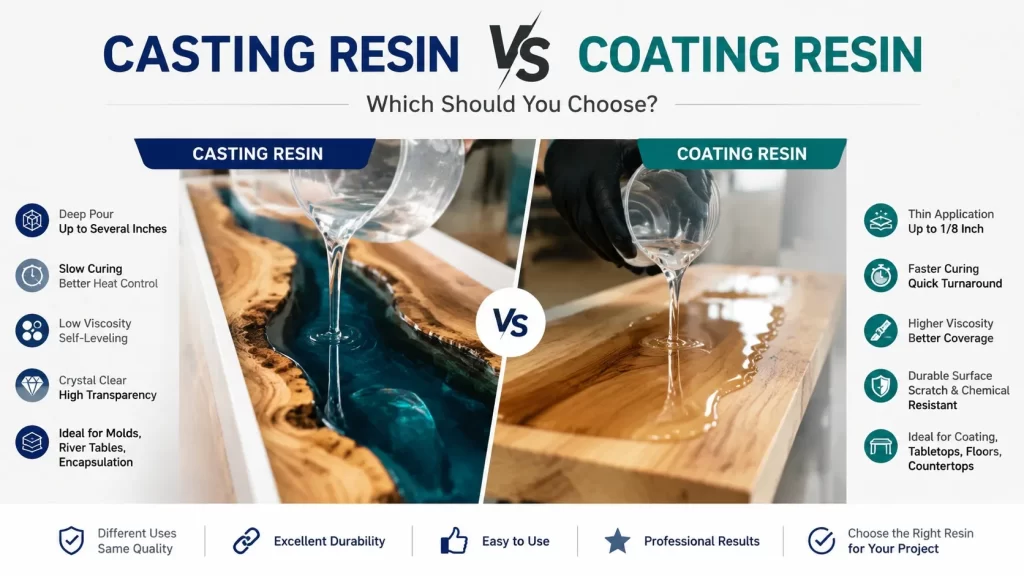
Using the wrong type of resin can cause issues of incomplete curing, overheating, cracking, surface finish, and shortened product life. Casting resin vs coating resin is a difference that must be understood by artists, manufacturers, and businesses to choose the best resin for their needs and applications.
This guide covers the differences between casting resin and coating resin, such as its thickness, curing performance, use and the advantages, and selection of resin for your project.
What Is Casting Resin?
Casting resin is a special formulation of epoxy resin that is used for deep pours and 3-D casting. It has lower viscosity, slow curing properties and good self leveling properties which makes it suitable for flowing into molds and filling large space.
Casting resin can be cast thicker than normal surface coatings because its chemical make-up allows for control of the heat produced during curing.
Some common uses of casting resin are:
- River tables and epoxy furniture
- Resin art and decorative objects
- Jewelry and craft projects
- Mold casting
- Encapsulation of wood, flowers, and other materials
- Industrial prototypes
Casting resin is particularly favored by woodworkers, artists, and studios involved in resin manufacturing.Casting resin is widely used by woodworkers, artists, and resin manufacturers for its excellent clarity and excellent visual effects.
What Is Coating Resin?
The coating resin is an epoxy system, used mainly for surface protection and finish. It provides a protective, smooth and shiny coating to various materials.
Coating resin has a higher viscosity and faster curing speed than casting resin. Optimized for thin application, it adheres well, and forms a strong protective barrier.
Common uses of coating resins are:
- Epoxy countertops
- Tabletops and bar surfaces
- Floors and industrial coatings
- Protective layers for wood and metal
- Artwork sealing
- Decorative finishes
The primary advantage of coating resin is not to fill in large amounts, but rather to add to the surface appearance and make it more scratch resistant, chemical resistant and waterproof.
Key Differences Between Casting Resin and Coating Resin
Although both resins are epoxy-based, their properties differ significantly.
1. Application Thickness
The significant difference between casting resin and coating resin is the suggested pour thickness.
Casting Resin
Casting resin is made to be used for deeper casts. Its thickness can be poured is typically several centimeters in one application, depending on the formulation.
It reacts more slowly, which lets heat out slowly, so that it is less likely to cause:
- Cracking
- Yellowing
- Excessive bubbles
- Thermal damage
Coating Resin
Coating resin is used for thin coatings (typically millimeters).
Coating resin is used in a thick layer, resulting in:
- Surface defects
- Shrinkage
- Warping
- Internal stress
For deep projects, casting resin is the safer choice.
2. Viscosity and Flow Performance
Viscosity determines how easily resin flows and fills spaces.
Casting Resin Characteristics:
- Low viscosity
- Excellent flow ability
- Easier bubble release
- Suitable for molds and deep cavities
The low viscosity allows the resin to surround embedded objects and reach small details.
Coating Resin Characteristics:
- Higher viscosity
- Better surface coverage
- Creates a thicker protective film
- Provides excellent leveling on flat surfaces
Coating resin stays where it is applied, making it ideal for countertops, tables, and floors.
3. Curing Time
Curing speed is another important difference.
Casting Resin
Casting resin usually cures slowly. A longer curing time helps control heat buildup and improves clarity.
Advantages include:
- Better transparency
- Reduced bubbles
- More stable deep pours
- Improved final appearance
However, projects may require more waiting time before handling.
Coating Resin
Coating resin generally cures faster, allowing quicker project completion.
Benefits include:
- Shorter production cycles
- Faster surface protection
- Convenient application for commercial projects
For businesses requiring high production efficiency, coating resin can offer significant advantages.
4. Final Appearance
Both resin types can provide a beautiful glossy finish, but their visual effects differ.
Casting Resin Appearance
Casting resin is known for:
- Crystal-clear transparency
- Deep 3D effects
- Excellent light transmission
- Smooth internal appearance
It is commonly used for artistic projects where depth and clarity are important.
Coating Resin Appearance
Coating resin provides:
- High-gloss surface finish
- Smooth protective coating
- Professional appearance
- Improved surface durability
It is widely used where appearance and protection are equally important.
5. Durability and Performance
Both casting resin and coating resin offer strong durability, but their strengths are different.
Casting Resin Advantages:
- Excellent dimensional stability
- Good impact resistance
- Strong bonding properties
- Suitable for thick structures
Coating Resin Advantages:
- Superior scratch resistance
- Strong surface protection
- Excellent chemical resistance
- Easy maintenance
The best choice depends on whether durability is needed throughout a thick structure or mainly on the surface.
Casting Resin vs Coating Resin: Application Comparison
| Feature | Casting Resin | Coating Resin |
|---|---|---|
| Main Purpose | Deep filling and casting | Surface protection |
| Thickness | Thick pours | Thin layers |
| Viscosity | Low | Medium to high |
| Curing Speed | Slow | Faster |
| Bubble Control | Excellent | Good |
| Best For | Molds, river tables, crafts | Floors, countertops, surfaces |
| Finish | Deep transparent effect | Glossy protective layer |
| Heat Control | Better for large volumes | Limited thickness |
How to Choose Between Casting Resin and Coating Resin?
The right resin depends on your project requirements.
Choose Casting Resin If You Need:
✔ Deep pours
✔ Large-volume filling
✔ Transparent 3D effects
✔ Embedded objects
✔ Resin artwork
✔ Mold casting
Examples:
- Creating an epoxy river table
- Encapsulating decorative materials
- Producing thick resin blocks
Choose Coating Resin If You Need:
✔ A protective surface layer
✔ High gloss finish
✔ Scratch resistance
✔ Fast curing
✔ Easy application
Examples:
- Sealing a wooden tabletop
- Protecting artwork
- Creating an epoxy countertop
- Applying industrial coatings
Common Mistakes When Choosing Resin
Many resin problems happen because users select the wrong product type.
Using Coating Resin for Deep Pours
This may cause overheating, cracks, and uneven curing.
Using Casting Resin for Surface Coating
Because casting resin cures slowly and is designed for depth, it may not provide the ideal surface hardness or efficiency.
Ignoring Resin Quality
High-quality resin manufacturers provide better:
- UV resistance
- Color stability
- Mixing performance
- Curing consistency
- Long-term durability
For professional applications, choosing a reliable resin supplier is essential.
Industrial Applications of Casting and Coating Resin
Both resin types are widely used in modern industries.
Casting Resin Applications:
- Electronics encapsulation
- Decorative manufacturing
- Prototype production
- Composite materials
- Custom crafts
Coating Resin Applications:
- Industrial flooring
- Automotive protection
- Furniture manufacturing
- Construction surfaces
- Commercial decoration
Manufacturers often select specialized epoxy systems depending on environmental conditions, production requirements, and performance expectations.
Why Work With a Professional Resin Manufacturer?
For businesses purchasing resin in bulk, working with an experienced resin manufacturer provides several benefits:
- Customized resin formulations
- OEM and private label services
- Stable quality control
- Technical support
- Large-scale production capability
Professional suppliers can develop specialized solutions for applications such as:
- Fast-curing epoxy resin
- UV-resistant resin
- Low-viscosity casting resin
- High-strength coating resin
- Industrial epoxy systems
This helps companies achieve better product performance and reduce production risks.
Final Thoughts: Casting Resin or Coating Resin?
It is generally determined by the needs of the project whether to use a resin cast or a coated resin.
For deep filling, transparent effects or large volume casting, casting resin is the superior choice. It offers outstanding flow, thermal properties and 3D clarity.
For a durable protective surface, it is best to use a resin, if you require a glossy surface. It provides excellent surface protection, chemical resistance and professional appearance.
Knowing the differences between these two epoxy resin solutions will allow for better results, longer life and better project performance.
From crafts to furniture, to industrial production to commercial products, the selection of the appropriate type of resin is the only guarantee of obtaining a good product at the end of the process.