




Epoxy resin is popular in contemporary building due to its high strength, superior adhesion, chemical resistance, waterproof, and durability. Epoxy resin can be used for various construction applications such as concrete repair, industrial flooring, structural bonding, and protective coatings.
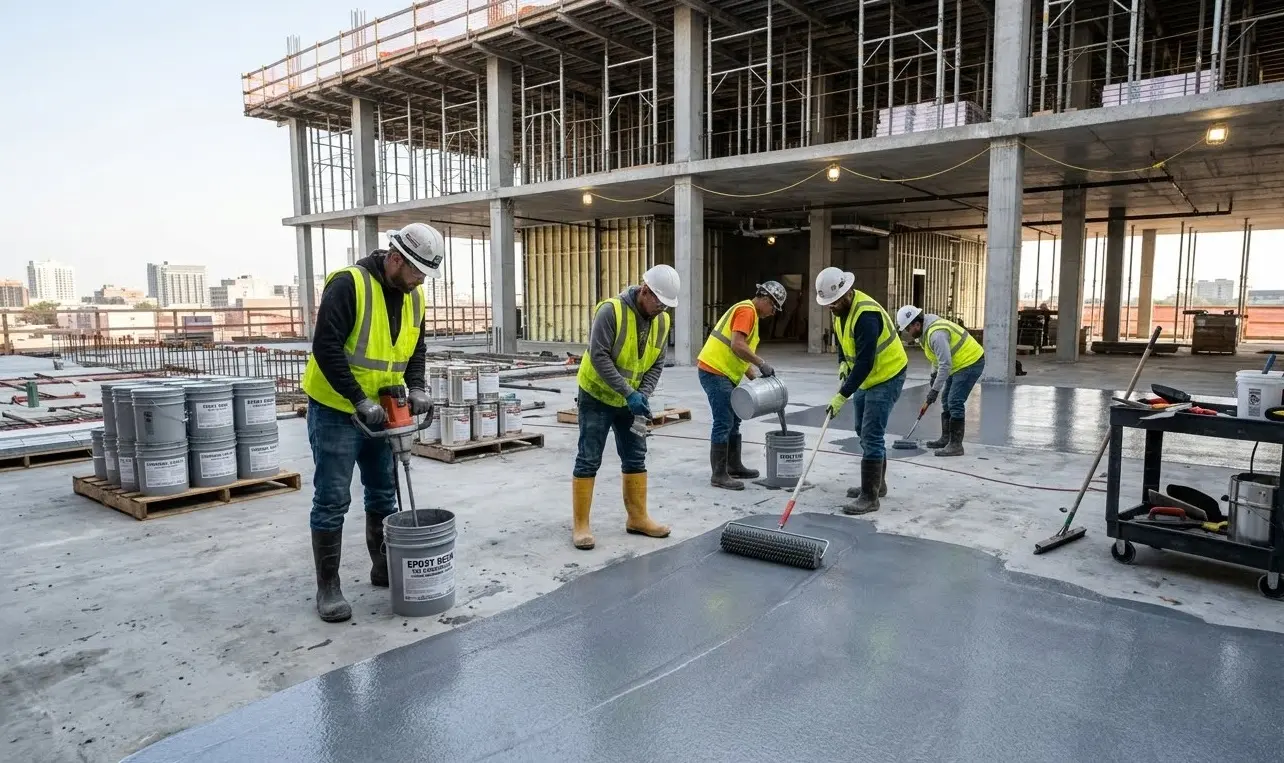
Then, what are the uses of epoxy in construction? They are used in construction bonding, concrete floor coatings, crack repair, surface protection, structure reinforcement and decorative surfaces.
This guide discusses the most popular epoxy applications in construction, the benefits, and selecting the right epoxy for specific construction applications.
What Is Epoxy?
Epoxy is a thermosetting polymer that is usually packaged in two components: an epoxy resin and a hardener. These ingredients, when combined in the proper proportions, react chemically and harden to a hard, rigid material.
Cured epoxy is an adhesive that can bond materials like concrete, metal, wood, glass, and composite materials, unlike many other conventional adhesives and coatings. It is useful in building and repairing jobs because it is resistant to moisture, chemicals, abrasion and the environment.
Numerous uses of epoxy in concrete have been recognised by the American Concrete Institute (ACI) such as coatings, grouts, bonding agents, repair materials, sealers, adhesives, and epoxy mortars.
1. Epoxy Adhesives for Structural Bonding
One of the most important uses of epoxy in construction is structural bonding.
Epoxy adhesives can bond various materials together to form strong, durable bonds. They can be used to bond concrete, metals, wood, glass, stone and composite materials depending on the formulation.
An epoxy adhesive can be used for construction by professionals who:
- Bonding concrete components
- Securing metal anchors
- Attaching construction panels
- Bonding wood laminates
- Fixing building components
- Installing reinforcement materials
- Connecting dissimilar materials
Epoxy is especially effective in applications where there is a need for a construction joint that either has very high bond strength or needs to be moisture or environmentally resistant.
In the case of infrastructure projects, epoxy may also be applied to join new concrete to existing concrete and for special repair and grouting jobs. Caltrans for instance mentions epoxy use such as bonding fresh to hardened concrete, crack pressure grouting, and epoxy concrete and mortar applications with high strengths.
2. Epoxy Flooring for Commercial and Industrial Buildings
Another large-scale use of epoxy flooring applications is in the construction field.
Epoxy is applied to an appropriately prepared concrete base surface and forms a hard-wearing, seamless surface that is resistant to foot traffic, equipment, impacts, stains, and many chemicals.
This makes epoxy flooring a good choice for:
- Warehouses
- Manufacturing facilities
- Garages
- Workshops
- Hospitals
- Laboratories
- Commercial kitchens
- Parking areas
- Basements
- Retail and commercial spaces
Epoxy flooring offers an excellent benefit of maintenance. The surface is smooth, so there are less joints which can trap dirt and impurities, and cleaning is easier.
Decorative aggregates, pigments, textures, anti-slip additives and colored flakes are also available to customize epoxy floors. The smooth epoxy surface may even become slippery when wet, and if extra slip-resistant surface is needed, a proper texture or aggregate can be added during epoxy application.
3. Concrete Crack Repair and Restoration
One of the common areas where epoxy is applied to concrete is to repair cracks, voids, and damaged surfaces.
The epoxy injection system can fill in appropriate cracks and be bonded with the surrounding concrete to restore continuity and keep the repaired area from further damage.
Common applications include:
- Concrete crack injection
- Structural crack repair
- Concrete patching
- Joint repair
- Filling voids
- Repairing damaged concrete surfaces
- Restoring aging infrastructure
The type of epoxy system will vary, depending on the type, width, movement, and moisture of the crack and the structural needs. Not all concrete cracks need to be fixed with a stiff epoxy.
When used with the right material and application techniques, epoxy can be a very effective repair process for infrastructure maintenance, with a minimal impact on the surrounding environment.
4. Waterproofing and Moisture Protection
Water is one of the biggest challenges to concrete and construction materials in general. Excessive exposure to water can cause deterioration, corrosion, staining and other building issues.
If the surface to be coated is properly prepared, epoxy coatings can provide a dense, protective surface that reduces water penetration.
These are typically considered for some of the following:
- Basement floors
- Parking garages
- Industrial floors
- Concrete walls
- Utility rooms
- Workshops
- Marine structures
But, epoxy is not a one-size-fits-all solution to all moisture issues. For example, moisture vapor coming through a concrete slab can cause adhesion or coating failures if the substrate is not properly evaluated before installation.
Appropriate surface preparation or moisture testing are, therefore, essential for good performance over time.
5. Chemical-Resistant Protective Coatings
Oil, solvents, acids, alkalis, cleaning chemicals and other aggressive materials can be found on surfaces at construction sites in factories, laboratories, warehouses, and food processing facilities.
Some types of epoxy resists chemicals and are suitable as protective coatings for concrete and other surfaces.
For instance, industrial floors can be protected from the following with epoxy coatings:
- Oil and grease
- Fuel
- Cleaning chemicals
- Solvents
- Selected acids
- Alkalis
- Industrial contaminants
The exact chemical resistance depends on the epoxy formulation, concentration of the chemical, temperature, exposure time, and application thickness. Therefore, project specifications should always be checked against the manufacturer's chemical-resistance data.
6. Structural Strengthening with Epoxy and Reinforcement Materials
Epoxy also plays an important role in structural strengthening and rehabilitation.
It can be combined with reinforcement materials such as carbon fiber, fiberglass, or steel components to strengthen existing structures.
Potential applications include reinforcing:
- Concrete beams
- Columns
- Slabs
- Bridges
- Tunnels
- Building structures
- Other load-bearing components
This approach can be particularly useful when an existing structure needs additional capacity or rehabilitation without adding substantial weight.
Epoxy adhesives are also used in infrastructure applications involving bonded anchors and composite reinforcement systems.
7. Epoxy for Bridges, Roads, and Infrastructure
Beyond buildings, epoxy is widely used in civil engineering and infrastructure projects.
Bridges, highways, tunnels, and concrete structures are exposed to traffic loads, moisture, temperature changes, deicing chemicals, and other environmental stresses.
Epoxy systems can be used for:
- Concrete crack repair
- Bonding applications
- Bridge-deck systems
- Pavement repairs
- Joint treatment
- Protective coatings
- Structural rehabilitation
Because infrastructure repairs can affect transportation and public access, construction teams often value repair systems that provide reliable performance while reducing project downtime.
8. Epoxy Countertops and Decorative Surfaces
Epoxy is not limited to structural applications. It is also used to create decorative and functional surfaces.
Epoxy resin can be applied to or combined with materials such as wood, recycled glass, aggregates, and other decorative components to produce customized countertops and surfaces.
Designers can incorporate:
- Pigments
- Metallic effects
- Decorative flakes
- Colored aggregates
- Recycled materials
- Custom patterns
This makes epoxy attractive for kitchens, bathrooms, commercial interiors, retail spaces, and custom architectural projects.
Besides appearance, cured epoxy can provide a hard, easy-to-clean surface when the appropriate formulation and installation method are used.
9. Marine and Outdoor Construction Applications
Epoxy is also valuable in environments where construction materials are exposed to water and demanding outdoor conditions.
Marine applications may include:
- Boat hulls
- Decks
- Docks
- Marine structures
- Waterproofing systems
- Protective coatings
Epoxy's strong adhesion and moisture resistance make it useful for protecting suitable substrates in wet environments.
However, outdoor epoxy systems must be selected carefully. UV exposure, temperature changes, substrate movement, and weather conditions can affect long-term performance. A formulation designed specifically for exterior or marine use may be more appropriate than a general-purpose epoxy.
Key Benefits of Epoxy in Construction
Why is epoxy so widely used?
The answer is its combination of properties. Depending on the product formulation, epoxy can provide:
Strong adhesion: Epoxy can bond effectively to many common construction materials.
Durability: Properly cured epoxy can withstand substantial wear and mechanical stress.
Chemical resistance: Specialized formulations can protect surfaces from various chemicals.
Moisture resistance: Epoxy coatings can help reduce water penetration and protect suitable substrates.
Versatility: Epoxy can be formulated as adhesives, coatings, grouts, repair materials, sealers, and mortars.
Low maintenance: Seamless epoxy surfaces are generally easy to clean.
Custom appearance: Pigments, flakes, aggregates, and other additives allow decorative finishes.
How to Choose the Right Epoxy for Construction
Not all epoxy products are the same. Choosing the right product depends on the application.
Before purchasing epoxy, consider:
- Substrate: Is the material concrete, metal, wood, glass, or another surface?
- Application: Do you need an adhesive, coating, grout, repair material, or sealer?
- Load requirements: Will the material experience heavy traffic or structural loads?
- Chemical exposure: What chemicals will contact the cured epoxy?
- Moisture conditions: Is the substrate dry, damp, or exposed to water?
- Temperature: What temperatures will the finished system experience?
- Indoor or outdoor use: Will the epoxy be exposed to sunlight and weather?
- Cure time: How quickly does the construction area need to return to service?
- Surface preparation: Can the substrate be properly cleaned, profiled, and prepared?
Correct product selection and installation are just as important as the epoxy chemistry itself.
Frequently Asked Questions About Epoxy in Construction
What is epoxy mainly used for in construction?
Epoxy is mainly used for adhesive bonding, concrete repair, protective coatings, industrial flooring, grouting, sealing, and structural strengthening.
Is epoxy good for concrete?
Yes. Epoxy is widely used with concrete for coatings, crack repair, bonding, grouting, sealers, and repair materials. The American Concrete Institute lists epoxy among the established materials used in concrete construction and repair.
Is epoxy waterproof?
Cured epoxy can provide a highly water-resistant or waterproof barrier, depending on the formulation and system design. However, substrate moisture and movement must be properly addressed because water vapor or concrete cracking can cause coating problems.
How long does construction epoxy last?
There is no single lifespan for all epoxy products. Service life depends on the formulation, substrate preparation, installation quality, traffic, chemical exposure, temperature, UV exposure, and maintenance.
Can epoxy repair structural concrete cracks?
Certain epoxy injection systems are designed for appropriate structural concrete crack repair. However, crack movement, structural conditions, moisture, and the cause of the cracking should be evaluated before selecting a repair method.
Conclusion
So, what is epoxy used for in construction? It offers a lot more than just adhesive bonding. Industrial floors, concrete repair, structural bonding, waterproofing, chemical-resistant coatings, infrastructure rehabilitation, reinforcement systems, decorative surfaces and marine applications are just a handful of where epoxy can be used.
Epoxy is a significant material in new construction and renovation due to its strength, adhesion, durability and resistance.
However, the selection of the epoxy should always be made for the particular application and environmental conditions for best results. Proper preparation of the substrate, correct mixing, application, curing, and maintenance are necessary to obtain the expected performance.
Epoxy's versatility in addressing many challenging applications in the field of building and infrastructure makes it a versatile material for these demanding construction projects.