





Epoxy flooring is gaining popularity among home owners, offices, warehouses, garages, restaurants, and industrial facilities. Epoxy flooring is hard-wearing, chemical resistant, easy to maintain, and has a variety of design options, making it an ideal choice for creating a durable, functional, and attractive floor surface.
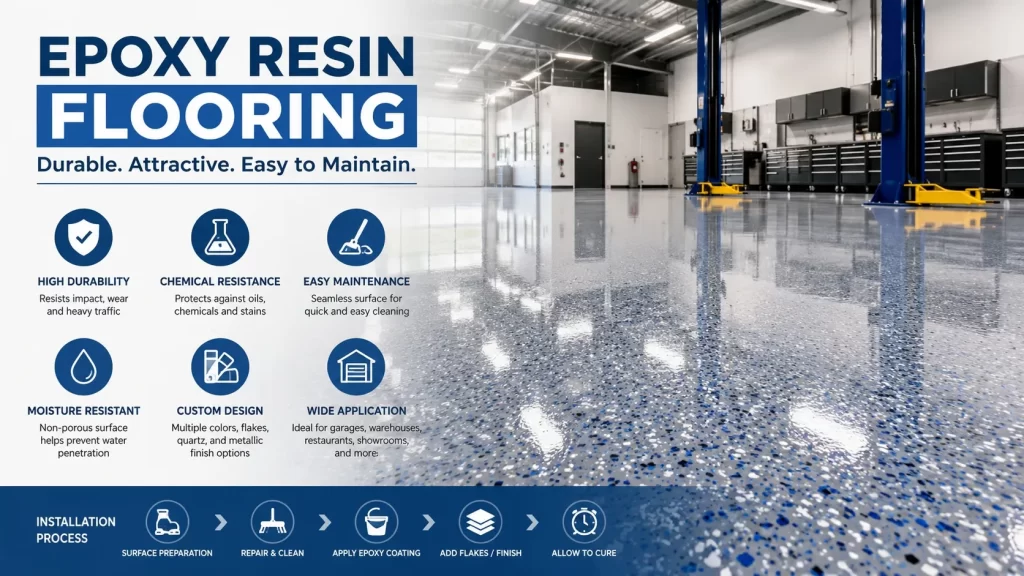
So what is an epoxy resin floor, what type of floors are there and where are they used? This guide will cover the information you need to know before you decide on an epoxy flooring system.
What Is Epoxy Resin Flooring?
Epoxy resin flooring is the protective floor coating comprising of 2 components: epoxy resin and hardener. If these parts are combined properly, a chemical reaction occurs that results in strong, hard, plastic-like surface.
Epoxy is not merely a painted floor, but actually chemically bonds to a well-prepared base. After cure, the coating forms a continuous and impervious surface, which can help to prevent moisture, stain, chemical corrosion, impact, and normal wear and tear of concrete.
Epoxy is available in a variety of colors, flakes, quartz aggregates and metallic pigments, and can be formulated to include anti-slip additives, which makes it functional and decorative.
Why Choose an Epoxy Floor?
Concrete is sturdy but it's not indestructible. The unprotected concrete floor is vulnerable to damage over time as a result of heavy traffic, fluids of vehicles, chemicals, moisture, abrasion, and impact.
An epoxy coating provides a protective surface to prolong service life and enhance looks of the underlying surface.
1. Excellent Durability
Epoxy flooring has tremendous advantages, one of which is its strength. When installed correctly, epoxy systems can handle significant amounts of foot traffic, equipment moving, vehicle traffic and normal impacts.
This makes epoxy a great choice for garages, warehouses, manufacturing facilities, commercial spaces and other high-traffic areas.
2. Chemical and Stain Resistance
Epoxy floors are extremely resistant to a lot of the everyday spills and contaminants. A properly sealed epoxy surface will not allow oils, grease, cleaning chemicals and other substances to penetrate.
This is particularly beneficial in garages, workshops, restaurants, manufacturing plants and industrial settings, where there is potential for spills.
3. Easy to Clean and Maintain
Epoxy forms a smooth, sealed surface which makes dirt and liquids easier to clean than most conventional flooring surfaces.
Normal maintenance would include sweeping, mopping with an appropriate solution as needed and dusting. The seamless feature also eliminates many of the joints and gaps in tiled floors where dirt gathers.
4. Moisture Resistance
Epoxy coating forms a non permeable coating over concrete. This will prevent water from seeping in and make epoxy a practical material in moist environments.
Moisture testing and surface preparation prior to installation, however, are important to help ensure a successful coating installation as moisture under the slab can adversely impact coating performance.
5. Attractive Design Options
Gray or industrial looking is not the only option for epoxy flooring. The modern systems can be customized in various colors and finishes.
Popular options include:
- Solid-color epoxy
- Decorative flake flooring
- Quartz-filled systems
- Metallic epoxy
- Self-leveling epoxy
- Custom decorative designs
This flexibility allows epoxy flooring to match both industrial requirements and residential interior designs.
Common Types of Epoxy Flooring
Different environments require different flooring characteristics. The following epoxy systems are among the most common options.
Solid-Color Epoxy Flooring
Solid epoxy floors provide a clean, uniform appearance. They are available in a wide range of colors and work well in commercial buildings, garages, kitchens, showrooms, workshops, and other areas where a simple professional finish is preferred.
Flake Epoxy Flooring
Decorative flake flooring incorporates colored chips into the epoxy system. The flakes create a textured visual effect while helping improve surface traction.
Flake epoxy is especially popular for garages, basements, locker rooms, showrooms, recreational facilities, and other areas where appearance and practicality are both important.
Quartz Epoxy Flooring
Quartz aggregates can be incorporated into epoxy systems to create a highly decorative and durable surface. Different aggregate colors and combinations can produce customized designs.
Quartz flooring can be particularly useful in commercial and industrial spaces that require both visual appeal and enhanced surface performance.
Metallic Epoxy Flooring
Metallic epoxy uses specially formulated pigments to create three-dimensional visual effects, including waves, swirls, and marble-like patterns.
This type of flooring is often selected for showrooms, retail spaces, offices, restaurants, entertainment areas, and residential interiors where aesthetics are a major consideration.
Self-Leveling Epoxy Flooring
Self-leveling epoxy is designed to create a smooth, uniform surface over properly prepared concrete. It can be useful for floors with minor surface imperfections and is commonly considered for warehouses, offices, garages, commercial facilities, and other areas requiring a seamless finish.
Where Can Epoxy Flooring Be Used?
Epoxy resin flooring is versatile enough for residential, commercial, and industrial applications.
Residential Applications
Homeowners commonly choose epoxy flooring for:
- Garages
- Basements
- Kitchens
- Bathrooms
- Utility rooms
- Workshops
- Patios and other suitable concrete areas
Garage epoxy flooring is particularly popular because it can improve the appearance of concrete while making the surface easier to clean and maintain.
Commercial Applications
Businesses can use epoxy coatings in:
- Restaurants
- Retail stores
- Showrooms
- Offices
- Commercial kitchens
- Locker rooms
- Sports facilities
- High-traffic corridors
A seamless epoxy surface can provide a professional appearance while simplifying routine cleaning.
Industrial Applications
Industrial-grade epoxy systems are often used in:
- Warehouses
- Manufacturing plants
- Workshops
- Production facilities
- Automotive facilities
- Food-processing environments
- Equipment areas
- High-traffic industrial buildings
The specific epoxy formulation should always be selected according to the expected chemical exposure, traffic level, temperature, moisture conditions, and other site requirements.
How Is Epoxy Flooring Installed?
Professional epoxy installation begins with surface preparation rather than simply applying coating over concrete.
Step 1: Inspect and Prepare the Concrete
The existing concrete must be inspected for cracks, contamination, weak areas, moisture issues, and other defects. Dirt, grease, oils, coatings, and debris should be removed.
Mechanical preparation methods may be used to create an appropriate surface profile and improve adhesion.
Step 2: Repair Surface Defects
Cracks, holes, damaged areas, and other imperfections should be addressed before coating. A properly prepared substrate is critical for achieving a durable result.
Step 3: Apply the Epoxy System
Once the concrete is clean, dry, and properly prepared, the epoxy components are mixed according to the manufacturer's specifications.
The coating is then applied at the appropriate thickness. Depending on the selected system, additional layers, decorative flakes, quartz, pigments, or anti-slip materials may be incorporated.
Step 4: Add Additional Coats or Finishes
A second coat or compatible topcoat can be used to provide increased durability, enhance appearance, increase chemical resistance, or provide additional slip resistance.
If a certain area is exposed to water or oil, an anti-slip additive can be added to the system to achieve better traction.
Step 5: Allow Proper Curing
Epoxy requires sufficient curing time before the floor is put back into normal use. The curing time varies based on product, temperature, humidity, coating thickness and site conditions.
For instance, the epoxy coating process at JDL Surface Innovations can take at least 48 hours to dry and cure so that the surface can be used normally, but this varies depending on the system and conditions.
Is Epoxy Flooring Slippery?
Epoxy floor is slippery if it comes in contact with water, oil, or other liquids. This is one of the key factors to take into account when choosing a flooring system.
Thankfully, anti-slip aggregates or textured finishes can be added to the coating by the contractor. The surface can be enhanced by means of silica or aluminum oxide.
It will depend on the environment and degree of slip resistance needed.
What Are the Limitations of Epoxy Flooring?
Epoxy flooring has numerous advantages, but it is not right for all circumstances.
The quality of installation is very important, especially first. Failure of the coating may be due to poor surface preparation, wrong mixing, excess moisture, or inappropriate environmental conditions.
Second, there can be visible odors or vapors that are noticeable when a new application of epoxy is made. Ventilation, protective equipment and access restrictions are pertinent during application and curing.
Finally, epoxy is generally installed over an existing substrate such as concrete. It is not a floor in and of itself, but a coating system.
How Long Does Epoxy Flooring Last?
The life expectancy of an epoxy coating is influenced by the quality of the product, the quality of the substrate, the type of installation, the use, exposure to any chemicals, maintenance, and environmental conditions.
With the right preparation and maintenance and a professional installation, a system can give long term performance. A stronger coating system may be necessary in a high traffic industrial area than a residential garage.
Therefore, selection of the correct epoxy system cannot be made on the basis of the lowest installation cost.
Epoxy Flooring vs. Polished Concrete
Both epoxy and polished concrete are popular options for concrete floors, but they have different effects.
Epoxy is a resin based surface treatment applied over the substrate, forming a sealed, impervious surface. Polished Concrete, on the other hand, entails mechanized grinding and polishing of the existing concrete surface.
Epoxy tends to offer greater choice of colors, decorative flakes, metallic finishes, and custom finishes. If the concrete is the feature, a natural industrial look might be desired and polished concrete can be used to achieve that appearance.
The right one will depend on the project's visual effect, functionality, cost, upkeep, and environmental needs.
How to Choose the Right Epoxy Flooring System
Before choosing an epoxy floor, consider these questions:
- What type of traffic will the floor receive?
Foot traffic, vehicles, forklifts, and heavy machinery require different levels of performance. - Will the floor be exposed to chemicals or oils?
If so, choose a system designed for the expected chemical environment. - Is slip resistance important?
Wet or oily areas may require textured finishes or anti-slip aggregates. - What appearance do you want?
Solid colors, flakes, quartz, and metallic systems provide different visual results. - Does the concrete have moisture problems?
Moisture testing and proper preparation should be completed before coating. - How quickly does the space need to return to service?
Select a system and installation schedule that match the project's downtime requirements.
Final Thoughts
Epoxy resin flooring provides a good balance of durability, chemical resistance, moisture resistance, low maintenance and design options. The correct epoxy system can enhance the performance and appearance of a concrete surface from residential garage floors to challenging industrial facilities.
But it's not just about the coating—succeeding with epoxy flooring requires more. All of these - proper preparation of the substrate, selection of products, and their installation, control of the environment, and curing - are essential.
At higher traffic levels, commercial or industrial projects, the selection of an epoxy system to suit the environment is best accomplished by working with an experienced concrete coating professional. JDL Surface Innovations, for instance, offers epoxy coating for residential, commercial and industrial applications such as garages, warehouses, restaurants, manufacturing facilities and other high-traffic areas.
When considering applying an epoxy resin floor, you should first assess your concrete, the foot traffic and exposure, the look you want and the maintenance you will need. If you have the right system, and professional installation, epoxy can be a great way to make your concrete floor into a durable, good-looking, and easier-to-maintain floor.