





An epoxy resin tabletop can make an ordinary piece of wood into a beautiful piece of furniture. Epoxy resin is a durable, glossy surface that can be used on a wide variety of items, from live-edge dining tables and river tables, to coffee tables, desks, and bar tops.
But the selection of the best epoxy for table tops is not just about getting the clearest resin or the cheapest. There are many different types of epoxy, all with varying specifications for the application in question, the pouring depth, curing conditions, and the performance desired.
Well, what would be best epoxy resin for Tabletop? It depends on your project. If you know what the most vital properties of tabletop epoxy are, you can select one that offers the look, durability and workability you need.
What Is Tabletop Epoxy Resin?
Table top epoxy is a two part epoxy that has resin and hardener. A chemical reaction starts when the two components are combined in the recommended proportions, and the liquid slowly turns into a hard, lasting floor surface.
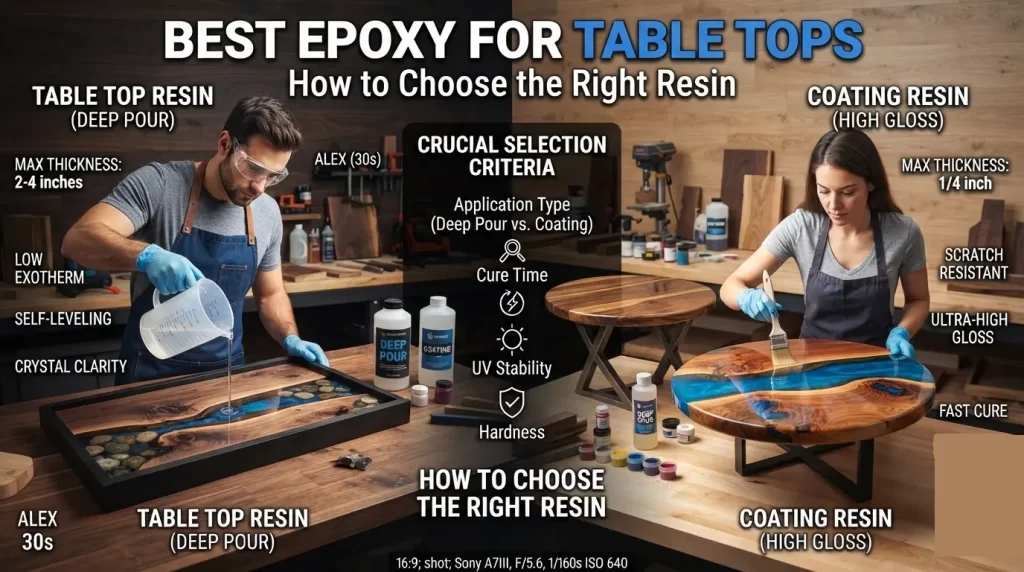
Tabletop epoxy is typically used for relatively thin protective or decorative coatings unlike deep pour epoxy that is used for thicker casts. It is popularly used over wooden surfaces to provide smoothness, glossiness, and to keep wood from absorbing water, staining and getting into daily use.
When pouring resin for river tables, or similar applications where a greater quantity of resin will be used, always refer to the manufacturer's suggested maximum pour depth before beginning.
What Makes the Best Epoxy for Table Tops?
No one epoxy resin fits all table tops. Your furniture size, design, location, and use will dictate which one is the best choice for you.
The following are the key features to look for.
1. Crystal-Clear Appearance
Clarity is one of the most crucial factors in many woodworking projects. To see the grain, the color, and the details of the wood, a good clear epoxy will not be cloudy.
Clear epoxy is particularly sought after for live-edge tables, as it achieves a glass-like finish while still maintaining the wood's natural look.
For colored table tops, choose a resin to which you can add mica powders, liquid pigments, metallic pigments or other epoxy colorants.
2. UV Resistance and Color Stability
Epoxy may fade over time when left in the sun. This is especially true of furniture that is situated close to a big window or used outside.
To ensure long-term color stability, consider using an epoxy with UV stable additives/stabilizers. But not all epoxy are UV resistant enough to be used outdoors for a long time.
Also look at changing temperatures, moisture, and exposure to the weather for outside furniture, and the manufacturer's recommendations for use.
3. Scratch and Heat Resistance
Accessories such as cups, plates, laptops, keys, and others come into contact with the tabletop every day – a lot more than decorative resin art.
Hence, for use on dining tables, desks, countertops and bar tops, scratch resistance and hardness are essential factors to consider when choosing epoxy.
Heat resistance is important, too. Some resin surfaces may be damaged by hot mugs, dishes, cookware and other heated objects. Don't assume that a cured epoxy surface is heat-proof; always refer to the product's technical specifications.
4. Self-Leveling Performance
An ideal tabletop epoxy will flow evenly on the surface and form an even coating.
Applying to large wooden slabs can be easier with self leveling properties. The work area however, still needs to be properly leveled. Epoxy will not work on a very rough surface.
A level surface of the table helps to keep the resin from migrating to one end and creating a thickness variance.
5. Bubble Release
Air bubbles are one of the most common problems when working with epoxy resin.
Wood is porous and air can become trapped in the wood and permeate the liquid epoxy during the curing process. Air can also be added when mixing.
A formula that is low in viscosity and has a release for bubbles can make it easier. Proper preparation is also crucial. It may be helpful to use a thin seal coat prior to the main pour to minimize air escaping from permeable wood.
If needed bubbles may be removed carefully following the instructions of the resin manufacturer.
6. Mixing Ratio and Working Time
The usability is particularly relevant for novice users.
Some tabletop epoxies will mix 1:1 resin to hardener, while others might call for a different ratio. The ratio itself is not necessarily an indication of quality. The important thing is that the instructions of the manufacturer are followed exactly.
Another factor of great importance is a factor known as working time or pot life. The longer the working time, the more time you will have to spread the resin, install decorative elements, and pop bubbles out of the resin before it becomes too thick.
Popular Types of Epoxy for Tabletop Projects
Different epoxy products can serve different purposes.
Clear Tabletop Epoxy
Clear epoxy is ideal when the goal is to highlight natural wood. It is commonly used for live-edge furniture, dining tables, desks, and decorative surfaces.
The main advantages are transparency, glossy appearance, and the ability to create a smooth protective layer.
Pigmented Epoxy
Pigmented epoxy allows you to create custom colors and artistic effects. Popular designs include ocean-inspired blue tables, metallic finishes, marble effects, and abstract patterns.
Before adding pigments, make sure they are compatible with your epoxy system and do not interfere with curing.
Deep-Pour Epoxy
If your project involves filling a deep gap between wood slabs, standard tabletop epoxy may not be the best option.
Deep-pour epoxy is specifically formulated for thicker applications and larger resin volumes. It often has different curing characteristics and should be selected according to the required pour depth.
How to Choose Epoxy for Different Table Applications
Your intended use should guide your selection.
For a dining table: Prioritize clarity, durability, scratch resistance, easy cleaning, and appropriate heat resistance.
For a coffee table: A high-gloss clear epoxy can provide an attractive decorative finish while protecting the wood from everyday spills.
For a desk: Consider hardness, scratch resistance, and long-term surface durability because office equipment and accessories can create frequent contact.
For a river table: Pay close attention to maximum pour depth, curing characteristics, bubble release, and compatibility with large wood slabs.
For an outdoor table: UV stability and environmental resistance become particularly important. Always verify that the complete system is suitable for outdoor conditions.
Tips for Getting a Professional Epoxy Tabletop
Choosing the right resin is only part of the process. Preparation and application have a major effect on the final result.
First, make sure the wood is clean, dry, and properly prepared. Remove dust, loose particles, and contaminants before applying epoxy.
Second, seal porous wood before making the main pour. This can help reduce air bubbles and prevent excessive absorption.
Third, measure resin and hardener accurately. Do not guess the ratio or change it to make the epoxy cure faster or slower.
Fourth, mix thoroughly but carefully. Scrape the sides and bottom of the mixing container to ensure both components are properly combined while avoiding unnecessary air incorporation.
Finally, allow the epoxy to cure according to the manufacturer's instructions. A surface that feels dry is not necessarily fully cured and ready for heavy everyday use.
Is Expensive Epoxy Always Better?
Not necessarily.
A premium epoxy may offer advantages such as better clarity, longer working time, improved UV stability, easier bubble release, or better technical support. However, the most expensive resin is not automatically the best choice for every project.
Instead, compare the properties that actually matter for your application. Look at coverage, recommended thickness, curing time, UV resistance, hardness, temperature limitations, mixing ratio, and manufacturer support.
For large projects, calculating the required resin volume before purchasing is also important. Buying too little can interrupt the project, while buying significantly more than necessary can increase costs.
Frequently Asked Questions
What is the best epoxy for a wooden tabletop?
The best epoxy is one specifically designed for tabletop or coating applications and matched to your project's thickness, appearance, durability, and environmental requirements.
How thick should tabletop epoxy be?
The appropriate thickness varies by product. Always follow the manufacturer's maximum and minimum application thickness instead of assuming that all epoxy resins can be poured to the same depth.
Does epoxy make a table waterproof?
A properly cured epoxy coating can provide strong resistance to water and spills. However, the performance depends on complete coverage, proper curing, surface preparation, and the specific formulation.
Can epoxy resin be used outdoors?
Different formulations can be more or less resistant to UV and environment. When using epoxy outdoors, see to it that the product is suitable for outdoor use.
Final Thoughts
The best epoxy for table tops is not just the resin that has the highest gloss or is the cheapest. The best product should correspond to the particular needs of your piece of furniture project.
For most table top uses, it is recommended to find the right balance of clear appearance, self leveling characteristics, bubble release, hardness, UV stability, and good curing characteristics. Take into account the size of the project, the depth of the pouring, the location of the project, and its usage into account.
With the appropriate epoxy resin, careful wood preparation, accurate mixing, and proper curing, you can turn a live-edge slab or simple wooden surface into a long-lasting, visually appealing tabletop that will be the focal point of any room.