





The type of resin to use can have a significant impact on the quality, longevity and appearance of your project. When you're considering casting resin vs epoxy resin, you might think they're all the same product or materials.
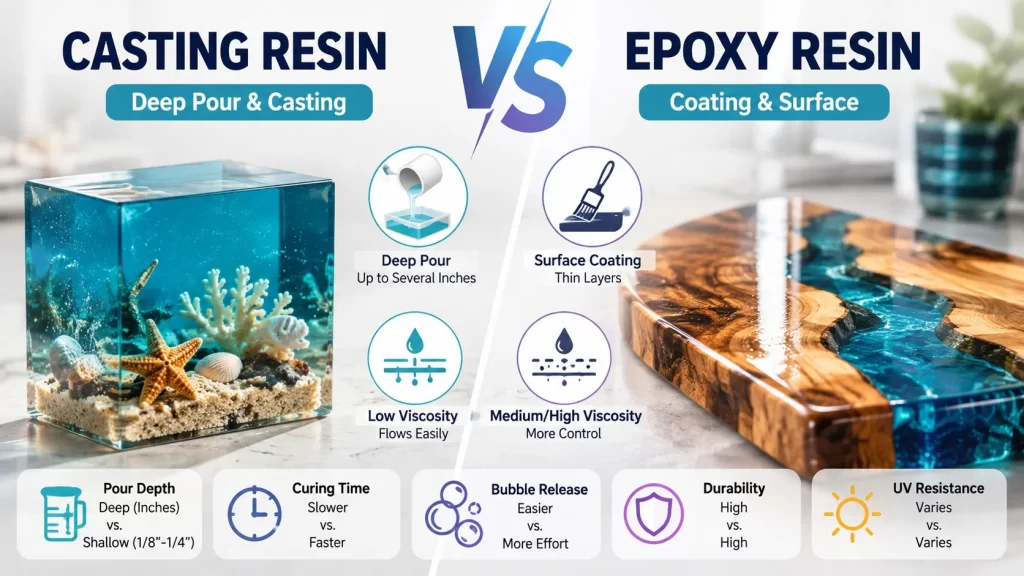
Casting resin is a type of epoxy resin designed for deep pours and casting. Other types of epoxy, like coating resin or art resin, are mostly used for thin coatings on the surface.
Knowing the viscosity, curing rate, pouring depth, hardness, bubble release and application of the different resins will help you to choose the right resin for your project and prevent common issues like overheating, cracking, trapped bubbles, or incomplete curing.
What Is Casting Resin?
Casting resin – also known as deep pour epoxy resin – is a low viscosity epoxy system that can be poured into molds or applied for relatively thick applications.
The fluid consistency of the resin permits it to flow around objects, fill in details in molds, and air out bubbles easily. Casting resin can be made to pour several inches deep depending on the formulation, but will vary by manufacturer.
Common applications include:
- River tables
- Resin molds
- Jewelry and decorative objects
- Figurines
- Encapsulating flowers, shells, photographs, and other objects
- Wood and epoxy projects
- Decorative blocks and sculptures
- Deep casting applications
Many casting resins cure slower which aids in controlling the heat released during the epoxy cure. This is especially important when working with large volumes of resin.
What Is Epoxy Resin?
The word epoxy resin is more general. Epoxy is a group of thermosetting polymers that can be compounded to be used for various purposes.
In the realm of crafts and do-it-yourself projects, epoxy resin can be used to coat resin or art resin, a type of resin with a smooth, shiny protective surface.
Epoxy coatings are used for relatively shallow applications and tend to be thicker than resin coatings.
Typical uses include:
- Tabletop coatings
- Countertops
- Bar tops
- Resin artwork
- Coasters
- Trays
- Wood projects
- Decorative surfaces
- Protective coatings
So, it's not a fair comparison to make the comparison of “casting resin” and “epoxy resin”. Rather, it would be a more appropriate comparison to make with the coating or art epoxy type.
Casting Resin vs Epoxy Resin: Key Differences
The biggest difference is the way each formulation is designed to behave during pouring and curing.
| Feature | Casting Resin | Coating / Art Epoxy |
|---|---|---|
| Viscosity | Very low | Medium to high |
| Main purpose | Deep casting and molds | Surface coating |
| Pour depth | Several inches, depending on product | Usually thin layers |
| Curing speed | Generally slower | Generally faster |
| Bubble release | Excellent when used correctly | More difficult in thick pours |
| Flow | Very fluid | More controlled |
| Typical projects | Molds, river tables, encapsulation | Tables, artwork, countertops |
| Heat management | Designed for deeper pours | Designed for shallow applications |
| Mixing ratio | Often 2:1 or 3:1 | Often 1:1 or 2:1 |
| Working time | Often longer | Usually shorter |
These specifications are general guidelines. Resin manufacturers use different formulations, so always check the technical data and product instructions before starting a project.
1. Viscosity
Viscosity is a property of a liquid's flow.
A casting resin generally is of a low viscosity and can be likened to a thin syrup or fluid liquid. This simplifies the ability of the material to fill small openings, complex molds and around embedded objects.
The second benefit of using a low viscosity formulation is that it assists air bubbles in rising to the surface during curing.
Epoxy coating and art epoxy generally are more viscous. This is helpful if you are applying to a tabletop or artwork as the resin does not immediately run all over it.
One of the biggest reasons to avoid using coating epoxy in place of deep pour casting epoxy is the difference in viscosity.
2. Maximum Pour Depth
The difference between casting resin and coating epoxy is easily understood when it comes to maximum pour depth.
A specially designed casting resin is available for deeper applications. Depending upon product specifications, some of these deep-pour products can be poured several inches per layer.
Typical epoxy coatings are designed for much thinner coatings. Many coating and art resins come with a specification of around 1/8” to 1/4” per application, although this is dependent upon the specific type of resin that was used.
What's the importance of this?
A chemical reaction, called curing, occurs during the production of epoxy, which releases heat. When too much standard epoxy is poured into one thick layer, heat can build up rapidly.
This may cause:
- Excessive heat
- Premature curing
- Yellowing
- Cracking
- Bubbles
- Surface defects
- Damage to the mold or surrounding materials
For deep projects, a properly formulated casting or deep-pour epoxy is usually the safer choice.
3. Curing Time
Another significant difference is that the curing speed.
Casting resins cure slower than the coating epoxies. The slow cure also allows thick amounts of resin to absorb heat in this chemical reaction.
Coating and art resins tend to be faster curing due to their thin application.
But the curing time will vary according to factors such as:
- Resin formulation
- Pour thickness
- Room temperature
- Humidity
- Mixing accuracy
- Total resin volume
A product may be touch-dry before it is fully cured. Always follow the manufacturer's recommended cure schedule before sanding, polishing, machining, or putting the finished piece into service.
4. Mixing Ratio
Typically, epoxy resin is comprised of two parts, resin and hardener.
It is important that the mixing ratio is correct, since the two components should react in the proportion desired.
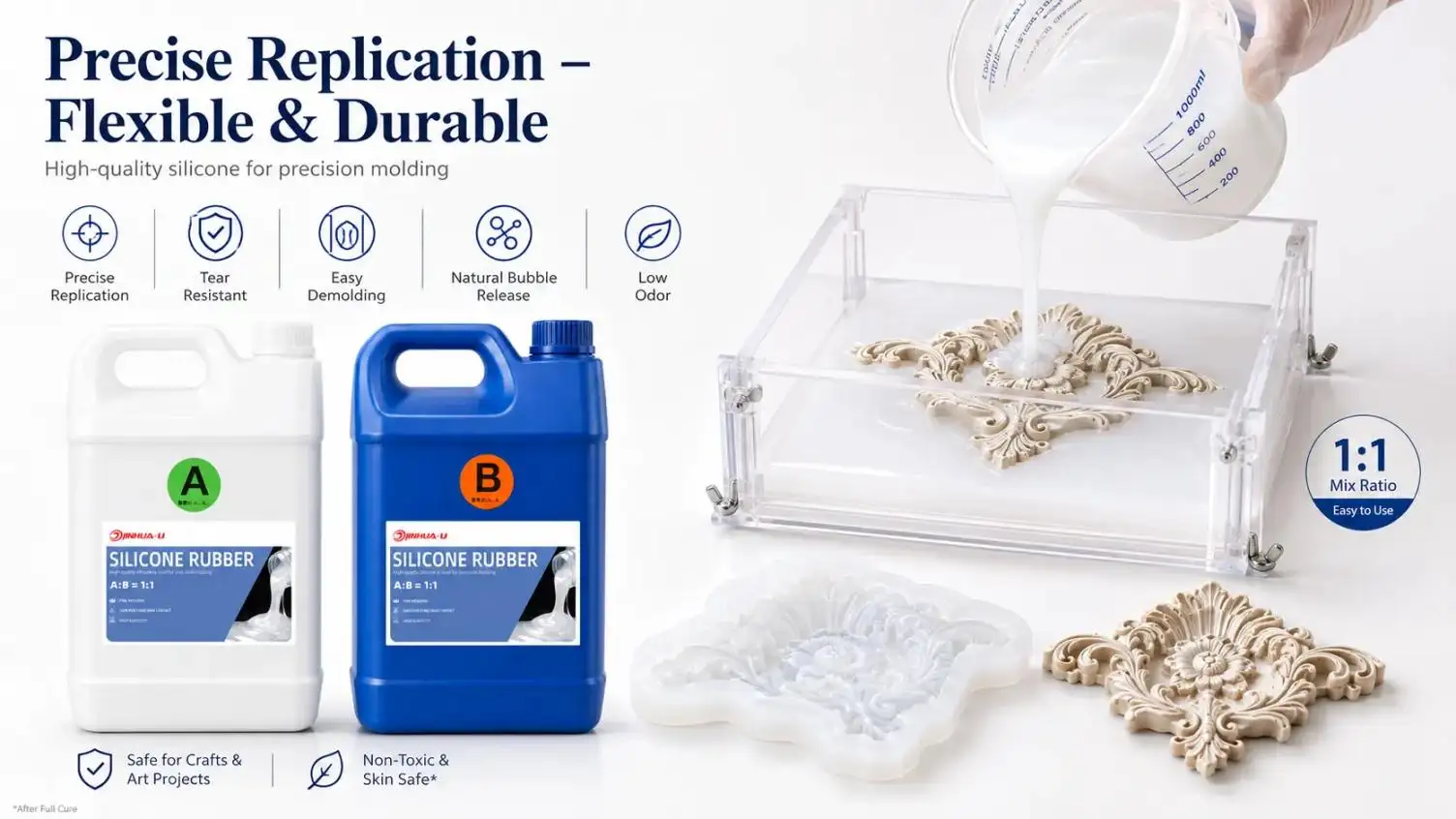
Some art epoxies are made using a 1:1 ratio; some coating and casting products use ratios of 2:1, 3:1, etc.
Do not assume all epoxy products are made with a 1:1 ratio!
If a product needs a ratio of 2:1, the resin to hardener, then two parts resin and two parts hardener would not give the desired chemical reaction.
Follow manufacturer's directions and stir well. Wrong ratios may lead to sticky, soft or partially cured resin.
5. Air Bubbles
Bubbles are the most frequent resin project issues.
However, the low viscosity of casting resin means that it has an advantage in deep pour work since trapped air can flow more readily through the liquid.
But, low viscosity does not equate to the absence of bubbles.
The bubbles can originate from:
- Porous wood
- Embedded objects
- Incorrect mixing
- Cold resin
- Rapid stirring
- Air trapped inside molds
In the case of wood projects, the porous surface may be sealed first to lessen the chances of air getting trapped in the resin later.
For casting resin, a slow pour and thinning following the recommended advise can help minimize defects and clarity issues.
6. Hardness and Durability
Hardness of epoxy resins varies.
A coating epoxy is frequently used in tabletops, countertops, and many other applications to give it a durable, scratch resistant surface.
Cast resins can come in various hardness levels, as required by the application. There are some that will make hard castings, others may be slightly flexible.
When hardness is a consideration, consider manufacturer's technical specifications instead of just the "epoxy" word.
Appearance is not all that matters for professional applications, which may also be influenced by Shore hardness, tensile strength, impact resistance, heat resistance, and/or chemical resistance.
7. UV Resistance and Yellowing
Over time an epoxy that is clear can begin to discolor due to exposure to UV rays.
This is especially evident in clear casting projects as a thick casting may show more yellowing with time.
For long term clarity, select a resin containing the proper type of UV stabilizers and adhere to the manufacturer's exposure guidelines.
Be aware that even UV-resistant epoxy is not necessarily permanently UV resistant. A lot of polymer materials are affected by the direct and prolonged sunlight.
For display items, reducing the continuous direct sunlight can help to retain clarity longer.
Which Resin Should You Choose?
The best resin depends primarily on your project.
Choose Casting Resin If:
- You need to pour deep layers.
- You are filling a silicone mold.
- You are embedding objects.
- You are making a river table.
- You need resin to flow into detailed areas.
- You want a resin specifically designed for deep casting.
Choose Coating or Art Epoxy If:
- You are coating a tabletop.
- You are creating resin artwork.
- You need a glossy surface finish.
- You are making coasters or trays.
- You need controlled flow over a relatively flat surface.
- Your application requires a thin protective layer.
The simplest rule is:
Casting resin fills a mold or deep space, while coating epoxy covers and protects a surface.
Can You Use Casting Resin as a Coating?
Casting resin can be applied to some surfaces technically, but may not be the best working properties.
It can be hard to control on vertical or irregular surfaces, due to its low viscosity. May run to the edges or off the project prior to cure.
For a smooth tabletop or artwork coating, a resin designed for coating applications is typically preferred.
Can You Use Regular Epoxy for Deep Pours?
This is where novice traders often go wrong.
Generally, standard coating epoxy should not be poured deeply without the manufacturer's specific recommendation to do so.
If the thickness is too great, it can produce excessive heat during the curing process. This can result in deformities, bubbles, cracking, discoloration or failure.
When pouring deep, choose a product that is labelled for casting, deep pour or thick layer pour and follow the maximum pour depth stated.
Tips for Getting Better Resin Results
Regardless of which resin you choose, good preparation is essential.
1. Read the technical data sheet.
Check the mixing ratio, maximum pour depth, working time, cure time, and temperature requirements.
2. Measure accurately.
Use the exact resin-to-hardener ratio specified by the manufacturer.
3. Mix slowly and thoroughly.
Aggressive mixing can introduce unnecessary air bubbles.
4. Prepare porous materials.
Seal wood and other porous materials before the main pour.
5. Control the temperature.
Temperature affects viscosity, working time, and curing behavior.
6. Do not exceed the recommended pour depth.
More resin in one layer does not necessarily mean a better result.
7. Protect the curing project.
Keep the work area clean and prevent dust from settling on the surface.
Final Thoughts: Casting Resin vs Epoxy Resin
When you consider the applications, the difference between casting resin and epoxy resin is much clearer.
Casting Resin is an epoxy specially formulated for deep pours, molds, encapsulation and other applications that require the epoxy to cure in a thicker amount. It's low viscosity and slow curing allow it to control deep pouring requirements.
Coating and art epoxies are ideal for surface coatings and artistic work, and are the most affordable. Their thicker consistency provides a more amount of control to the users for applying glossy finishes on artwork, tables, countertops, trays and even on other surfaces.
The best resin will vary depending on the specific project. The selection is based on the depth of pour, viscosity, curing rate, finish, hardness, UV resistance and application.
In advance of buying any resin, determine the nature of the work and the suggested application thickness by the manufacturer. Selecting the right resin to complement the project is one of the simplest ways to ensure a cleaner, stronger and more professional looking finish.