



Updated 2 months ago
Epoxy Floor Coating vs Polyurethane Flooring: Which Lasts Longer?

hqt

Durability can be the critical specification in choosing a high performance flooring system for commercial, industrial or residential use. The two more widely used types of floors are epoxy floors and polyurethane floors. The two materials offer great protection, resistance to chemicals and have a smooth finish, but act differently in different situations.
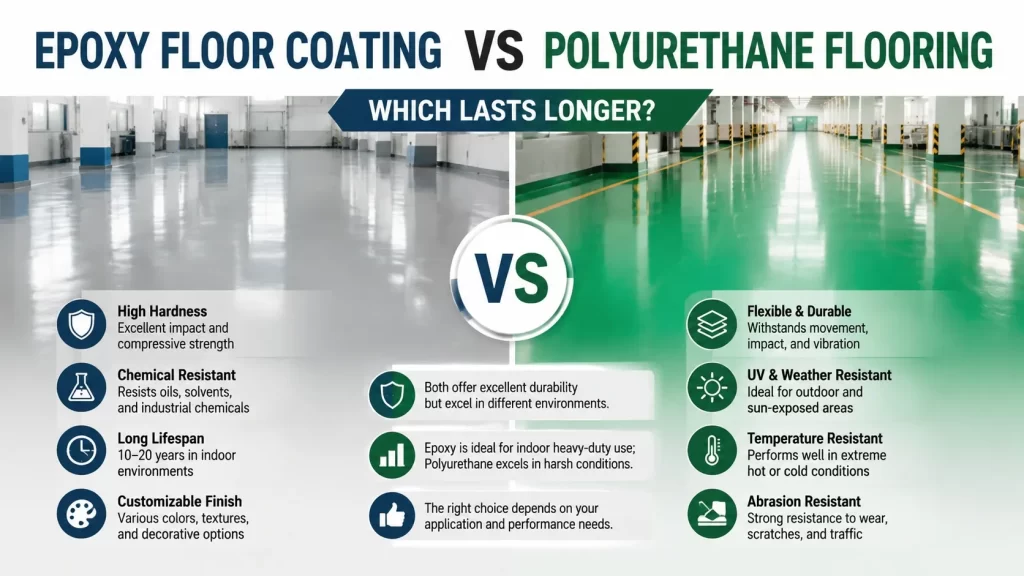
The main concern that many buyers have is: Epoxy floor coating or polyurethane flooring, which lasts longer?
This is highly dependent on environmental conditions, traffic loads, chemical exposure, maintenance needs and installation quality. Knowing the pros and cons of each flooring system will assist you in selecting the right one for your project.
What Is Epoxy Floor Coating?
Epoxy floor coating is a system of resin floors that consists of epoxy resin combined with a hardener. Once cured it creates a tough, hard, unbroken surface, tightly adhering to concrete floors.
Epoxy flooring is popularly used in:
- Warehouses
- Manufacturing facilities
- Garages
- Laboratories
- Food processing plants
- Showrooms
- Commercial buildings
It is popular for its high strength, good adhesion and clean and beautiful surface.
Advantages of Epoxy Floor Coating
1. Excellent Mechanical Strength
One of the biggest advantages of epoxy flooring is its ability to withstand heavy loads. It can handle:
- Forklift traffic
- Heavy machinery
- Industrial equipment
- Constant foot traffic
A properly installed epoxy floor can last 10–20 years in suitable environments.
2. Strong Chemical Resistance
Epoxy coatings provide excellent resistance against many chemicals, including:
- Oils
- Fuels
- Solvents
- Cleaning chemicals
- Industrial liquids
This makes epoxy an ideal choice for factories, workshops, and industrial facilities.
3. Smooth and Easy-to-Clean Surface
The seamless surface prevents dust, dirt, and bacteria from accumulating. This makes epoxy flooring suitable for:
- Cleanrooms
- Healthcare facilities
- Food production areas
- Pharmaceutical environments
4. Customizable Appearance
Epoxy floors are available in various colors, textures, and finishes. Options include:
- Metallic epoxy flooring
- Flake epoxy flooring
- Quartz-filled epoxy
- Anti-slip epoxy coatings
Businesses can combine performance with attractive designs.
What Is Polyurethane Flooring?
Polyurethane is a type of resin flooring that is available in a wide range of flexibility and has good UV, temperature and shock resistance.
Polyurethane is slightly more flexible than epoxy. This enables it to absorb the impact and motion without breaking easily.
The most typical applications of polyurethane flooring are:
- Outdoor areas
- Food processing facilities
- Cold storage rooms
- Parking structures
- Chemical plants
- High-temperature environments
Advantages of Polyurethane Flooring
1. Superior Flexibility and Impact Resistance
Polyurethane flooring can expand and contract with temperature changes. This flexibility helps prevent:
- Cracking
- Surface damage
- Stress fractures
It performs especially well in environments with vibration or thermal movement.
2. Excellent UV Resistance
A major weakness of traditional epoxy is that prolonged sunlight exposure can cause yellowing or discoloration.
Polyurethane offers better UV stability, making it suitable for:
- Outdoor applications
- Areas near windows
- Sun-exposed facilities
3. Better Scratch and Abrasion Resistance
Polyurethane coatings have strong resistance against surface wear caused by:
- Foot traffic
- Moving equipment
- Cleaning operations
This makes them suitable for demanding commercial environments.
4. Handles Temperature Changes Better
Polyurethane flooring performs well in extreme temperature conditions, including:
- Freezers
- Cold storage facilities
- Hot production areas
Its flexibility reduces the risk of damage caused by thermal expansion and contraction.
Epoxy Floor Coating vs Polyurethane Flooring: Durability Comparison
When comparing which flooring lasts longer, several factors should be considered.
1. Lifespan
Epoxy Flooring Lifespan
With proper installation and maintenance:
- Residential use: 10–15 years
- Commercial use: 5–10 years
- Heavy industrial use: 10+ years
Epoxy provides excellent long-term durability in controlled indoor environments.
Polyurethane Flooring Lifespan
Polyurethane flooring typically lasts:
- 10–20 years depending on application
- Longer in environments with temperature changes or UV exposure
Because of its flexibility and wear resistance, polyurethane often performs better in harsh environments.
Winner: Polyurethane for extreme conditions; epoxy for controlled indoor environments.
2. Resistance to Chemicals
Both flooring systems provide good chemical resistance, but their performance differs.
Epoxy:
✔ Excellent against oils and solvents
✔ Strong resistance to industrial chemicals
✔ Suitable for factories and workshops
Polyurethane:
✔ Better resistance to acids and aggressive chemicals
✔ Performs well in food and chemical processing environments
Winner: Polyurethane for aggressive chemical exposure; epoxy for general industrial use.
3. Impact and Heavy Load Resistance
Epoxy has a harder surface and excellent compressive strength, making it ideal for heavy machinery and warehouse floors.
However, its rigid structure may crack if the concrete substrate moves.
Polyurethane absorbs impact better because of its flexibility.
Winner: Depends on application.
- Heavy static loads → Epoxy
- Dynamic impact and vibration → Polyurethane
4. UV and Weather Resistance
For outdoor flooring applications, polyurethane has a clear advantage.
Epoxy may:
- Fade under sunlight
- Turn yellow over time
- Lose appearance outdoors
Polyurethane maintains its color and performance under UV exposure.
Winner: Polyurethane flooring
5. Installation and Maintenance
Both systems require proper surface preparation for maximum performance.
The installation process includes:
- Concrete surface preparation
- Cleaning and repairing cracks
- Primer application
- Resin coating installation
- Final curing
Epoxy generally requires longer curing time but creates a very hard surface.
Polyurethane usually cures faster and offers easier maintenance.
Winner: Polyurethane for faster recovery; epoxy for strong bonding.
Which Flooring System Should You Choose?
The best choice depends on your specific application.
Choose Epoxy Floor Coating If You Need:
- High-strength indoor flooring
- Heavy machinery support
- Chemical resistance
- Decorative finishes
- Cost-effective durability
Recommended applications:
- Warehouses
- Garages
- Manufacturing floors
- Workshops
- Retail spaces
Choose Polyurethane Flooring If You Need:
- Flexible performance
- Outdoor durability
- UV resistance
- Temperature resistance
- High abrasion protection
Recommended applications:
- Food factories
- Parking areas
- Cold storage facilities
- Outdoor walkways
- Chemical processing plants
Can Epoxy and Polyurethane Be Used Together?
Yes. In many professional flooring systems, epoxy and polyurethane are combined to achieve maximum performance.
A common solution is:
- Epoxy base layer for strong adhesion and structural strength
- Polyurethane topcoat for UV protection, flexibility, and abrasion resistance
This hybrid approach provides:
- Strong bonding
- Longer service life
- Improved appearance
- Better protection against wear
Many industrial facilities choose this combination for demanding environments.
Final Verdict: Which Lasts Longer?
So, epoxy floor coating vs polyurethane flooring, which lasts longer?
There is no single answer because each material performs best in different conditions.
- Epoxy flooring lasts longer in indoor environments with heavy loads and controlled conditions.
- Polyurethane flooring lasts longer in environments with UV exposure, temperature changes, chemicals, and impact.
Epoxy continues to be a widely used material for commercial and industrial flooring for its durability and cost-effectiveness. But polyurethane can offer better long term durability in the most difficult environments.
There are a number of factors to consider when selecting an appropriate flooring system, such as your operating environment, traffic needs, and performance needs. When properly chosen and cared for, a professionally installed epoxy or polyurethane floor can last for decades.