




If you are interested in DIY crafts, furniture projects, jewelry making, coating projects or industrial applications, then you have more than likely come across the terms resin and epoxy resin. These are often confused with one another, but are not synonymous.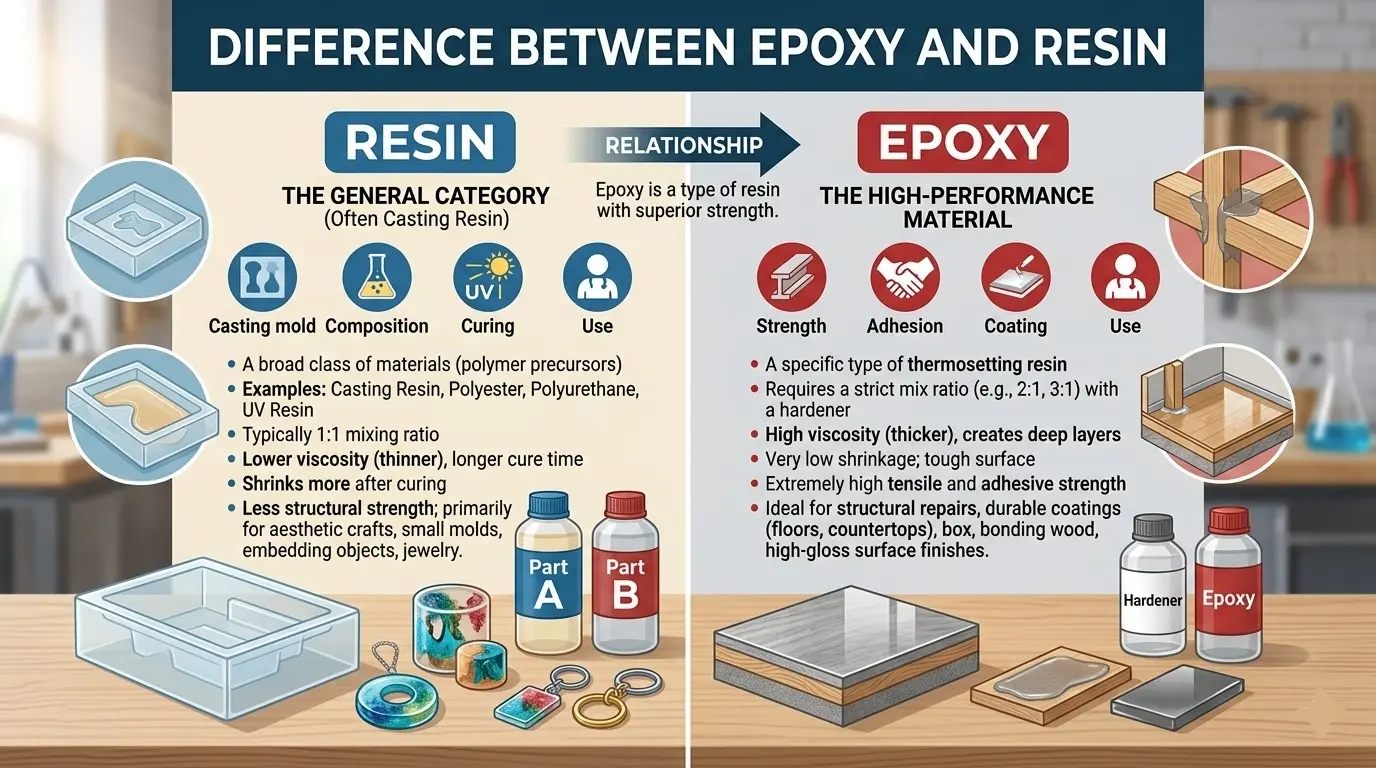
So, what is the difference between epoxy and resin?
The simplest answer is:
Epoxy is a type of resin, but not all resin is epoxy.
“Resin” is a broad category that includes several different materials, such as epoxy resin, polyester resin, polyurethane resin, and UV resin. There are various ways of curing each type, along with performance attributes and preferred uses.
These differences can assist you in selecting the appropriate material that you are working on.
What Is Resin?
Resin is a collective term for a family of materials that may be liquids, semi-liquids or solids, and can be converted by curing or other chemical means to form permanent structures.
Resins are either natural or synthetic. Some plants make natural resins and synthetic resins are made from chemicals, they are used in many adhesives, coatings, plastics, composites and decorative products.
In the field of crafting and manufacturing, the term "resin" can be used to describe a liquid synthetic material that solidifies.
But just picking a product that is called ‘resin' is not sufficient. The properties of different resin systems may be quite different.
What Is Epoxy Resin?
Epoxy resin is a specific type of thermosetting resin known for its strong adhesion, durability, chemical resistance, and versatile performance.
Most two-part epoxy systems contain:
- Epoxy resin
- Hardener or curing agent
When these components are mixed in the manufacturer's specified ratio, they undergo a chemical reaction. The liquid mixture gradually transforms into a solid material.
Once fully cured, epoxy can provide a hard, durable, and attractive surface.
This is why epoxy resin is commonly used for tabletop coatings, artwork, river tables, molds, jewelry, flooring, protective coatings, adhesives, and industrial applications.
Epoxy vs Resin: Key Difference
The main difference between epoxy and resin is that resin is a broad category, while epoxy refers to a specific resin chemistry.
Think of it this way:
Resin = a large material family
Epoxy resin = one member of that family
Therefore, asking whether epoxy and resin are different materials is similar to asking whether a specific type of fruit is different from fruit in general.
Epoxy has its own curing system, performance characteristics, and application requirements.
Quick Comparison
| Feature | Resin | Epoxy Resin |
|---|---|---|
| Meaning | Broad material category | Specific type of resin |
| Types | Epoxy, polyester, UV, polyurethane, etc. | One resin family |
| Curing method | Depends on resin type | Usually resin + hardener |
| Applications | Varies widely | Coatings, crafts, casting, adhesives |
| Durability | Depends on formulation | Generally high |
| Chemical resistance | Varies | Generally excellent |
| Adhesion | Depends on type | Typically strong |
Common Types of Resin
Not every resin behaves like epoxy. Understanding the major resin types makes it easier to select the right material.
1. Epoxy Resin
Epoxy resin is one of the most versatile resin systems available. It can provide excellent adhesion, durability, surface protection, and resistance to moisture and many chemicals.
Depending on the formulation, epoxy resin can be designed for thin coatings, deep casting, artwork, industrial bonding, or protective surfaces.
2. Art Resin
Art resin is generally formulated specifically for creative projects.
It is commonly used for:
- Paintings
- Tumblers
- Decorative artwork
- Coasters
- Jewelry
- Art panels
- Glossy surface finishes
Many art resins are designed to provide a clear, glossy finish and convenient working characteristics for DIY users.
3. Casting Resin
Casting resin is designed to be poured into molds or used to create three-dimensional objects.
It is particularly useful for projects such as:
- Epoxy river tables
- Jewelry
- Decorative objects
- Figurines
- Embedded objects
- Mold casting
Casting formulations are often optimized for flow and bubble release, although the appropriate pouring depth depends on the specific product.
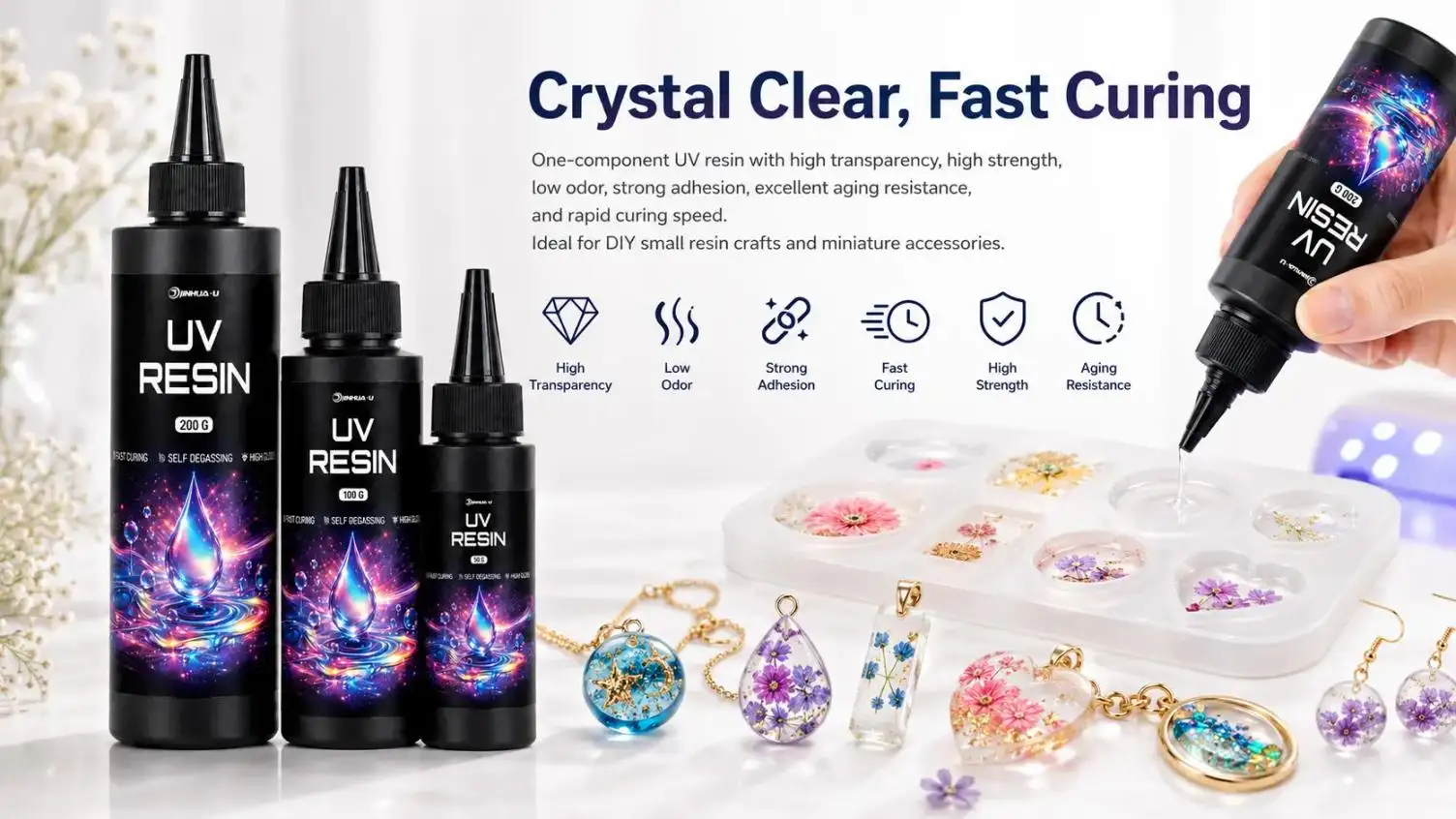
4. UV Resin
UV resin cures when exposed to ultraviolet light. Unlike traditional two-part epoxy resin, it does not normally require mixing a separate hardener.
Its fast curing time makes UV resin popular for small jewelry and craft projects.
However, UV resin has limitations. Large or thick pieces may not cure uniformly because UV light needs to reach the material. Its working time is also more limited because curing begins when sufficient UV light reaches the resin.
5. Polyester Resin
Polyester resin is another synthetic resin commonly used in composites, construction-related applications, and crafts.
One advantage of polyester resin is its relatively low material cost and fast curing characteristics. However, its performance differs from epoxy, particularly regarding adhesion, moisture resistance, and certain mechanical properties.
The choice between polyester and epoxy should therefore depend on the specific application rather than price alone.
Epoxy Resin vs UV Resin
One of the most common questions is whether UV resin or epoxy resin is better.
The answer depends on the project.
Choose UV resin when:
- You need very fast curing.
- You are making small decorative items.
- You have access to a suitable UV lamp.
- You are working with relatively thin layers.
Choose epoxy resin when:
- You need longer working time.
- You want to cast larger objects.
- You need strong adhesion.
- You require a durable coating.
- You are working on furniture or larger creative projects.
For larger applications, epoxy is generally more flexible in terms of project size and curing conditions.
Epoxy Resin vs Polyester Resin
Epoxy and polyester resin can both be used for composites and other applications, but they are not interchangeable.
Epoxy is often selected when strong adhesion, durability, moisture resistance, and performance are important. Polyester resin may be attractive when cost and rapid processing are major considerations.
The correct choice depends on the substrate, desired strength, curing requirements, environmental conditions, and final application.
Is Epoxy Better Than Resin?
There is no universal answer because “resin” describes an entire category of materials.
Epoxy may be a better choice when you need:
- Strong bonding
- A durable finish
- Good moisture resistance
- Chemical resistance
- A smooth, glossy surface
- Reliable performance in demanding applications
But another resin may be more appropriate when fast UV curing, lower cost, specific flexibility, or other performance requirements are more important.
The best resin is always the one whose formulation matches the project.
How to Choose the Right Resin
Before purchasing a resin product, consider these questions:
1. What are you making?
A tabletop coating requires different properties than jewelry or deep casting.
2. How thick will the material be poured?
Some epoxy systems are designed for thin coatings, while others are formulated for deeper pours.
3. How quickly do you need it to cure?
UV resin can cure rapidly under suitable UV light, while two-part epoxy typically provides more working time.
4. What type of finish do you want?
For decorative applications, clarity, gloss, color stability, and surface hardness can be important.
5. What environmental conditions will it face?
Consider temperature, moisture, sunlight, chemicals, abrasion, and expected usage.
6. What does the manufacturer's technical documentation recommend?
Always follow the product's mixing ratio, application thickness, curing conditions, and safety instructions.
Frequently Asked Questions
Is epoxy the same as resin?
No. Resin is a broad category of materials, while epoxy is a specific type of resin.
Is epoxy resin stronger than regular resin?
“Regular resin” is not a specific material, so strength cannot be compared without knowing the resin type and formulation. Epoxy is generally known for strong adhesion and good durability, but performance varies between products.
Can I use any resin for an epoxy project?
No. Resin types have different curing systems and properties. Always select a product designed for your intended application.
What is the difference between epoxy resin and UV resin?
Epoxy resin generally cures through a chemical reaction between resin and hardener, while UV resin cures when exposed to ultraviolet light. UV resin is convenient for small, thin projects, while epoxy is often more suitable for larger or deeper applications.
Which is better for crafts: epoxy or resin?
For many craft applications, epoxy resin is an excellent option because it can provide a clear, glossy, durable finish. However, UV resin can be more convenient for small projects requiring rapid curing.
Final Thoughts
To understand the difference between epoxy and resin, just recall this simple rule:
Epoxy is resin, and resin isn't necessarily epoxy.
Resin is an umbrella term for several materials; epoxy resin is a type of thermosetting resin that is usually cured by mixing resin with a hardener.
Epoxy resin can provide a good combination of durability, adhesion, clarity and versatility for coatings, furniture, artwork, casting and jewelry, as well as many other projects. Depending on the application, other types of resin can be more appropriate, like UV resin and polyester resin.
If you're looking for a resin, consider the curing process, viscosity, working time, pour depth, durability, chemical resistance, finish and application.
Using the proper formulation, resin can be more than just a crafting material, it can be a practical tool for more challenging decorative, commercial, and industrial projects.