




Advanced composite manufacturing uses two of the most commonly used materials; carbon fiber and epoxy resin. They are combined together and when combined, they form a lightweight high performance material that has a great balance of strength, stiffness, durability and design flexibility.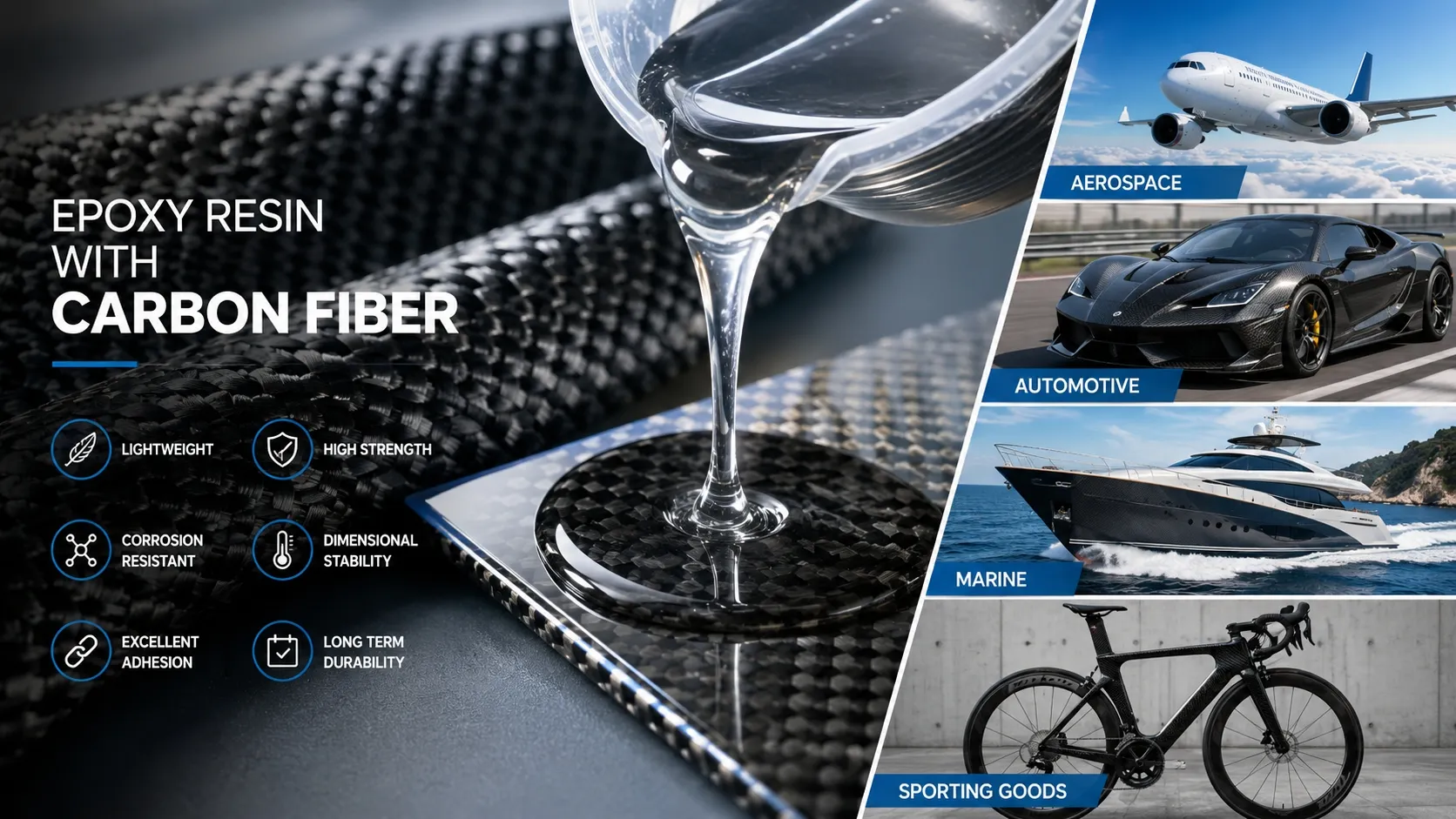
Carbon fiber reinforced epoxy composites are being used in a variety of applications, ranging from aerospace structures and automotive components to sporting goods, marine products, and industrial parts, to enable manufacturers to use lighter materials, but maintain high levels of mechanical performance.
However, why is epoxy resin always used in combination with carbon fiber? What are its advantages, and where is it used?
The purpose of this guide is to give a basic understanding of carbon fiber epoxy composites, its prime advantages, production factors and significant industrial applications.
What Is a Carbon Fiber Epoxy Composite?
Carbon fiber epoxy composite is a type of engineered material which is created by the combination of carbon fibre reinforcement and epoxy resin.
Both materials have different but complementary functions. The core of the composite is made of carbon fiber, which accounts for most of the composite's tensile strength and stiffness. The epoxy resin is used to use the carbon fiber as the reinforcement, to transfer loads between the fibers, to protect the reinforcement, to create the final hard composite structure after curing.
Epoxy is a thermosetting polymer. It is usually liquid or very viscous resin and is able to flow around and into the carbon fiber reinforcement before it is cured. After the appropriate curing reaction takes place, the resin forms a permanent three-dimensional polymer network.
The resulting material is dependent on the properties of the resin system itself, along with the orientation, architecture and volume of the carbon fibers.
Why Is Epoxy Resin Used with Carbon Fiber?
Carbon fiber is very strong, but the fibers are small and easily damaged during handling and usage. These also do not have the ability to create a completed structural element on their own.
The matrix material around the fibres is the epoxy resin. It keeps fibres in place and conducts loads between fibres within the composite.
Strong adhesion is one of the most important properties of epoxy. Stress transfer to and from the resin to the carbon fibers is only effective when good adhesion is achieved between the resin and carbon fibres.
Epoxy systems can also be developed in a variety of viscosities, cure rates, toughness, thermal properties, and more. This enables the resin to be chosen or modified by the manufacturer to suit the manufacturing process and the end application.
Key Benefits of Carbon Fiber and Epoxy Resin
1. Excellent Strength-to-Weight Ratio
One of the biggest reasons manufacturers choose carbon fiber epoxy composites is their high strength-to-weight ratio.
Carbon fiber can provide substantial tensile strength and stiffness without adding the mass associated with many conventional metals. This makes composite materials especially attractive when reducing component weight is an important design objective.
In transportation applications, lighter components can contribute to improved energy efficiency and overall system performance.
2. High Stiffness and Structural Performance
Carbon fiber is known for its high modulus and stiffness. When the fibers are properly oriented within an epoxy matrix, engineers can design composite structures to handle loads in specific directions.
This directional performance is one of the major differences between composites and many conventional isotropic materials.
By adjusting fiber orientation and laminate construction, manufacturers can optimize a component for specific loading conditions.
3. Good Fatigue Resistance
Repeated mechanical loading can eventually cause fatigue in many engineering materials. Carbon fiber composites are valued for their ability to perform under cyclic loading when properly designed and manufactured.
The epoxy matrix helps maintain the fiber structure and distribute stresses throughout the composite, supporting long-term performance in demanding applications.
4. Low Thermal Expansion
Carbon fiber has a relatively low coefficient of thermal expansion. This characteristic can help composite structures maintain dimensional stability when temperatures change.
For precision components and applications exposed to varying thermal conditions, dimensional stability can be an important engineering consideration.
The final thermal performance, however, depends on the complete composite system, including the fiber architecture and selected epoxy formulation.
5. Chemical and Environmental Resistance
Cured epoxy resins can provide resistance to many chemicals, moisture, corrosion-related environments, and physical wear.
Unlike metals that can be susceptible to corrosion, properly designed carbon fiber epoxy composites do not experience conventional rust. This makes them useful in certain marine, chemical-processing, industrial, and outdoor applications.
The exact environmental resistance should always be evaluated based on the specific resin formulation and service conditions.
6. Strong Adhesion
Epoxy resin is widely used in composite manufacturing partly because of its excellent adhesive properties.
A well-designed epoxy system can effectively bond to carbon fiber reinforcement and other compatible substrates. Strong interfacial bonding helps transfer loads between the resin matrix and reinforcement.
This is particularly important for structural composite components where poor adhesion can negatively affect mechanical performance.
7. Design Flexibility
Carbon fiber epoxy composites can be manufactured into complex shapes and structures.
Engineers can vary fiber orientation, laminate thickness, reinforcement architecture, resin characteristics, and curing conditions to achieve different performance targets.
This design flexibility can help manufacturers consolidate components, reduce assembly requirements, and develop lightweight structures that would be difficult or inefficient to produce from conventional materials.
Carbon Fiber Tow, Fabric, and Tape
Carbon fiber can be supplied in several reinforcement formats.
Carbon fiber tow consists of bundles containing many continuous carbon filaments. These fibers can be used in different composite manufacturing processes or converted into reinforcement products.
Woven carbon fiber fabric interlaces fibers into a textile structure. Different weave patterns can provide different handling characteristics and reinforcement behavior.
Carbon fiber tape provides aligned reinforcement and is commonly used when directional strength and stiffness are important.
The appropriate reinforcement format depends on the manufacturing process, component geometry, required mechanical properties, and production volume.
Common Applications of Epoxy Carbon Fiber Composites
The combination of epoxy resin and carbon fiber is used across numerous industries.
Aerospace and Aircraft
Aerospace manufacturers place a strong emphasis on weight reduction, structural efficiency, durability, and dimensional stability.
Carbon fiber epoxy composites can provide high performance while reducing component weight compared with some traditional metallic alternatives. They are used in aircraft structures, interior components, and other engineered applications.
Automotive and Motorsport
Performance vehicles and motorsport applications benefit from lightweight, rigid materials.
Carbon fiber epoxy composites can be used for body panels, structural components, interior parts, aerodynamic components, and other applications where weight reduction and appearance are important.
Marine Applications
Boats and marine structures must withstand moisture, mechanical loads, and demanding environmental conditions.
Carbon fiber epoxy composites can provide high strength and corrosion resistance while helping reduce structural weight.
Sporting Goods
Carbon fiber composites are widely associated with products such as bicycles, tennis equipment, hockey equipment, golf products, and other performance-oriented sporting goods.
The combination of low weight, stiffness, and durability makes the material attractive for equipment where handling and performance are critical.
Wind Energy
Large wind turbine structures require materials capable of handling repeated mechanical loading while remaining lightweight.
Carbon fiber epoxy composites can be used in selected reinforcement structures and components where high stiffness and weight efficiency are important.
Industrial Equipment
Industrial manufacturers can use carbon fiber epoxy composites for components requiring corrosion resistance, dimensional stability, high strength, or reduced weight.
Potential applications include specialized equipment, machinery components, tooling, and engineered structures.
How to Select an Epoxy Resin for Carbon Fiber
Choosing the right epoxy resin for carbon fiber requires more than simply selecting a strong adhesive.
Manufacturers should evaluate several factors, including:
- Required tensile and flexural performance
- Resin viscosity and processing method
- Cure temperature and cure time
- Glass transition temperature (Tg)
- Toughness and impact resistance
- Chemical and moisture resistance
- Fiber wet-out characteristics
- Required operating temperature
- Production volume and manufacturing process
- Final component requirements
For demanding applications, a customized epoxy formulation may provide better results than a general-purpose resin.
Why the Resin Formulation Matters
Not every epoxy resin is designed for carbon fiber composite manufacturing.
A suitable resin must provide the right balance of flow, wet-out, adhesion, curing behavior, mechanical properties, and environmental resistance.
For example, a resin designed for a fast manufacturing process may require different characteristics from an epoxy system intended for large structural components.
Manufacturers should therefore evaluate the entire carbon fiber composite system, rather than selecting resin and reinforcement independently.
Frequently Asked Questions
Is epoxy resin good for carbon fiber?
Yes. Epoxy resin is widely used with carbon fiber because it provides strong adhesion, effective fiber impregnation, and a durable matrix after curing. The resulting composite can offer excellent strength-to-weight performance.
What does epoxy resin do in carbon fiber?
Epoxy acts as the matrix that surrounds and binds carbon fibers. It helps transfer loads between fibers, maintains the composite structure, and protects the reinforcement.
Is carbon fiber stronger with epoxy?
Carbon fiber and epoxy perform different functions, so it is more accurate to describe epoxy as enabling the carbon fibers to function effectively as a composite reinforcement. The final strength depends on fiber type, fiber orientation, resin formulation, fiber volume, laminate design, and manufacturing quality.
What industries use carbon fiber epoxy composites?
Major applications include aerospace, automotive, marine, sporting goods, transportation, wind energy, construction, industrial equipment, and other advanced manufacturing sectors.
Conclusion
Carbon Fiber Reinforced Epoxy Resin is a strong composite material for the applications that demand low weight, strength, stiffness, durability and flexibility.
The reinforcement is carbon fiber and the matrix is epoxy that ties the fibers together and carries mechanical loads. When combined, these materials can generate engineered parts that deliver performance benefits to a multitude of conventional materials.
When manufacturers are designing high performance composite components, they must also make the right selection of epoxy formulation in addition to the selection of the right carbon fiber. Viscosity, cure conditions, thermal performance, toughness and adhesion, as well as environmental resistance should all be taken into account.
Epoxy Resin and Carbon Fiber will remain vital materials in the manufacture of advanced composites in the future as industries demand lighter, stronger, and more efficient products.