




Outside concrete surfaces are subjected to a great deal more than typical usage. Over time, patios, driveways and sidewalks, as well as garage floors, can suffer from damage caused by weather, water, humidity, temperature variation, car traffic, oil, chemicals and freeze-thaw.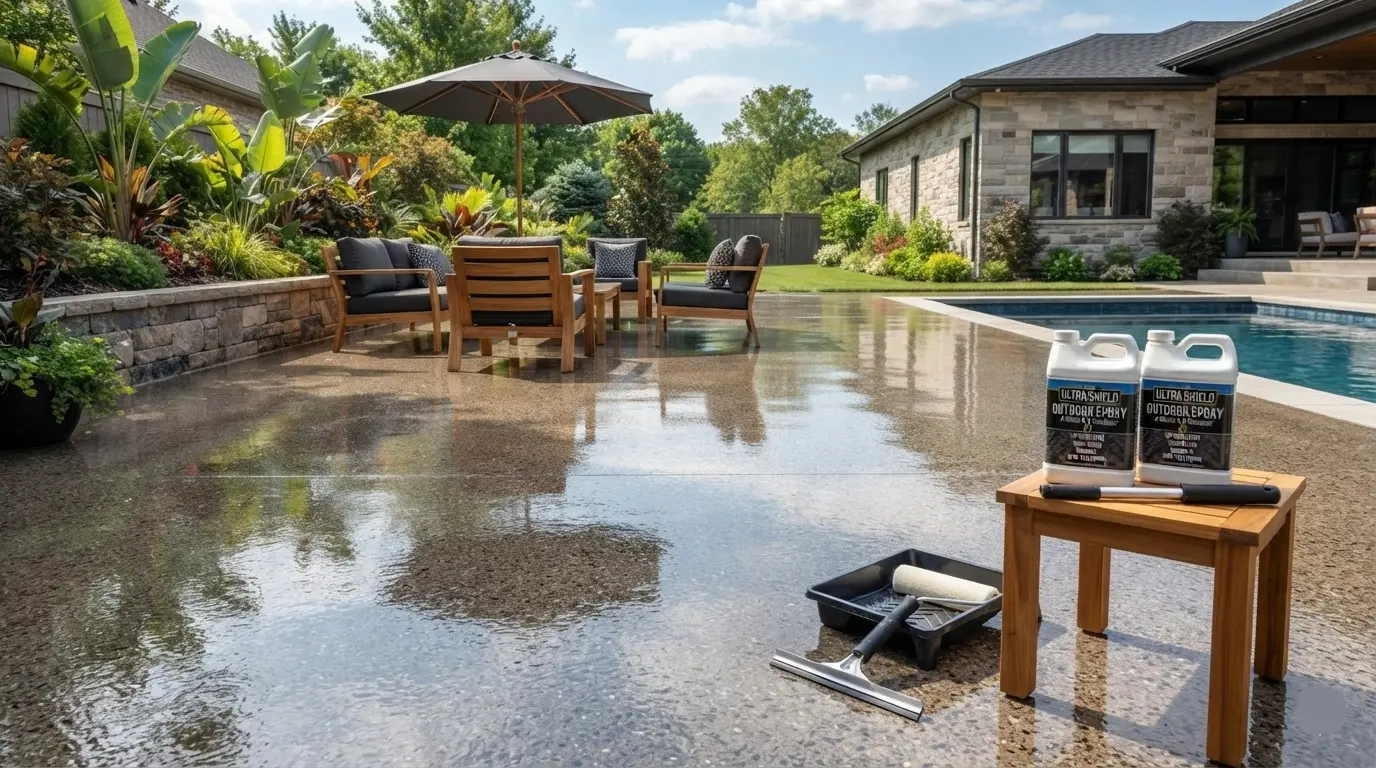
The best outdoor epoxy resin for concrete can not only be a long-lasting protective coating, but also enhance the look and maintenance of the surface. But not all epoxy resin products are suitable for outside use. Hardness or gloss alone may result in premature yellowing, peeling, cracking or adhesion failure.
This guide will explain what to expect from an outdoor concrete epoxy, how to prep the surface, the application process, and what kind of system is best for a project.
Is Epoxy Resin Good for Outdoor Concrete?
Yes, epoxy offers a method of coating concrete, provided the right type of epoxy is used and the entire epoxy system is suitable for exterior use.
Epoxy forms a tight film and can help to coat and protect concrete from stains, water, abrasion, and chemicals. Can also be used as a beautiful finish for decorative surfaces.
But regular indoor epoxy is not necessarily applicable for outdoor purposes. Conventional epoxy systems can yellow or deteriorate from extended exposure to UV rays, all the more crucial in direct sunlight. When choosing an exterior product, look for a product that is designed for outdoor use or mix epoxy with an appropriate UV protective topcoat.
The best outdoor epoxy resin is not necessarily the hardest epoxy. It is the product system that best suits the actual, climatic, traffic, moisture and appearance requirements.
Key Features of the Best Outdoor Epoxy Resin
When comparing outdoor epoxy for concrete, consider these five factors.
1. UV Resistance
UV stability is one of the most important considerations for exterior concrete coatings.
Long-term sunlight exposure can cause some epoxy coatings to yellow, discolor, lose gloss, or deteriorate. A UV-resistant formulation can improve resistance to these effects.
If your concrete receives direct sunlight for several hours each day, choose a product specifically rated for exterior or UV-exposed applications. A compatible polyurethane or urethane topcoat may also provide additional UV protection.
2. Moisture and Water Resistance
Outdoor concrete frequently encounters rain, humidity, irrigation water, pool water, and other sources of moisture.
A suitable coating should resist water penetration and maintain good adhesion after curing. However, coating performance also depends heavily on the condition and moisture level of the concrete before application.
Concrete should be properly cleaned and sufficiently dry before coating. Applying epoxy over damp or contaminated concrete can contribute to adhesion problems.
3. Durability and Abrasion Resistance
Driveways and walkways experience substantially more mechanical stress than decorative surfaces.
If the coating will be exposed to vehicles, heavy foot traffic, outdoor furniture, or frequent cleaning, prioritize:
- High abrasion resistance
- Strong adhesion
- Impact resistance
- Chemical resistance
- Good wear performance
For residential patios with light foot traffic, the requirements may be less demanding than for commercial exterior floors.
4. Slip Resistance
A smooth, glossy epoxy surface can become slippery when wet.
This is particularly important for pool decks, patios, steps, ramps, and outdoor walkways. Consider an anti-slip formulation or incorporate a compatible aggregate or traction additive into the coating system.
Slip resistance should be treated as a functional requirement, not simply an aesthetic feature.
5. Temperature Resistance
Outdoor concrete expands and contracts as temperatures change. In some regions, surfaces may experience substantial differences between daytime and nighttime temperatures or seasonal temperature cycles.
The coating system should therefore be appropriate for the expected service temperature range.
A strong bond and properly prepared concrete are just as important as the resin itself. Even a high-performance coating can fail when applied over weak, contaminated, or poorly prepared concrete.
Best Outdoor Epoxy Applications for Concrete
Outdoor epoxy systems can be considered for a variety of concrete projects, including:
Patios: Epoxy can create a clean, decorative surface that is easier to maintain.
Driveways: A durable coating can help resist stains and everyday vehicle-related wear.
Walkways: Adding texture or an anti-slip additive can improve traction.
Pool decks: Water resistance and slip resistance become especially important around pools.
Outdoor garage areas: Chemical and abrasion resistance can be useful where vehicles, oil, and dirt are common.
Decorative concrete: Clear or pigmented coatings can enhance the color and visual appearance of an existing surface.
The ideal coating depends on the specific environment. A product suitable for a covered patio may not be the best choice for a driveway exposed to intense sunlight and heavy traffic.
How to Apply Epoxy Resin to Outdoor Concrete
Proper application is essential for long-term performance.
Step 1: Inspect and Prepare the Concrete
Start by checking the concrete for cracks, damaged areas, loose material, oil, grease, dirt, old paint, or previous coatings.
Remove contaminants thoroughly. Repair significant cracks or damaged areas using an appropriate concrete repair material.
The surface should be clean, sound, and properly profiled so the coating can bond effectively.
Step 2: Check Moisture Conditions
Before applying the coating, make sure the concrete meets the product manufacturer's moisture requirements.
Outdoor slabs can retain moisture, particularly after rain or in humid environments. Applying a non-breathable coating over unsuitable concrete conditions can result in blistering, bubbling, or adhesion failure.
Step 3: Mix the Epoxy Correctly
Most two-component epoxy systems consist of a resin and hardener.
Measure and mix the components according to the manufacturer's specified ratio. Inaccurate proportions can affect curing, hardness, adhesion, and final performance.
Avoid guessing the mixing ratio or adding extra hardener to make the product cure faster.
Step 4: Apply the Coating
Use the recommended roller, brush, squeegee, or other application equipment.
Apply the epoxy evenly and maintain the specified coverage rate. Avoid excessively thick or thin areas because uneven application can affect the final appearance and performance.
Environmental conditions such as temperature and humidity can also influence working time and curing.
Step 5: Add a UV-Resistant Topcoat
For many exterior applications, a compatible protective topcoat can be an important part of the system.
Polyurethane or urethane-based topcoats may provide improved UV resistance, chemical resistance, scratch resistance, and appearance retention. The exact combination should always be confirmed with the coating manufacturer.
Step 6: Allow Sufficient Curing Time
Do not expose the newly coated concrete to heavy traffic before the system has adequately cured.
Follow the manufacturer's instructions for light foot traffic, vehicle traffic, water exposure, and full cure. Cure times can vary considerably depending on formulation and environmental conditions.
Common Mistakes to Avoid
Even a high-quality outdoor epoxy can fail if installation conditions are poor.
Avoid these common mistakes:
- Using an indoor epoxy on an exposed exterior surface
- Applying coating to damp concrete
- Skipping surface preparation
- Ignoring cracks and weak concrete
- Mixing resin and hardener incorrectly
- Applying the coating outside the recommended temperature range
- Creating a smooth surface without considering wet-slip safety
- Assuming epoxy alone provides unlimited UV protection
- Allowing heavy traffic before adequate curing
Good preparation is often just as important as the product selected.
Epoxy vs. Other Outdoor Concrete Coatings
Epoxy is only one option for protecting outdoor concrete.
Epoxy generally offers strong adhesion, hardness, chemical resistance, and a wide range of decorative possibilities.
Polyurethane can offer good UV and weathering performance and is frequently used as a protective topcoat over compatible systems.
Polyaspartic coatings are another option for projects where fast curing and exterior performance are priorities.
The best choice depends on the project's exposure, required service life, appearance, installation conditions, and budget.
Frequently Asked Questions
What is the best outdoor epoxy resin for concrete?
The best product is one specifically formulated or rated for exterior concrete and appropriate for the project's UV exposure, moisture conditions, traffic level, temperature range, and slip-resistance requirements.
Can regular epoxy resin be used outside?
Not necessarily. Many conventional epoxy products are intended primarily for indoor applications and may not provide sufficient long-term UV stability. Always check the manufacturer's exterior-use specifications.
Does outdoor epoxy protect concrete from water?
If properly cured, an epoxy can form a moisture barrier. However, the surface preparation, concrete condition, moisture content, and the entire coating system will affect the coating performance.
How long does outdoor epoxy last?
The duration of service life depends on product formulation, exposure to sunlight, traffic, climate, surface preparation and maintenance. The quality of the system installed in a suitable environment is better than a generic epoxy installed outside its scope of use.
Final Thoughts
Selecting the right outdoor epoxy resin for concrete isn't merely a matter of picking one that is shiny or hard. Concrete exposed to the outdoors must be protected from the sun, rain, abrasion, temperature fluctuations, chemicals and foot traffic.
Selects an exterior-rated epoxy system, prepares the concrete correctly, mixes and applies it properly, and applies a UV-resistant top coat if needed for best results.
From a patio to a driveway, from a pool deck to a walkway, when it comes to concrete, the right coating system will enhance durability and appearance and in the long run will save maintenance costs. The important thing is to match the type of resin and complete coating system with the actual conditions that the concrete will be subjected to.