




Clear epoxy resin is typically used for countertops, tables, bar tops, decorative surfaces, woodworking, electronics, and industrial uses. But not all epoxy resins are equal when it comes to heat resistance. When your project will often be exposed to hot objects or high temperatures, you'll need a high heat resistant clear epoxy resin.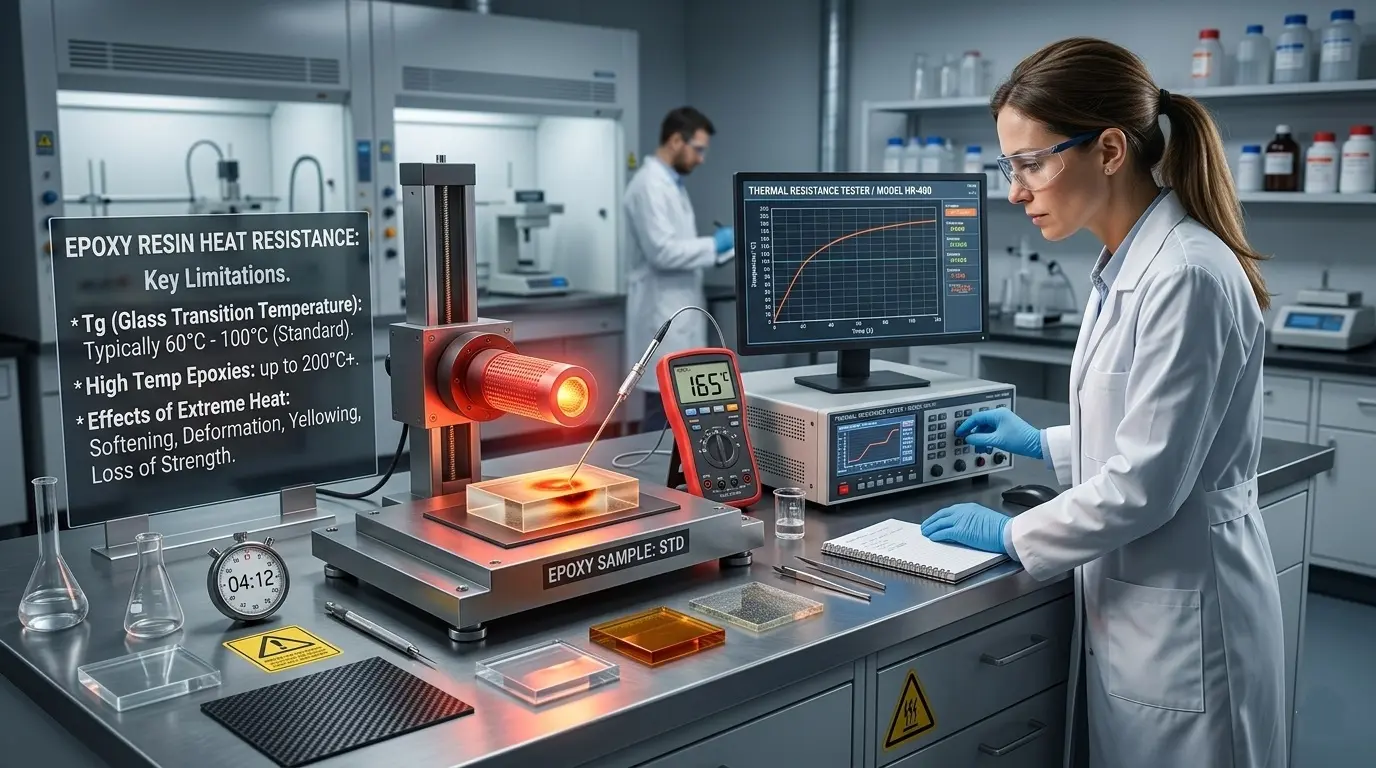
Knowing the epoxy resin temperature resistance can assist you in choosing the right epoxy resin, avoid damage to your surfaces, and get long-lasting performance.
What Is High Heat Resistant Clear Epoxy Resin?
Clear epoxy resin with high heat resistance is a 2-component thermosetting resin, which is an epoxy product designed to retain its hardness, appearance and structure at high temperatures.
High temperature epoxy systems are formulated differently from standard epoxy products (e.g. for decorative uses), to enhance thermal stability and softening resistance.
When resin and hardener are combined and completely cured, the resulting surface is hard and abrasive, and is clear. This varies according to formulation; some can withstand high temperatures, others low.
That is why there is no single temperature that is applicable to all epoxy resins. Please refer to manufacturer's technical data and recommended service temperature when choosing a product.
Is Epoxy Resin Heat Resistant?
No, not all epoxy resines can be heat resistant and even those that can vary depending on the formulation.
Exposure to temperatures outside of the designed service range may cause epoxy to start to soften. If a hot object is left on the surface for too long, it may lose its hardness and get marks, dents, impressions or lose its gloss.
Some epoxy surfaces will return to the original hardness after cooling. But over or over-heating may create permanent deformation.
Therefore, heat resistance is always a factor to consider when selecting epoxy resin for kitchen tops, countertops, industrial parts, furniture or other items that come in contact with heat.
Heat Resistance vs. Recommended Service Temperature
It's crucial to understand the difference between heat resistance and recommended service temperature.
Heat resistance is, in general, a measure of the response of the cured epoxy when approaching a temperature at which the physical properties of the epoxy change significantly. Manufacturers can test properties like softening point, heat deflection temperature or glass transition temperature.
Recommended service temperature, on the other hand, is the temperature range that the completed product can be typically used without significant loss of performance.
These measurements are not substitutional.
For instance, a resin's softening or heat-deflection temperature may be very high, but the temperature recommended for continuous use in the day-to-day world might be lower. Thus, just because an epoxy has a high numerical heat-resistance rating, it should not be assumed that it is the best choice.
What Temperature Can Clear Epoxy Resin Withstand?
There is no universal temperature rating for clear epoxy resin.
Standard craft and coating epoxies may soften when exposed to relatively high temperatures, while specialized high-temperature epoxy formulations can withstand substantially higher service temperatures. Some industrial epoxy systems are engineered for service temperatures of several hundred degrees Fahrenheit.
For everyday projects, the more useful question is often:
“What type of hot object will come into contact with the epoxy surface?”
A warm coffee cup creates a very different thermal load from a baking dish, hot pan, heating element, or industrial component.
For countertops and furniture, use an epoxy specifically rated for the intended application. Hot cookware should generally be placed on an appropriate trivet or heat-resistant pad rather than directly on an epoxy-coated surface.
Why Does Heat Soften Epoxy?
Epoxy is a polymer material, and temperature affects the movement of its molecular structure.
As temperature increases, the cured resin can become less rigid. When the temperature exceeds the resin's designed thermal range, the surface may soften enough to deform under pressure.
Several factors influence this behavior, including:
- Resin and hardener chemistry
- Degree of cure
- Cure temperature
- Mixing accuracy
- Coating thickness
- Formulation additives
- Glass transition temperature
- Heat exposure time
A properly formulated high-temperature epoxy maintains its mechanical properties better at elevated temperatures than a standard decorative resin.
Common Applications of Heat Resistant Clear Epoxy
High heat resistant clear epoxy resin can be used in a wide range of residential, commercial, and industrial applications.
1. Countertops
Epoxy-coated countertops are popular because they combine a glossy appearance with protection against moisture, stains, and everyday wear.
For kitchen and commercial countertops, a heat-resistant formulation can provide better protection against warm cups and other everyday heat sources. However, extremely hot cookware should still be handled carefully.
2. Tables and Bar Tops
Clear epoxy is commonly used to protect wooden tables, bar tops, desks, and decorative furniture.
A high heat resistant formula can reduce the risk of marks caused by warm mugs, serving dishes, and other household objects.
3. Woodworking and River Tables
Epoxy resin is frequently combined with natural wood to create river tables, serving boards, decorative panels, and custom furniture.
Because these surfaces may be expensive and difficult to repair, selecting an epoxy with suitable heat resistance can improve durability.
4. Industrial Components
Specialized high-temperature epoxy systems are also used for bonding, sealing, coating, potting, and encapsulation applications.
Industrial formulations can offer combinations of thermal resistance, chemical resistance, mechanical strength, and electrical insulation. Some specialized products are designed for service temperatures above 400°F, depending on the formulation and curing system.
5. Electronics and Electrical Applications
Certain high-temperature epoxy materials are suitable for electronic potting, encapsulation, and component protection.
However, electronics applications require more than heat resistance. Electrical insulation, thermal cycling, chemical resistance, viscosity, cure schedule, and adhesion should also be evaluated.
How to Maximize Epoxy Heat Resistance
Choosing the right product is only the first step. Proper mixing and curing are equally important.
Follow the Correct Mixing Ratio
Two-part epoxy consists of resin and hardener. The components must be measured according to the manufacturer's specified ratio.
An incorrect ratio can prevent the material from curing properly and may reduce hardness, durability, and temperature performance.
Mix Thoroughly
Incomplete mixing can leave areas with excess resin or hardener. These areas may remain soft or develop inconsistent properties after curing.
Scrape the sides and bottom of the mixing container while mixing to ensure the two components are thoroughly combined.
Control the Working Temperature
Ambient temperature affects epoxy viscosity, working time, and curing behavior.
Working within the manufacturer's recommended temperature range helps produce a more consistent cure.
Allow Full Cure
Epoxy may feel dry or hard before it has reached its maximum performance.
Do not judge temperature resistance solely by whether the surface feels dry. Follow the manufacturer's complete curing schedule before exposing the finished project to significant heat.
Avoid Excessive Exothermic Heat
When epoxy cures, the chemical reaction generates heat. Mixing a large quantity at once or pouring an excessively thick layer can cause heat buildup.
An uncontrolled exothermic reaction may result in rapid curing, cracking, discoloration, smoke, or other defects.
For large projects, follow the manufacturer's recommended maximum pour depth and working procedure.
How to Choose the Best High Heat Resistant Epoxy
Before purchasing a clear epoxy resin for a high-temperature application, consider these factors:
Temperature rating: Check both the maximum service temperature and relevant thermal test data.
Application: Determine whether the resin is intended for countertops, furniture, casting, coating, electronics, bonding, or industrial use.
Cure requirements: Some high-temperature epoxies require room-temperature curing, while others require elevated-temperature post-curing.
Chemical resistance: If the finished surface will encounter oils, solvents, cleaning chemicals, or industrial fluids, chemical resistance may be just as important as heat resistance.
Clarity and UV stability: For decorative projects, look for a formulation designed to maintain transparency and appearance over time.
Technical documentation: Always review the Technical Data Sheet (TDS) and Safety Data Sheet (SDS) before use.
Final Thoughts
Wherever ordinary epoxy is not enough to perform the required functions of transparency, durability and thermal resistance, there is a need for high heat resistant clear epoxy resin.
It is essential to realize that heat resistance is not "all the time heat resistance. Each epoxy system will have a range of performance characteristics and when exceeded, can lead to softening, deformations, discoloration and even permanent damage.
The best outcomes will be achieved by choosing an epoxy designed for the job, mixing according to instructions, maintaining a proper environment for application, and ensuring the epoxy is completely cured before use.
From protecting a custom wooden table to coating a countertop, manufacturing an industrial component or encapsulating heat sensitive parts, the right high-temperature clear epoxy resin can make the difference between a durable and reliable final product.