



Updated 4 weeks ago
How to Choose the Right Epoxy Resin for Different Applications

hqt
Epoxy resin is a versatile material that has a wide variety of applications in the industrial, construction, art, electronics, automotive and do-it-yourself manufacturing industries. Epoxy resin can provide superior strength, chemical resistance, adhesion and durability properties in various applications, such as making crystal clear tables for rivers, making durable flooring, protecting electronic components, bonding industrial materials, etc.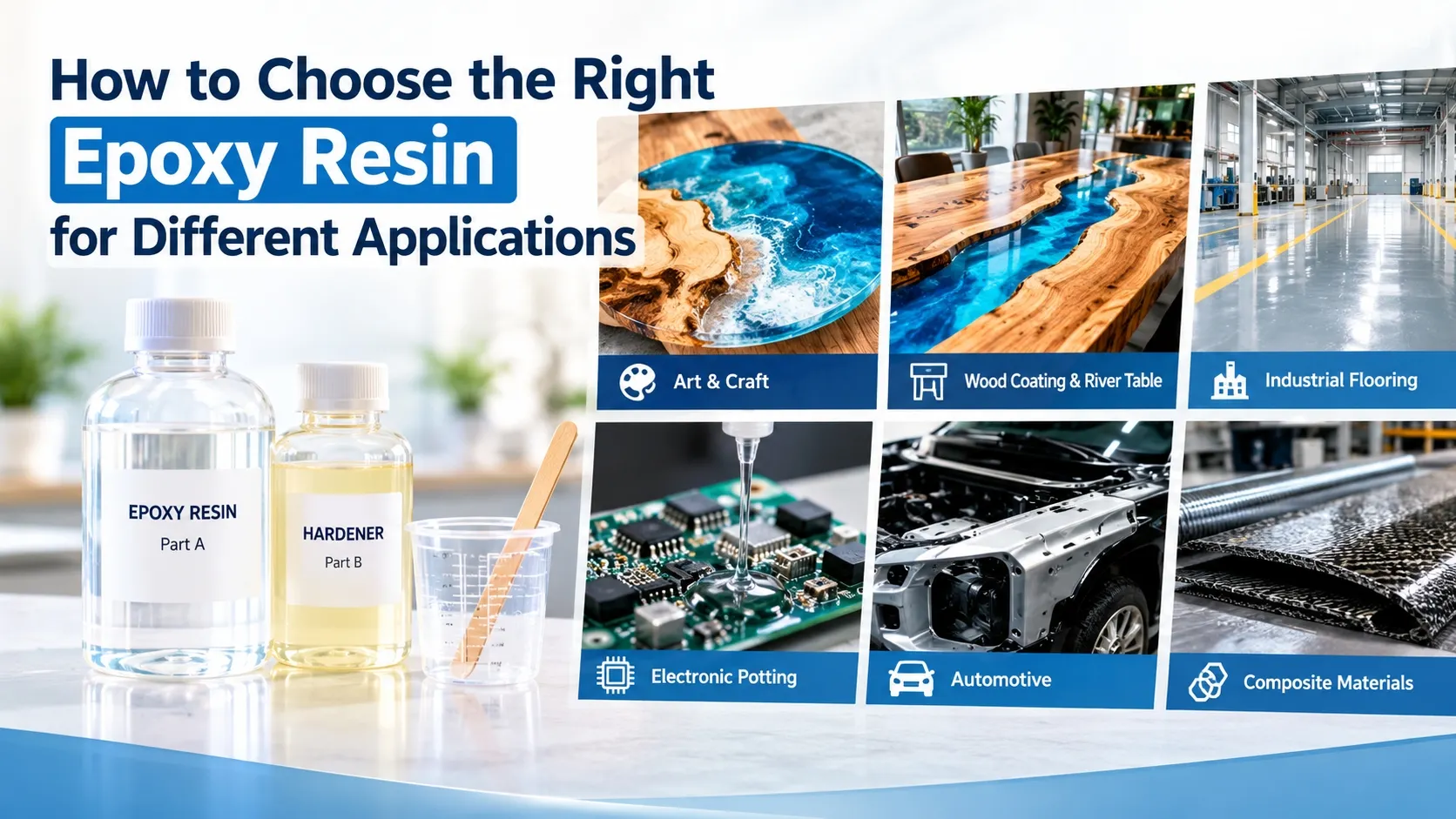
But epoxy resins are not all created equal.
Selecting the appropriate epoxy resin for various uses is crucial to ensure optimal performance, aesthetic appeal, and durability. The curing time, viscosity, UV resistance, hardness, temperature resistance and application thickness can have a significant impact on the final outcome.
This guide provides an understanding of the properties to consider when selecting the appropriate epoxy resin for your application and before you buy or source an epoxy resin product.
What Is Epoxy Resin?
Epoxy resin is a thermosetting polymer which usually contains two components: epoxy resin and a hardener. When these ingredients are combined at the proper proportions, a chemical reaction starts and the material sets to a solid that is strong and hard.
Epoxy resin may have a variety of properties depending on the formulation, such as:
- Strong adhesion
- High mechanical strength
- Chemical resistance
- Water resistance
- Electrical insulation
- Excellent surface hardness
- Clear and glossy finishes
- Heat resistance
- UV resistance
Because different industries require different performance characteristics, manufacturers develop specialized epoxy resin formulations for specific applications.
1. Choose Epoxy Resin Based on Your Application
The first step in selecting an epoxy resin is understanding exactly how it will be used.
A resin designed for artistic projects may not perform well in industrial flooring. Similarly, an epoxy formulated for deep casting may not be suitable for thin coating applications.
Common epoxy resin applications include:
- Art and craft projects
- Jewelry making
- River tables
- Wood coating
- Industrial flooring
- Electronic potting
- Composite materials
- Adhesives and bonding
- Marine applications
- Automotive components
Before choosing a product, ask yourself:
What material will the epoxy be applied to?
How thick will the epoxy layer be?
Will the finished product be exposed to sunlight, heat, water, or chemicals?
Does the application require flexibility or high hardness?
Answering these questions will help narrow down the most suitable epoxy resin formulation.
2. Epoxy Resin for Art and Craft Applications
Art and craft resin is commonly used for paintings, jewelry, coasters, decorative objects, and creative projects.
For these applications, appearance is usually one of the most important considerations.
A high-quality art epoxy resin should provide:
- Crystal-clear transparency
- High gloss
- Good color stability
- Easy mixing
- Low odor
- Bubble resistance
- UV resistance
Artists often add pigments, glitter, dried flowers, metallic powders, or other decorative materials to epoxy resin. Therefore, the resin should have good compatibility with colorants and additives.
For resin art projects, a medium-viscosity epoxy is often a good choice because it can flow smoothly while still holding decorative materials in place.
UV resistance is also important, especially for artwork displayed near windows or in bright environments.
3. Epoxy Resin for River Tables and Deep Casting
River tables and large casting projects require a different type of epoxy resin.
Deep pour epoxy resin is specifically designed for thicker applications. Unlike standard coating resin, deep casting resin generates less heat during curing, helping reduce problems such as cracking, yellowing, bubbles, and excessive shrinkage.
When choosing epoxy resin for river tables, consider:
- Maximum pouring depth
- Low exothermic reaction
- Long working time
- Bubble release performance
- Transparency
- Low shrinkage
A common mistake is using standard coating epoxy for a very thick pour. This can cause overheating and may damage the final project.
For large furniture projects, always check the manufacturer's recommended maximum casting depth. Some deep pour epoxy systems are designed for several centimeters of thickness, while others require thinner layers.
Choosing the correct deep casting epoxy resin helps produce a clear, stable, and professional-looking result.
4. Epoxy Resin for Wood Coating
Epoxy resin is widely used as a protective coating for wooden furniture, countertops, tabletops, and decorative surfaces.
A coating epoxy resin should provide excellent surface appearance and protection.
Important characteristics include:
- High gloss
- Scratch resistance
- Water resistance
- Good leveling
- Strong adhesion to wood
- Clear finish
- Easy bubble removal
For thin surface coatings, a self-leveling epoxy resin is often preferred. This allows the material to spread evenly across the surface and create a smooth finish.
For wood applications exposed to sunlight, choosing an epoxy with improved UV resistance can help reduce yellowing over time.
However, even UV-resistant epoxy can eventually change color after long-term exposure to strong sunlight. Additional protective coatings may be necessary for demanding outdoor environments.
5. Epoxy Resin for Industrial Flooring
Industrial and commercial flooring requires epoxy resin with significantly different properties from art resin.
Epoxy flooring must withstand:
- Heavy foot traffic
- Machinery
- Chemical exposure
- Oil and grease
- Abrasion
- Moisture
- Impact
When selecting epoxy resin for flooring, mechanical strength and chemical resistance are usually more important than crystal-clear appearance.
A high-performance flooring epoxy should offer strong adhesion to concrete and excellent durability.
Manufacturers and contractors should also consider:
- Concrete condition
- Moisture levels
- Surface preparation
- Required thickness
- Chemical exposure
- Working environment
For warehouses, factories, garages, and commercial facilities, specialized industrial epoxy systems are often the best choice.
Proper surface preparation is equally important. Even the highest-quality epoxy resin may fail if the concrete surface is contaminated, weak, or improperly prepared.
6. Epoxy Resin for Electronic Potting
Electronic potting epoxy is used to protect sensitive electronic components from environmental damage.
Potting compounds can protect devices against:
- Moisture
- Dust
- Vibration
- Electrical interference
- Chemicals
- Mechanical damage
Electronic epoxy resin should have good electrical insulation properties and stable curing performance.
Depending on the application, manufacturers may require epoxy with:
- Low viscosity
- Flame resistance
- Thermal conductivity
- Electrical insulation
- Low shrinkage
- High temperature resistance
Low-viscosity epoxy is particularly useful because it can flow around complex electronic components and fill small spaces.
For high-power electronic devices, thermal management may also be important. Thermally conductive epoxy formulations can help transfer heat away from sensitive components.
7. Consider Viscosity Before Choosing Epoxy Resin
Viscosity describes how easily a liquid flows.
Different epoxy applications require different viscosity levels.
Low-Viscosity Epoxy Resin
Low-viscosity epoxy flows easily and is suitable for:
- Electronic potting
- Composite materials
- Mold filling
- Small gaps
- Detailed casting
Medium-Viscosity Epoxy Resin
Medium-viscosity resin is commonly used for:
- Art projects
- Jewelry
- Decorative casting
- General applications
High-Viscosity Epoxy Resin
High-viscosity epoxy may be suitable for applications requiring the material to stay in position, such as vertical surfaces or specialized bonding applications.
Choosing the right viscosity improves application efficiency and helps achieve better final results.
8. Check the Curing Time and Working Time
The curing speed is also crucial.
The working time, or pot life, of epoxy resin products can vary.
In certain production situations, speed is essential, and fast-curing epoxy may prove helpful. It does, however, give less time to mix, pour and bubble removal.
Slow-curing epoxy will give you a longer working time and might be better for big projects.
When selecting a product, take into account:
- Pot life
- Initial curing time
- Full curing time
- Application temperature
The cure rate may be greatly influenced by temperature. In general, a higher temperature will help to cure faster while a lower temperature will help to cure slower.
Always use the recommended mixing ratio and curing conditions recommended by the epoxy resin manufacturer.
9. Consider UV Resistance and Yellowing Resistance
Epoxy resin, that was clear, can turn yellow over time due to exposure to ultraviolet light.
UV resistance is a desired property for applications like artwork, furniture, jewelry, and decorative products.
If clarity and appearance are important, consider using UV resistant epoxy resin to prolong their use.
When using outdoors, manufacturers must make careful consideration that the epoxy resin alone would be adequate for weather resistance.
For more arduous outdoor conditions, more protective coatings can be required.
10. Work with a Professional Epoxy Resin Manufacturer
Selecting the right epoxy resin isn't just a matter of picking one from a basic catalog.
When it comes to industrial applications, having a good relationship with an epoxy resin manufacturer or supplier can offer certain benefits.
A professional manufacturer can supply:
- Customized formulations
- OEM and ODM services
- Technical support
- Application testing
- Bulk supply
- Consistent product quality
In certain projects, it is particularly beneficial to customize a product to achieve a specific viscosity, cure time, hardness, flexibility, temperature resistance, or chemical resistance.
Conclusion
The selection of the proper epoxy resin for various applications depends on both the application site and the requirements for the finished product.
Crystal clear and UV resistant may be necessary in art projects. River tables should have a deep pour and be low heat. Industrial flooring must be tough and chemically resistant, while electronic potting applications need electrical insulation properties, and reliable protection.
Consider parameters like viscosity, curing time, application thickness, UV resistance, hardness, temperature resistance and chemical exposure before choosing an epoxy resin.
Businesses, manufacturers, contractors or DIY users can provide the epoxy resin formulation that is best suited for their specific application to achieve improved performance, improved durability, and more reliable results.
Selecting the right epoxy resin can make all the difference in any art project, furniture, flooring, electronics, composite project or industrial manufacturing.